Clear Sky Science · en
A crisscross-strategy-boosted beaver behavior optimizer for global optimization and oil reservoir production
Smarter Search for Better Decisions
From designing greener power grids to squeezing more value from aging oil fields, modern industries face choices so complex that even powerful computers can get lost. This paper introduces a new way for computers to "hunt" for the best decisions more efficiently. By blending ideas from animal behavior and clever math, the authors show how to find better solutions faster in problems where every wrong turn can cost millions of dollars.
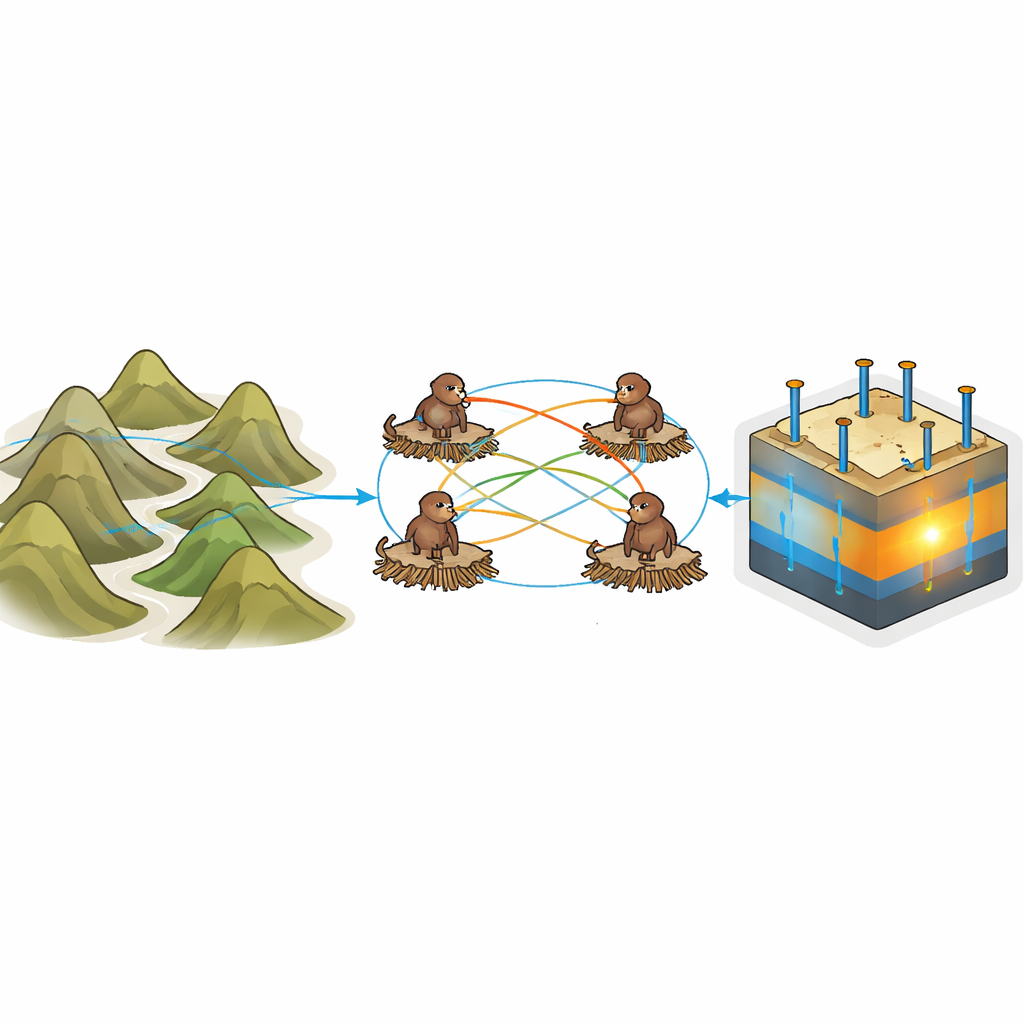
Why Finding the Best Answer Is So Hard
Many real-world decisions involve juggling dozens or even hundreds of variables at once. Think of setting pumping rates at oil wells over many years, or tuning every parameter in a solar power system. The landscape of possible choices is bumpy, full of many "pretty good" options that can trap a search before it reaches the truly best one. Traditional mathematical methods work well when this landscape is smooth and well-behaved, but they often fail when it becomes tangled, noisy, and highly constrained—as is common in modern engineering and energy problems.
Learning from Beavers to Guide the Search
To tackle these tough landscapes, researchers often turn to nature for inspiration. One recent method, called the Beaver Behavior Optimizer, imagines a group of beavers building and maintaining dams. In this analogy, each beaver represents a candidate solution. During a "material gathering" stage, the beavers explore widely, sharing ideas and scouting new possibilities. In a later "dam maintenance" stage, they focus on fine-tuning the best designs discovered so far. This two-phase behavior helps balance bold exploration with careful refinement, but the original approach can still get stuck when the search space is very large or rugged.
A Crisscross Upgrade to Avoid Getting Stuck
The authors propose an upgraded version called the Crisscross Beaver Behavior Optimizer, or CCBBO. The key improvement is a crisscross strategy that lets information flow more richly through the group. In one mode, different beavers exchange parts of their candidate solutions, blending their strengths in a kind of horizontal crossover. In the other, each beaver reshuffles the ingredients within its own solution, combining strong features from different "directions" of the problem in a vertical crossover. After each regular update step, this crisscross process creates new candidate solutions, and only the most promising ones survive. The result is a search that roams more freely early on but still narrows in sharply on high-quality answers.

Putting the Method to the Test
To judge how well CCBBO works, the authors first tested it on a widely used collection of artificial benchmark problems that mimic many shapes of decision landscapes: smooth, highly bumpy, mixed, and composite. They compared it against the original beaver-based method and eight other respected search techniques. Across 29 test problems, the new method not only found better answers on most cases, but it also did so with less variation from run to run, indicating greater reliability. Statistical tests confirmed that these gains were not due to chance.
Boosting Profits in a Virtual Oil Field
The team then moved from artificial tests to a realistic challenge: planning water injection in a complex oil reservoir over 1,500 days. Here, the goal was to maximize the net present value, a measure that weighs oil income against water handling and injection costs over time. This setup produced a 60-dimensional problem—far beyond what trial-and-error can handle. Using an industry-standard simulator, the authors showed that CCBBO consistently produced higher economic returns than all competing methods, with the smallest spread between good and bad runs. It quickly settled on injection patterns that yielded more profit while respecting the physical behavior of fluids in the underground rock.
What This Means for Real-World Decisions
In plain terms, the study shows that a carefully tuned, nature-inspired search strategy can help computers navigate very complex decision spaces more effectively. By adding a crisscross exchange of information on top of the beaver-inspired behavior, CCBBO avoids getting trapped in second-best solutions and finds more valuable answers with greater stability. For industries that depend on large-scale optimization—from oil production to renewable energy and structural design—this kind of smarter search could translate directly into higher returns, safer designs, and more efficient use of resources.
Citation: Huang, R., He, W. A crisscross-strategy-boosted beaver behavior optimizer for global optimization and oil reservoir production. Sci Rep 16, 14363 (2026). https://doi.org/10.1038/s41598-026-43024-7
Keywords: optimization algorithms, swarm intelligence, oil reservoir management, engineering decision-making, computational search methods