Clear Sky Science · en
Experimental investigation of dynamic shear stiffness and damping ratio characteristics of marine soils in Lingdingyang Bay, China
Why the seafloor matters for big coastal projects
When we picture giant sea crossings like the Hong Kong–Zhuhai–Macao Bridge, we usually focus on towers, cables, and traffic. But the real story starts below the waterline, where layers of soft mud, sand, and clay quietly hold up the entire structure and also carry earthquake waves. This study asks a practical question with big safety and cost implications: how do these underwater soils in Lingdingyang Bay behave when shaken, and can engineers predict that behavior without endless, expensive drilling and testing?
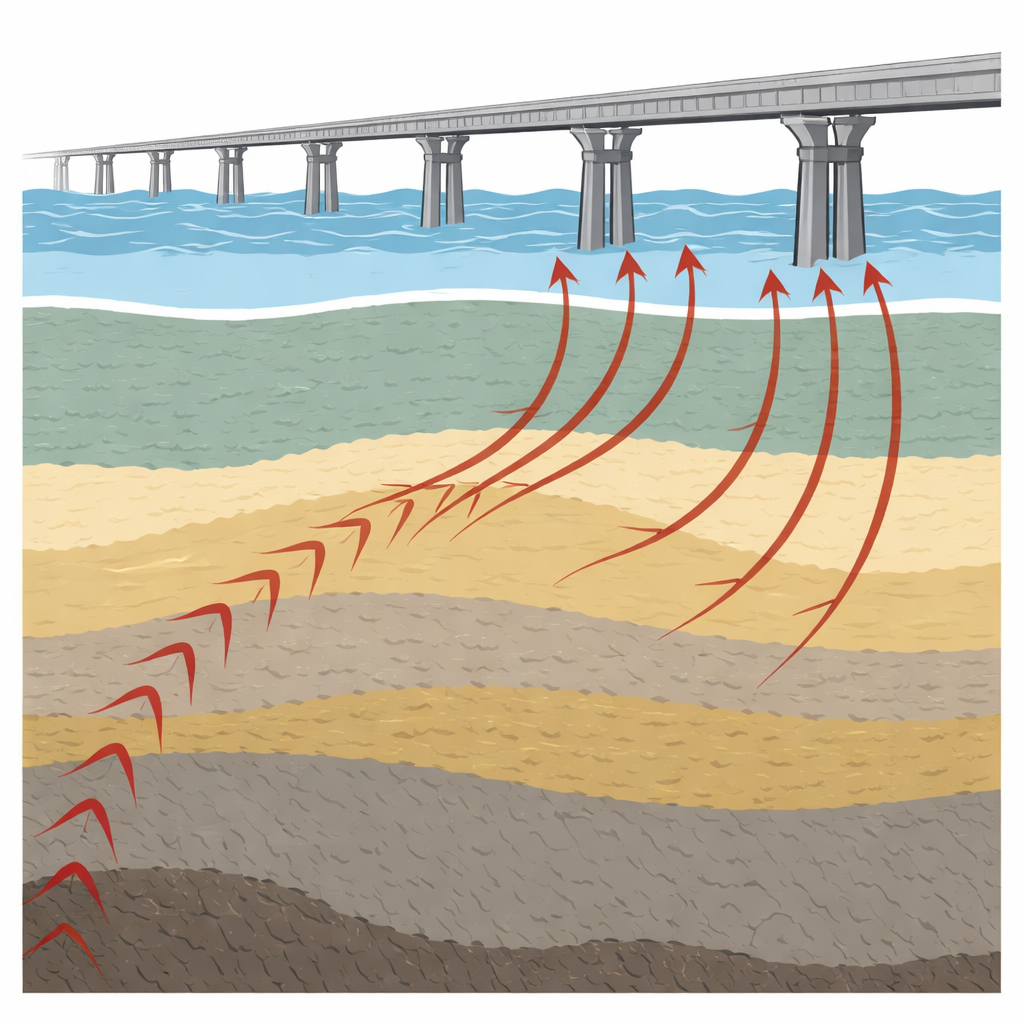
Looking under the bridge
The researchers examined the seafloor beneath and around the cross-sea bridge in the South China Sea, an area with moderate but periodic earthquake activity. The seabed there is far from uniform. It consists of soft surface muds, thicker layers of marine clays mixed with sand, and deeper sandy layers, all deposited over thousands of years by rivers and tides. Because these layers control how shaking travels upward to bridge foundations, the team first mapped how fast shear waves – sideways vibrations similar to those in earthquakes – move through different depths and soil types using instruments lowered into offshore boreholes.
Finding better ways to predict shaking speed
Engineers like to describe soil stiffness using shear wave velocity, a quantity that is usually expected to rise with depth as soil becomes more compressed. Earlier work on land had proposed simple formulas linking depth to this wave speed, and these formulas are widely used in design codes. By comparing those formulas with hundreds of measurements from 24 boreholes, the authors found that they work reasonably well for sandy layers beneath the bay: a curved, quadratic equation using only depth gives accurate predictions for coarse sand, fine sand, and silty sand. But the same approach fails for cohesive materials such as silty clay and clay–sand mixtures, whose behavior is also shaped by grain bonding, water chemistry, and microscopic structure.
Adding soil weight to the picture
To fix this, the team proposed a new prediction method for cohesive marine soils that combines depth with the soil’s natural wet density – essentially how heavy a given volume of sediment is in place. By normalizing shear wave velocity with density and fitting a simple straight-line relationship with depth, they created an equation that captures how stiffer, denser clays at greater depths transmit waves faster than softer, lighter clays near the surface. Tests showed that this two-factor model substantially reduces prediction errors compared with existing formulas, not only in Lingdingyang Bay but also when checked against independent data from Bohai Bay. For practical engineering, this means fewer offshore tests are needed to build a reliable picture of how fast shaking will travel through the seafloor.
How soft seafloor soils respond to shaking
Wave speed alone, however, only tells part of the story. The seafloor also behaves in a non‑linear way: under small strains it springs back almost elastically, but under stronger shaking it softens and absorbs more energy. To probe this behavior, the researchers took carefully preserved cores of different marine soils from various depths and tested them in a resonant column device, which twists the samples at controlled amplitudes. From these tests they calculated the dynamic shear modulus (a measure of stiffness during vibration) and the damping ratio (how much energy is lost each cycle). Across all soil types, they observed a common pattern: as strain grows, stiffness drops and damping rises, with marine soils in Lingdingyang Bay showing generally low stiffness and relatively high damping compared with many land soils.
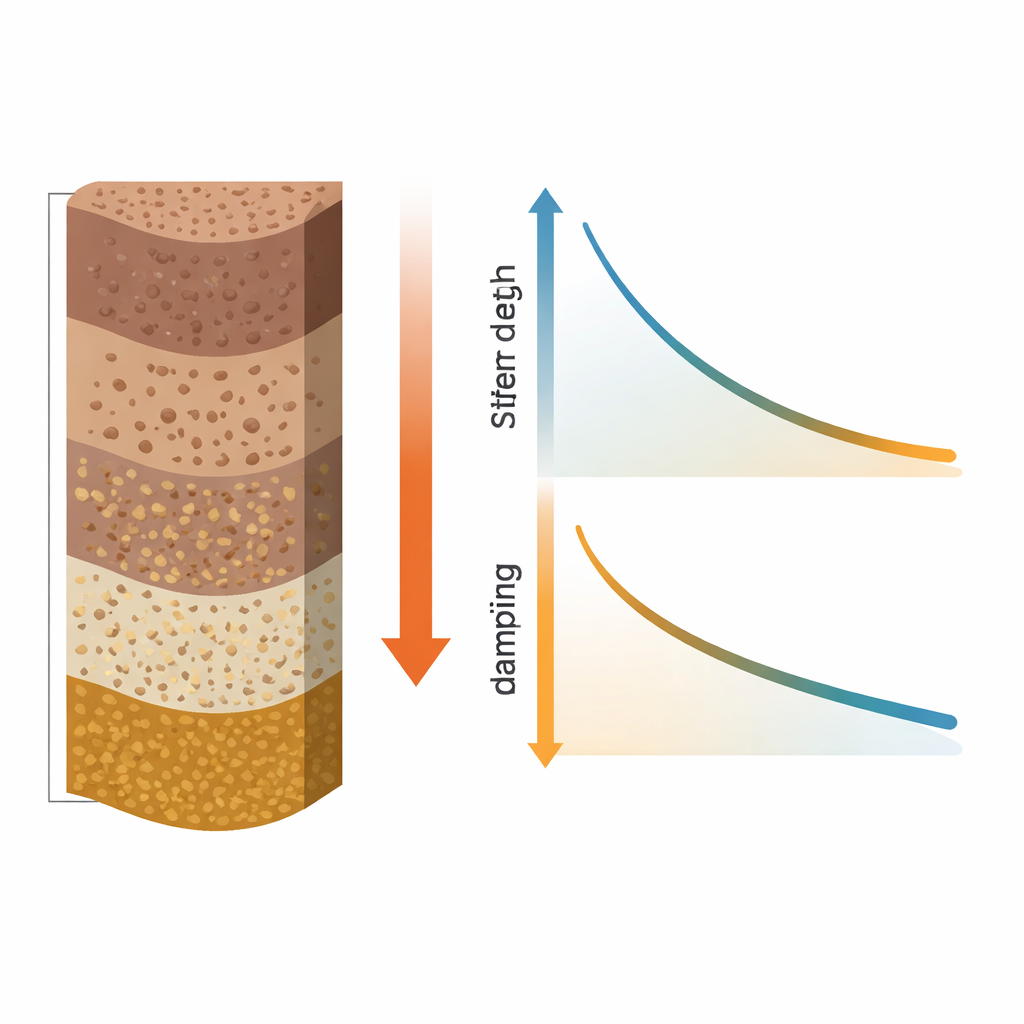
Depth changes the balance between softness and strength
The team then asked how these properties change with burial depth. They found that both field data and lab measurements agree: maximum small‑strain stiffness increases steadily as soils lie deeper under the seafloor, while damping tends to decrease. In other words, deeper layers are tighter and less energy‑absorbing. Using a widely adopted mathematical description of soil nonlinearity (the Davidenkov model), they discovered that the basic curve shape parameters remain almost constant with depth for each soil type, but the characteristic strain marking the onset of strong nonlinearity grows linearly as soils get deeper. This means deeper sediments can tolerate larger shaking amplitudes before they begin to soften markedly, a trend the authors captured with simple depth‑based formulas and a set of recommended parameters for different sands and clays.
What this means for safer offshore structures
For non‑specialists, the main takeaway is that the strength and “shock‑absorbing” ability of marine soils beneath major offshore projects can now be predicted more reliably with relatively simple measurements of depth and density. Sandy layers follow a refined version of earlier depth formulas, while clays require the new two‑factor relationship introduced here. Together with depth‑dependent descriptions of how stiffness and damping change during shaking, these tools help engineers build more accurate computer models of how bridges, tunnels, and wind turbines anchored in the seabed will respond to earthquakes and waves, improving safety while reducing the need for costly offshore testing campaigns.
Citation: Wu, Y., Qin, B., Fu, Y. et al. Experimental investigation of dynamic shear stiffness and damping ratio characteristics of marine soils in Lingdingyang Bay, China. Sci Rep 16, 13118 (2026). https://doi.org/10.1038/s41598-026-42997-9
Keywords: marine geotechnical engineering, shear wave velocity, seafloor sediments, dynamic soil behavior, earthquake site response