Clear Sky Science · en
Immunotolerant Oligomer scaffolds promote regenerative remodeling and improved muscle structure and function after volumetric muscle loss
Why rebuilding lost muscle matters
When people lose a large chunk of muscle in an accident, during combat, or after tumor surgery, the body cannot simply “grow it back.” Instead of healthy muscle, the injured area often fills with stiff scar tissue, leaving patients weaker, in pain, and less mobile. This study explores a new kind of collagen-based scaffold—called an Oligomer scaffold—that is designed not just to plug the gap, but to guide the body to rebuild real working muscle, complete with blood vessels and nerves.
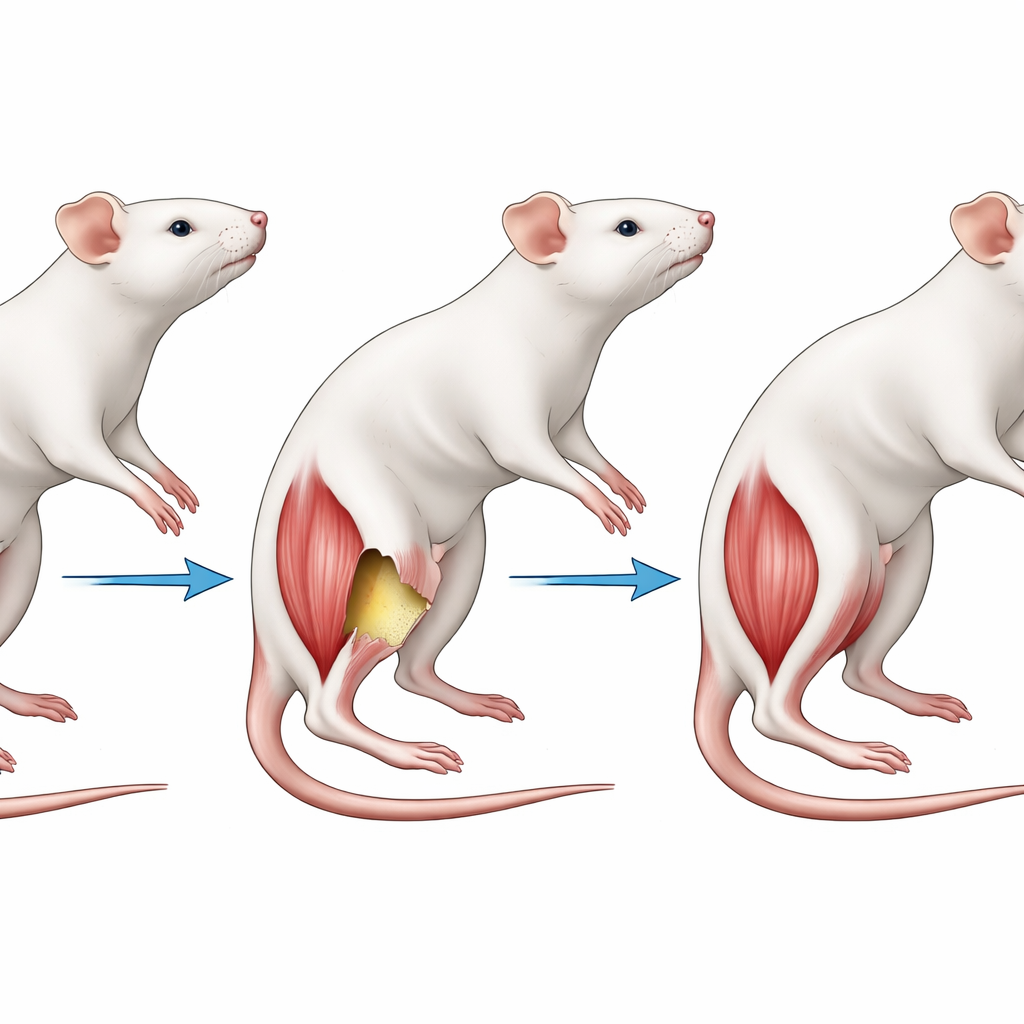
A severe injury that overwhelms self-repair
Ordinary pulled muscles or small tears usually heal well because muscle stem cells can repair damaged fibers using the tissue’s existing framework of proteins, blood vessels, and nerves. But in volumetric muscle loss, where roughly a third or more of a muscle is removed, that framework is destroyed. The result is an empty space that collapses, pulls neighboring tissue out of shape, and triggers inflammation and scarring instead of regeneration. Current surgical fixes, such as moving muscle from another part of the body or using off-the-shelf tissue patches, can restore some bulk but rarely restore normal strength and movement.
A new scaffold built to restore, not scar
The researchers tested an engineered collagen material, Oligomer, in rats with a full-thickness injury to the tibialis anterior muscle of the lower leg, removing about 30 percent of its volume. They implanted one of three scaffold versions that differed in how dense and how solid they were: a soft injectable gel that formed a scaffold in place, a pre-formed low-density slab, and a thicker high-density slab. A fourth group of animals received no implant. Over 16 weeks, the team measured muscle strength, mass, shape, and microscopic structure, and also mapped which genes were active in different regions of the healing tissue using spatial transcriptomics, a technique that links gene activity to precise locations in a tissue slice.
Holding the gap open to let real muscle grow
All three Oligomer scaffolds supported new muscle growth, but the high-density version performed best. Rats with this sturdier scaffold recovered over 60 percent more muscle strength than untreated animals and reached about 72 percent of the strength of their uninjured leg by 16 weeks. Their injured muscles also regained nearly normal mass and shape. Microscopy showed the high-density scaffold kept the defect from collapsing and maintained smooth muscle contours, gradually filling with aligned muscle fibers that resembled healthy tissue. The softer scaffolds allowed faster early cell entry, but sometimes shifted or collapsed, leading to more irregular geometry and less reliable functional gains. Untreated injuries shrank and filled with disorganized scar, with poor force generation.
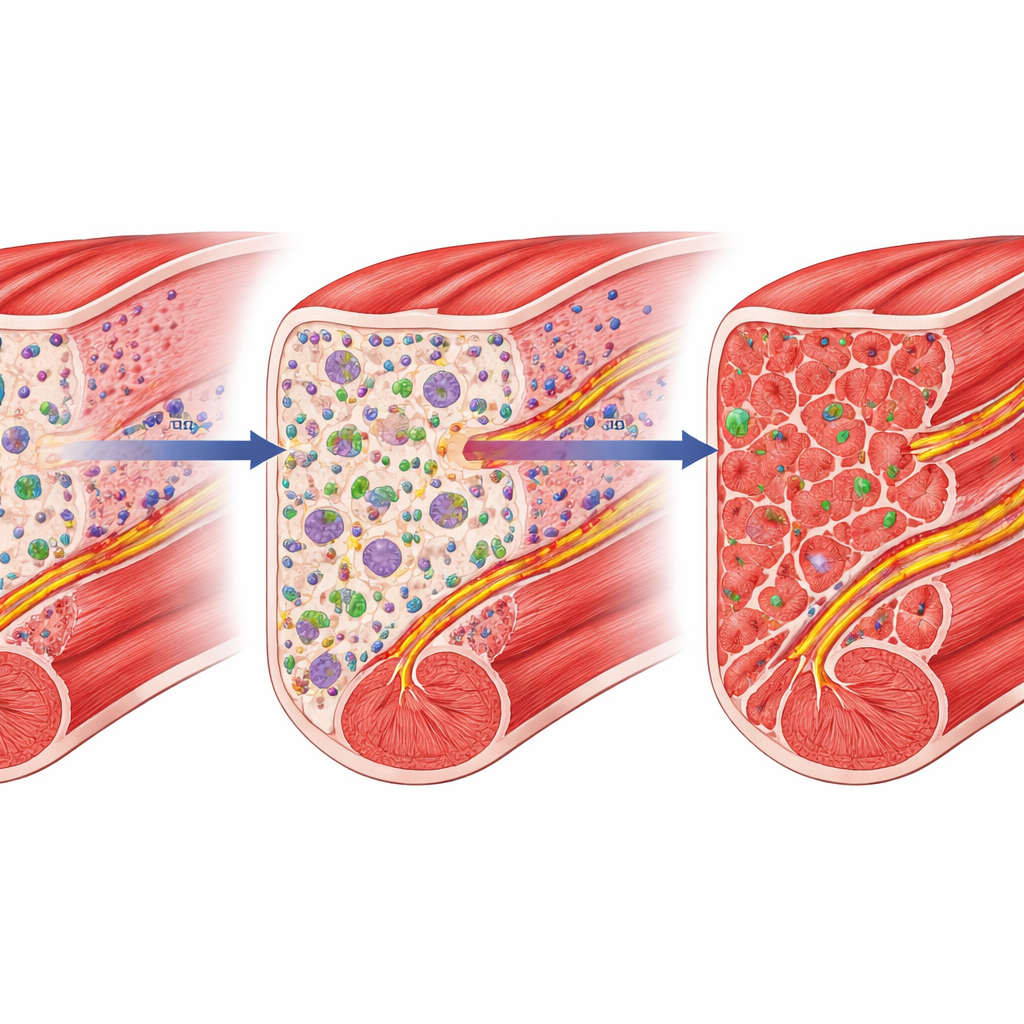
A quiet niche that invites builders, not fighters
The gene-mapping studies focused on the medium-density scaffold to capture the remodeling process in detail. Early after implantation, the scaffold region was rich in support cells—mesenchymal cells, blood vessel helpers called pericytes, muscle stem cells, and neural progenitors—but showed surprisingly few inflammatory immune cells. Genes linked to balanced collagen breakdown and rebuilding, gentle mechanical sensing, and cell movement were active, suggesting a controlled, “immunotolerant” environment rather than an aggressive foreign-body reaction. As time went on, genes that drive muscle fiber formation, blood vessel growth, and nerve development turned on in a coordinated way. New fibers matured, blood vessels stabilized, and nerve-and-vessel bundles formed that looked and behaved like those in normal muscle.
Recreating the conditions of development
By comparing their findings with what is known about how muscle forms before birth, the authors conclude that these Oligomer scaffolds recreate key features of early development inside an adult injury. The scaffold’s collagen fibers provide a physical track for cells to align along, while its mechanical strength holds the space open against the pull of surrounding tissue. Because it does not provoke strong inflammation or rapid breakdown, the scaffold gives time for a diverse cast of stem and progenitor cells to move in, organize, and gradually replace it with living muscle, blood vessels, and nerves. In this way, the material acts less like a disposable patch and more like a long-lasting scaffold that the body can build into, restoring structure and function rather than leaving a permanent scar.
Citation: Morrison, R.A., Sexton, J., Zhang, L. et al. Immunotolerant Oligomer scaffolds promote regenerative remodeling and improved muscle structure and function after volumetric muscle loss. Sci Rep 16, 12630 (2026). https://doi.org/10.1038/s41598-026-42993-z
Keywords: volumetric muscle loss, muscle regeneration, collagen scaffold, biomaterials, tissue engineering