Clear Sky Science · en
Optimized weight spectrum method for interference signal separation in FSO communication
Clearer Conversations Through Light
Imagine talking to someone far away, not by radio or fiber cable, but by a beam of light traveling through open air. This is the promise of free-space optical (FSO) communication: high-speed, wire-free links that can quietly carry your voice or data between buildings, towers, or even drones. But in the real world, air is restless and noisy. Heat, wind, and electronics all jostle the signal, making spoken words harder to recover at the far end. This paper introduces a new way to clean up those signals so conversations sent by light stay crisp and understandable.
Why Light Links Get So Noisy
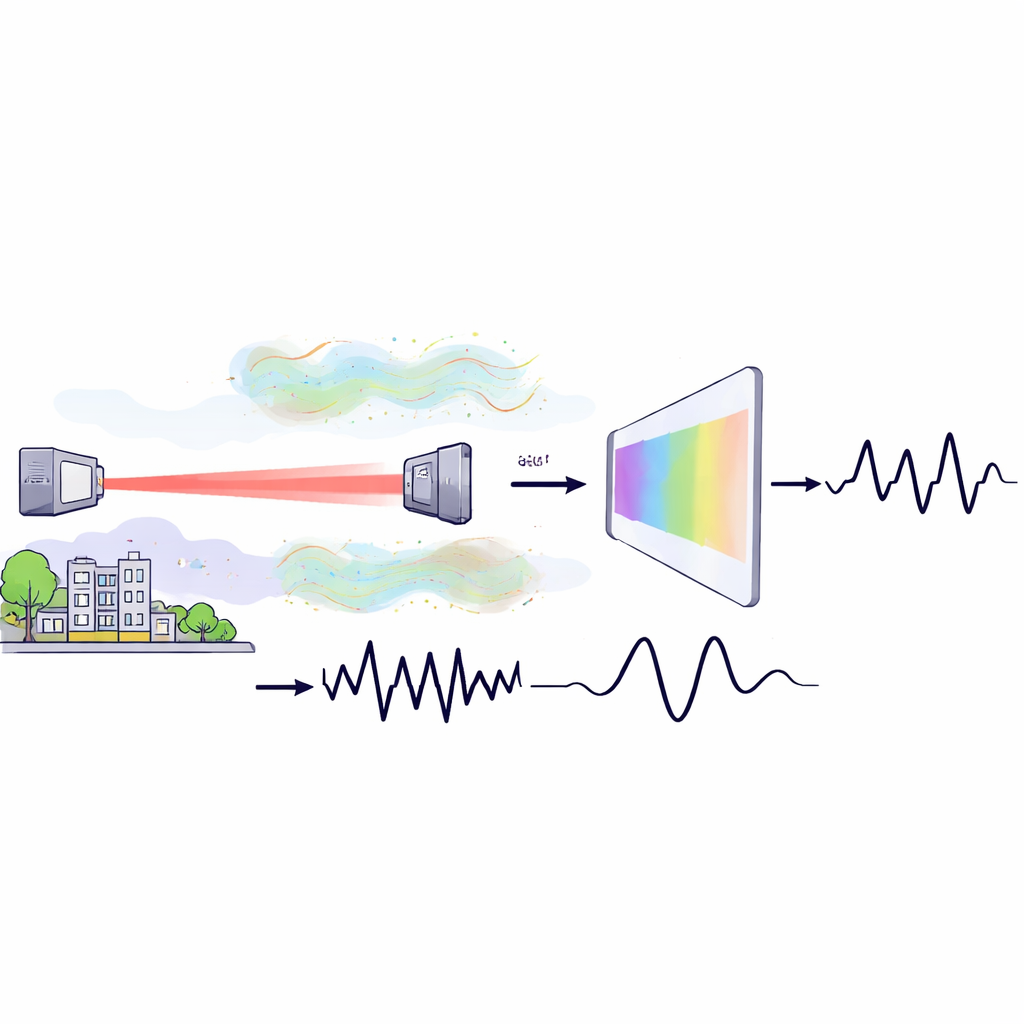
FSO systems send information by rapidly turning a light source on and off and catching the flickers with a sensitive detector. Unlike radio links, these light beams do not need a government license and can offer much higher data rates. However, they are at the mercy of the atmosphere and the receiver hardware. Turbulence in the air causes the light to shimmer and fade in a random way, while the electronics that convert light into an electrical signal add their own buzz of background noise. Together, these effects scramble the signal, make some bits flip in error, and raise what engineers call the bit error rate, or BER. Lower BER means fewer mistakes and clearer communication.
Looking at Signals in a New Way
Instead of trying to fix the signal directly in time, the authors look at it in terms of its musical notes, or frequencies. They use a mathematical tool called the Fourier transform to break each recorded signal into its frequency ingredients, a bit like turning a chord into individual notes. Clean voice signals in their FSO system tend to occupy a well-defined slice of this frequency range, while noise tends to spread more broadly. By comparing many examples of clean and noisy signals, the researchers found that their frequency “fingerprints” are consistently different, even when the air conditions and noise levels change.
Teaching a Filter to Tell Signal from Noise
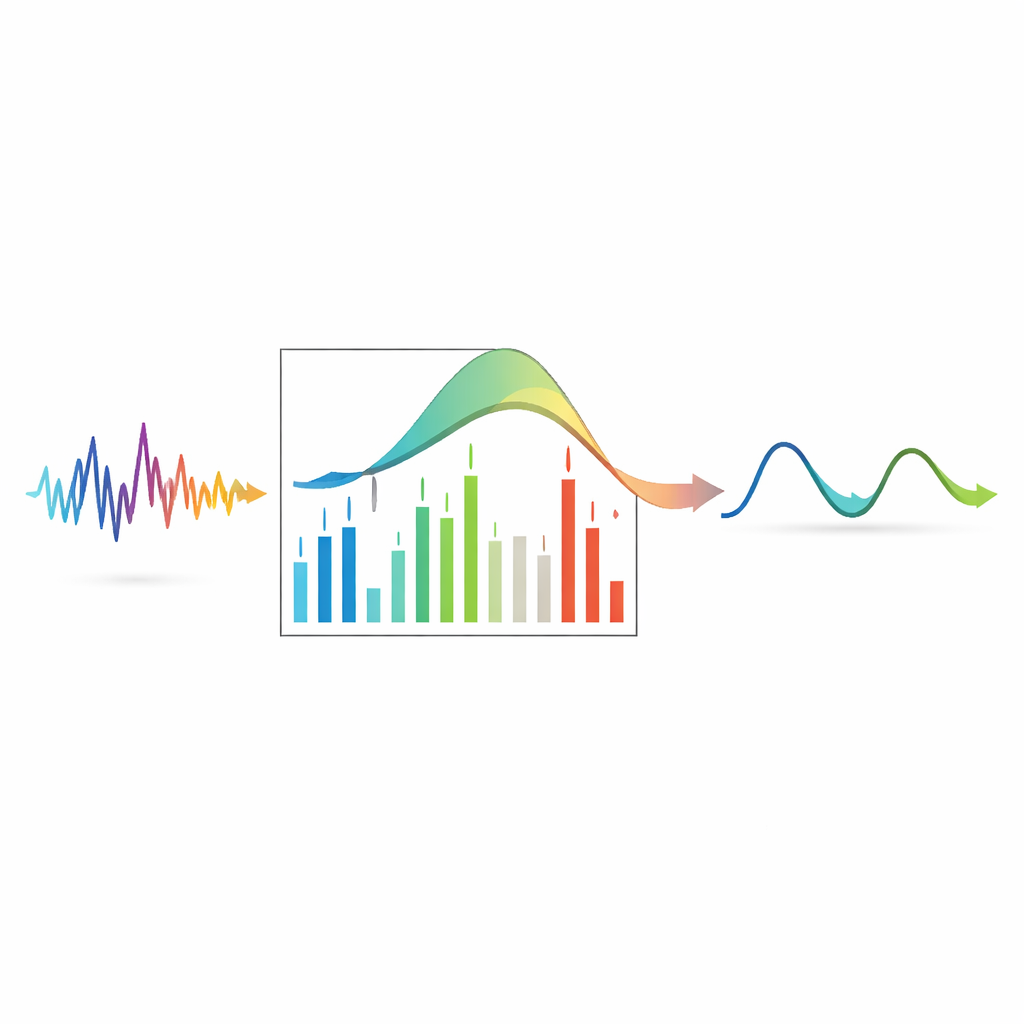
To take advantage of these differences, the team built a learning-based filter they call an Optimized Weight Spectrum. They fed the system many sets of real signals: some nearly noise-free, others with added artificial noise at various strengths. For each set, they examined the normalized frequency pattern and trained a simple mathematical model to draw a dividing surface between “mostly signal” and “mostly interference” in this frequency space. The outcome is a set of weights—one for each frequency component—that are positive where useful information tends to live and non-positive where noise dominates. They then refine these weights with an adaptive threshold, keeping only the strongest, most reliable components while discarding the rest.
From Lab Model to Outdoor Voice Link
After designing this spectral filter offline, the authors tested it in a real outdoor FSO link, 80 meters long, using an 850-nanometer light source and a common on–off modulation format for voice data. At the receiver, they applied the learned weight spectrum to the incoming signal’s frequency content, removed the parts tagged as interference, and then rebuilt the time-domain signal. They compared this approach with a basic demodulation method and with a more complex neural network model. In simulations, their optimized weight method reduced errors especially well at moderate noise levels that are typical of real links. In outdoor experiments, the bit error rate stayed below about 0.83%, and the cleaned signals showed wider eye openings and clearer waveforms, indicating more reliable decoding.
What This Means for Future Light Links
For non-specialists, the key idea is that the authors have created a smart, but relatively simple, “ear” for optical links that listens in the frequency domain. By learning in advance which parts of the spectrum usually carry real information and which are likely to be junk, their method can quickly strip away much of the interference without the heavy computing cost or large datasets that many deep-learning systems require. This makes it attractive for compact hardware in the field. While the method works best when noise sits slightly apart from the main signal band and may struggle in very harsh or overlapping conditions, it already offers a practical way to make free-space optical voice links more robust, clearer, and better suited to everyday outdoor environments.
Citation: Duan, Z., Qiang, S., Zhao, H. et al. Optimized weight spectrum method for interference signal separation in FSO communication. Sci Rep 16, 13544 (2026). https://doi.org/10.1038/s41598-026-42985-z
Keywords: free-space optical communication, interference suppression, signal processing, machine learning, noise reduction