Clear Sky Science · en
Chemical and hydrostatic pressure induced metallization in $$\hbox {NiS}_{2-x}$$ $$\hbox {Se}_x$$ single crystals
Why squeezing crystals matters
Modern electronics rely on materials that can either block or carry electric current, much like traffic lights control cars on a busy road. This study explores how a single family of crystals, made of nickel, sulfur, and selenium, can be gently pushed from acting like a stubborn traffic jam (an insulator) to behaving like a smooth-flowing highway (a metal). By changing the atoms in the crystal and by physically squeezing it, the researchers show how to switch its behavior in a controlled way, offering clues for future low-power electronics and fast electronic switches.
A simple crystal with complex behavior
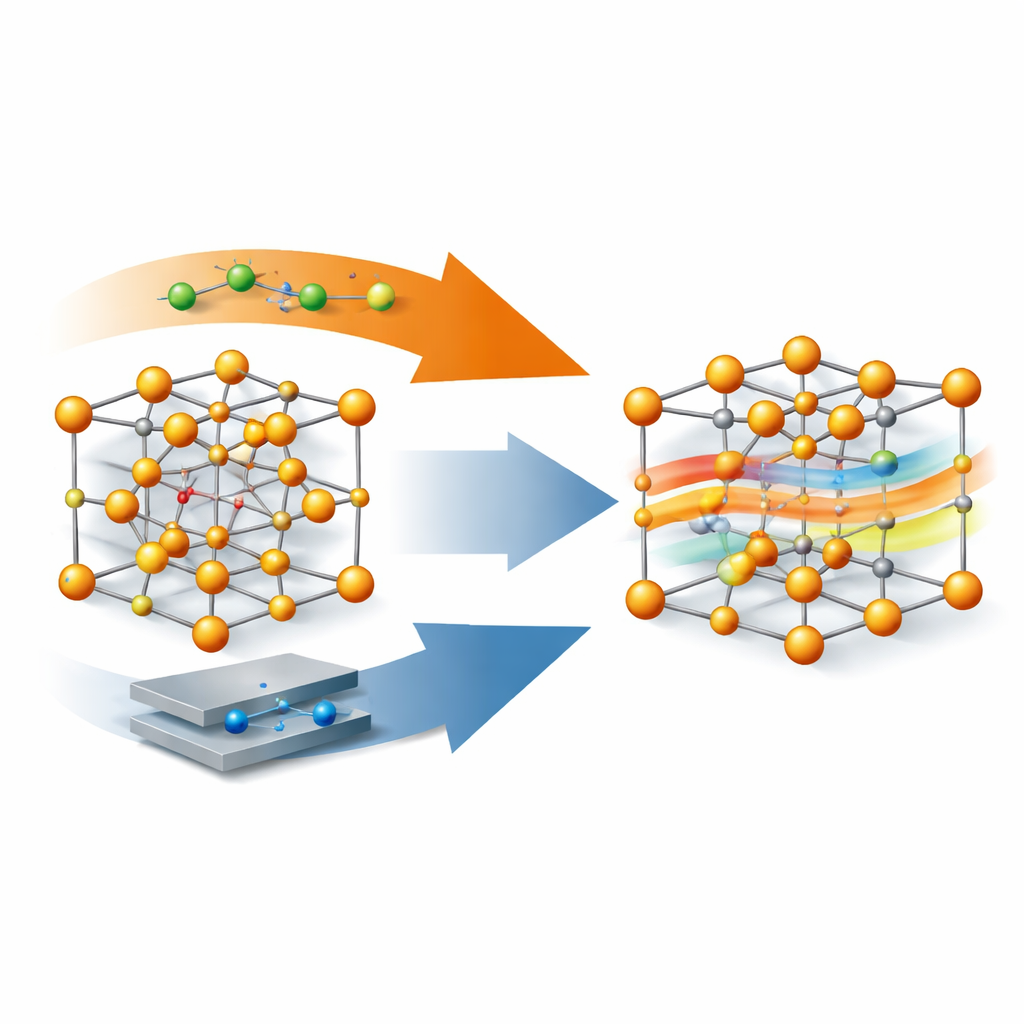
The crystals at the heart of this work belong to a group known as pyrites, where nickel atoms sit inside a cage of sulfur or selenium atoms in a neat cubic pattern. In the pure sulfur version, NiS2, electrons are strongly held in place by mutual repulsion, so they cannot move freely and the material behaves as an electrical insulator with magnetic order at low temperatures. Replacing some sulfur atoms with the larger selenium atoms subtly reshapes the environment where electrons live. This change lets their wave-like clouds overlap more, helping electrons move from site to site and gradually turning the material more metallic without changing the overall crystal shape.
Two ways to push electrons to move
The researchers combined two “control knobs” on the same material: chemical substitution, where sulfur is replaced by selenium, and hydrostatic pressure, where the whole crystal is squeezed evenly in all directions. Chemical substitution acts like an internal pressure by inserting slightly larger atoms that expand and re-balance the electronic structure, while external pressure physically pushes atoms closer together. Both actions increase the overlap between electron orbitals, broadening the pathways for electrons to move. By systematically varying selenium content (from none up to half of the sulfur sites) and applying pressures up to 14.4 kilobars, the team mapped how the material crosses from insulating to metallic behavior as temperature, composition, and pressure all change.
Watching the switch from insulator to metal
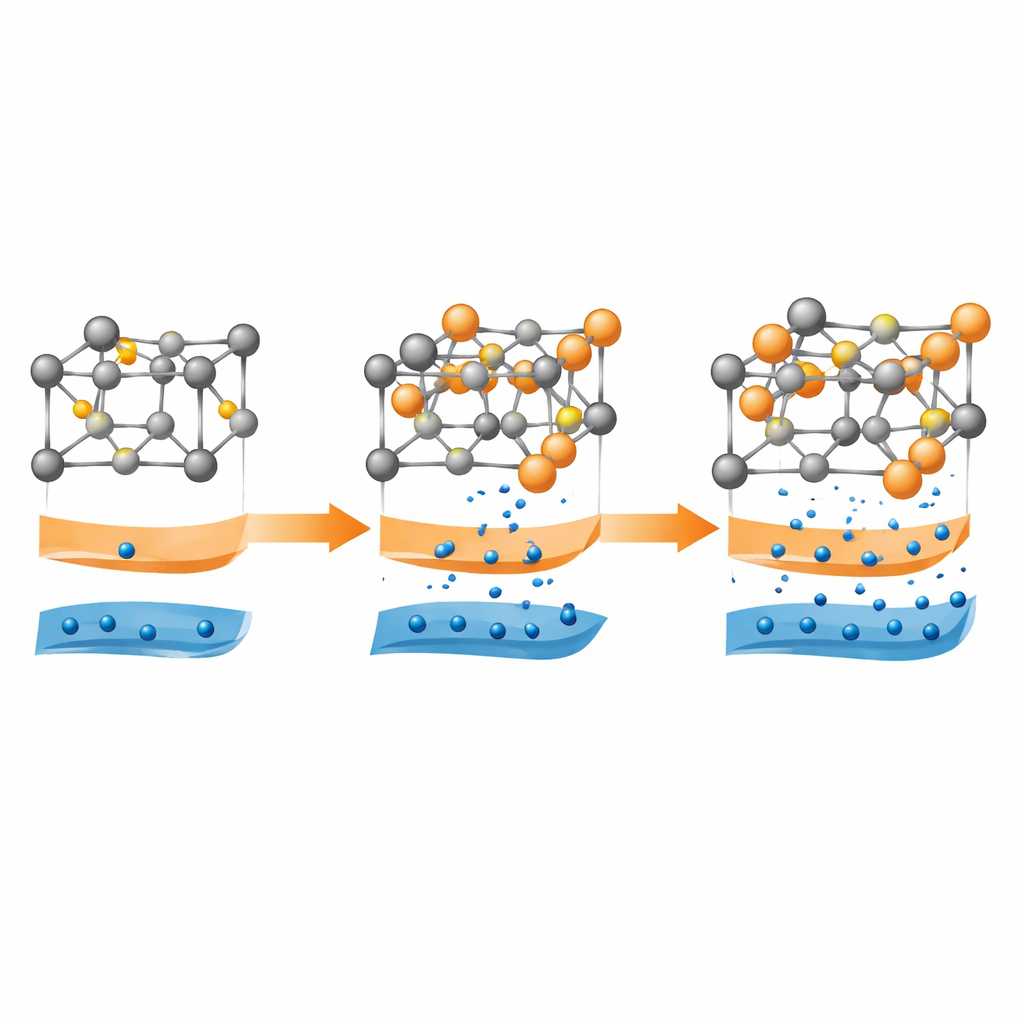
To track this switch, the team measured how strongly the crystals resisted electric current as they were cooled and squeezed. Pure NiS2 remained insulating within the pressure range they reached, although subtle changes in magnetic behavior and a shifting peak in resistance signaled that electrons were becoming slightly less confined. Lightly selenium-doped crystals, however, responded dramatically: in NiS1.9Se0.1 an insulator-to-metal transition appeared at about 7.5 kilobars, and in NiS1.6Se0.4 the same transition occurred at only about 1.3 kilobars. With even more selenium, NiS1.5Se0.5 was already metallic at low temperatures without any external pressure, and further squeezing pushed its metallic behavior up toward room temperature. These patterns reveal that adding selenium strongly lowers the pressure needed to make electrons mobile.
Tracing how the energy barrier shrinks
Beyond simple resistance curves, the researchers analyzed how easily electrons could jump across the energy barrier that keeps an insulator from conducting. By fitting the temperature dependence of the resistivity to a standard activated model, they extracted an “activation gap” that quantifies this barrier. For all compositions tested, the gap shrank steadily as pressure increased. Yet even a small amount of selenium cut the gap far more effectively than pressure alone; for instance, the gap of NiS2 at roughly 15 kilobars matched that of a lightly doped sample with only 10% selenium at ambient pressure. This shows that selenium substitution is a particularly powerful way to weaken electron localization and enhance their mobility, even though the basic crystal framework stays intact.
A unified map for tuning quantum materials
Putting all of these measurements together, the authors built a three-parameter phase diagram that links temperature, pressure, and selenium content to the material’s electronic and magnetic states. It shows where the crystal is insulating, weakly or strongly magnetic, and where it becomes a metal. For a lay reader, the key message is that both “chemical pressure” (swapping atoms) and real pressure (squeezing the crystal) act through the same basic idea: they let electrons share space more easily, lowering the energy barrier that once held them in place. Selenium does this job more efficiently than pressure alone, but the combination of both tools offers a flexible way to design and control materials whose electrical properties can be switched on demand—an essential step toward future smart and energy-efficient electronic devices.
Citation: Hussain, T., Choi, J., Omran, M. et al. Chemical and hydrostatic pressure induced metallization in \(\hbox {NiS}_{2-x}\) \(\hbox {Se}_x\) single crystals. Sci Rep 16, 13296 (2026). https://doi.org/10.1038/s41598-026-42983-1
Keywords: metal-insulator transition, nickel chalcogenides, chemical pressure, hydrostatic pressure, strongly correlated electrons