Clear Sky Science · en
Foot-and-mouth disease virus-derived dendrimer peptides induce germinal center-dependent antibody responses and IgG1 plasma cell differentiation in mice
Why this matters for animal health
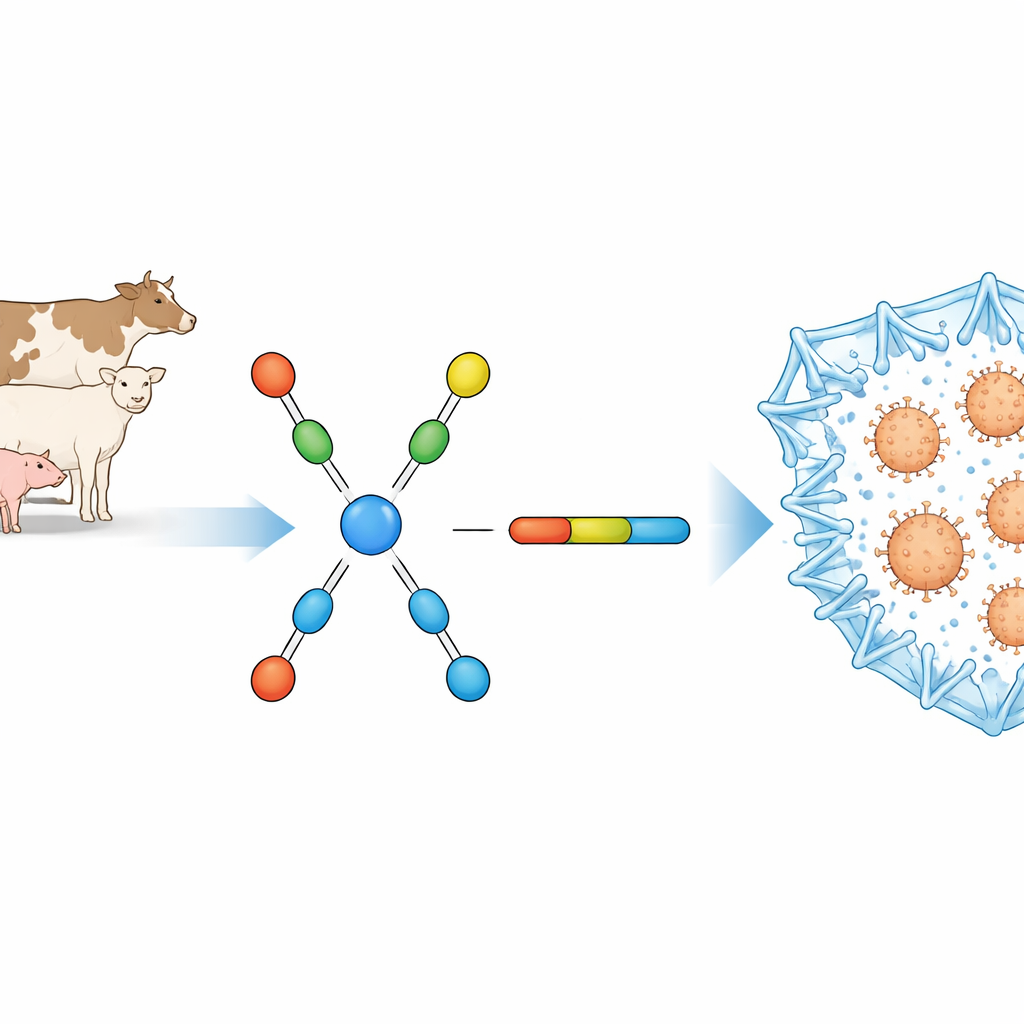
Foot-and-mouth disease is a fast-spreading infection of cattle, pigs, sheep and other cloven-hoofed animals, capable of shutting down trade and causing huge economic losses. Current vaccines rely on inactivated virus and come with safety and surveillance drawbacks. This study explores a new, highly targeted peptide-based vaccine design that aims not just to block the virus, but to train the immune system to build long-lasting protection, using mice as a first, controlled test bed.
A smarter vaccine made from small pieces
Instead of using whole virus, the researchers work with short protein fragments, or peptides, from foot-and-mouth disease virus. Their lead candidate, called B2T, is built like a tiny branched scaffold (a dendrimer) that carries two copies of a virus fragment recognized by antibody-producing B cells and one fragment recognized by helper T cells. This layout is meant to ensure that B cells and T cells are activated together, a known requirement for strong, durable antibody responses. A comparison construct, B2, carries only the B cell fragments but lacks the T cell part, allowing the team to test how crucial T cell help really is.
Testing the immune response in mice
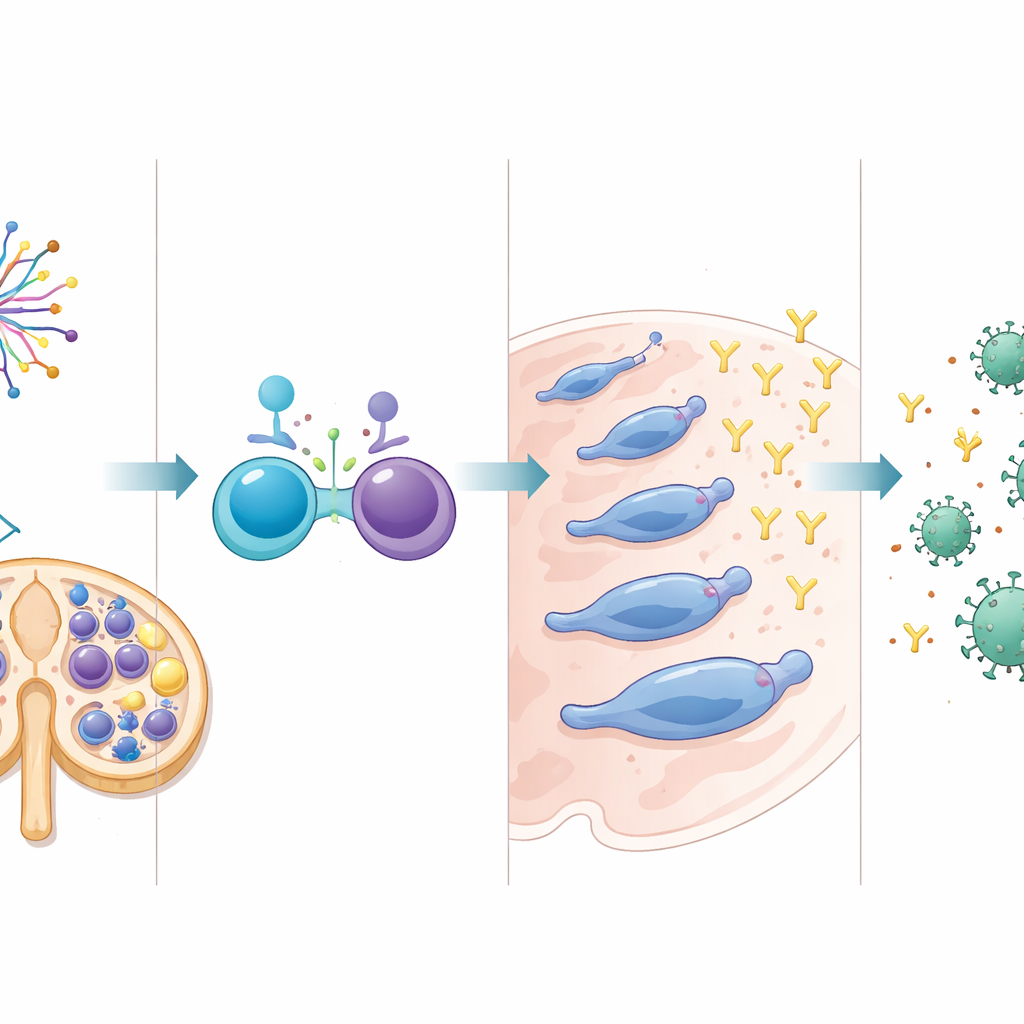
Using outbred CD1 mice, which better reflect genetic diversity in farm animals, the scientists immunized animals twice with B2T or control preparations. They tracked antibodies in the blood, the activity of T cells in the spleen, and the behavior of B cells in lymph nodes and bone marrow. B2T quickly triggered virus-specific antibodies after the first dose, and these levels rose sharply after the booster shot. Importantly, the antibodies were not just abundant; they neutralized live virus in cell culture, a strong sign that they could stop infection in a real animal. At the same time, spleen cells from B2T-vaccinated mice released high amounts of the antiviral messenger IFN-γ when re-exposed to the vaccine, showing that virus-specific T cells had been effectively primed.
Building long-lived antibody factories
The key question was whether this peptide vaccine could drive the specialized structures, called germinal centers, where B cells refine their antibodies and turn into long-lived plasma cells. By analyzing lymph nodes that drain the injection site, the team found that B2T strongly increased the proportion of germinal center B cells, especially those that had switched to producing the IgG1 type of antibody associated with high affinity and long-term protection. In the bone marrow, where the body stores its longest-lived antibody-secreting cells, B2T did not simply increase the total number of plasma cells, but selectively enriched those making IgG1. This pattern indicates that the vaccine was not just causing a short burst of activity but was seeding a durable reservoir of cells ready to secrete protective antibodies for extended periods.
The crucial role of T cell help
To confirm that this deep, long-lasting response depended on T cells, the researchers compared B2T with the B2 peptide, which lacks the T cell fragment. Mice given B2 failed to produce detectable anti-virus antibodies, showed no virus-neutralizing activity, and did not generate a pool of IgG1-producing memory plasma cells in their bone marrow. In contrast, B2T consistently produced high antibody titers, robust neutralization, and strong recall responses in both B cells and T cells. These side-by-side results make clear that simply presenting the antibody-targeted virus fragment is not enough; it must be linked to a T cell epitope in the same molecular package to drive a full response.
What this means for future vaccines
Put simply, the study shows that a carefully engineered peptide vaccine can teach the immune system of mice to build long-lived, high-quality antibody defenses against foot-and-mouth disease virus, but only when B cell and T cell targets are physically joined in a dendrimer structure. While these findings still need to be confirmed in the natural host species, they provide a clear blueprint: peptide vaccines that combine multiple virus fragments in the right architecture can mimic the best features of traditional vaccines while avoiding live virus, potentially leading to safer, more durable protection for livestock herds worldwide.
Citation: Iborra-Pernichi, M., de León, P., Torres, E. et al. Foot-and-mouth disease virus-derived dendrimer peptides induce germinal center-dependent antibody responses and IgG1 plasma cell differentiation in mice. Sci Rep 16, 13198 (2026). https://doi.org/10.1038/s41598-026-42982-2
Keywords: foot-and-mouth disease, peptide vaccine, dendrimer, germinal center, neutralizing antibodies