Clear Sky Science · en
Animal-origin-free method for generating blood vessel organoids
Why Growing Tiny Blood Vessels Matters
Our bodies rely on a vast network of blood vessels to deliver oxygen, clear waste, and help wounds heal. When this network fails, as in diabetes or severe injuries, current treatments are often limited. Scientists have begun to grow miniature versions of organs in the lab, called organoids, to study disease and test drugs. This article describes a new way to grow tiny, three-dimensional blood vessel structures from human stem cells without using animal-derived materials, making them safer, more reliable, and more suitable for future medical use.
Miniature Vessels Built from Human Stem Cells
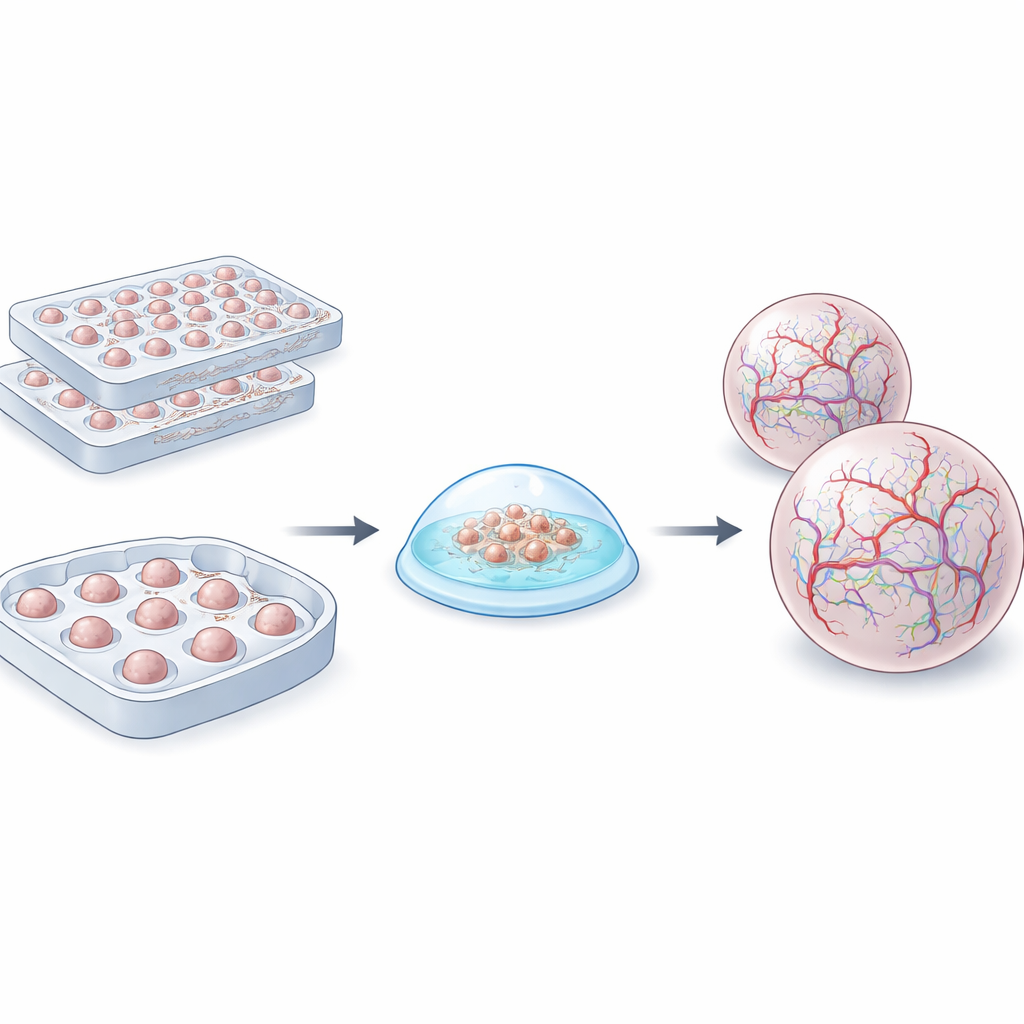
The researchers focus on blood vessel organoids—small spheres of tissue made from human induced pluripotent stem cells, a type of cell that can turn into many different tissues. These organoids contain two key cell types found in real vessels: endothelial cells, which line the inside of blood vessels, and pericytes, which wrap around them and provide support. In existing methods, organoids were grown in animal-derived gels such as Matrigel, which are complex, expensive, and vary from batch to batch. That variability makes it hard to reproduce experiments and nearly impossible to meet strict manufacturing standards needed for therapies in patients.
A Simpler One-Plate, “Sitting Drop” Setup
To solve these problems, the team redesigned the growth process around common 96-well plates whose U-shaped bottoms prevent cells from sticking. Human stem cells are added to each well, where they naturally clump into a single, round aggregate of defined size. The cells are then guided through stages that mimic early development, first nudging them toward a middle layer of the body (the mesoderm) and then toward blood vessel fate. Instead of transferring these delicate structures between dishes and embedding them in two layers of gel, the scientists simply place one droplet of gel directly over each aggregate in the same well—a configuration they call a “sitting drop.” This streamlined approach cuts handling steps, reduces errors, and fits neatly with automated liquid-handling robots.
From Animal Gels to Human Collagen
The team systematically tested which gels best supported healthy, well-structured organoids. They first compared different plate types and found that only ultra-low-adhesion U-bottom plates produced consistently sized, well-formed cell aggregates that developed properly into vessel-like tissue. They then moved away from animal mixtures such as Matrigel and Geltrex, trying instead a single, defined ingredient: collagen, the main structural protein in many tissues. Using either bovine collagen or fully recombinant human collagen, they produced organoids that were round, uniform, and rich in both endothelial cells and pericytes. At an optimized human collagen strength, the organoids reached a stable, spherical form relatively quickly and showed tightly organized internal vessel networks comparable to or better than those grown in traditional animal-based gels.
Putting Lab-Grown Vessels to the Test
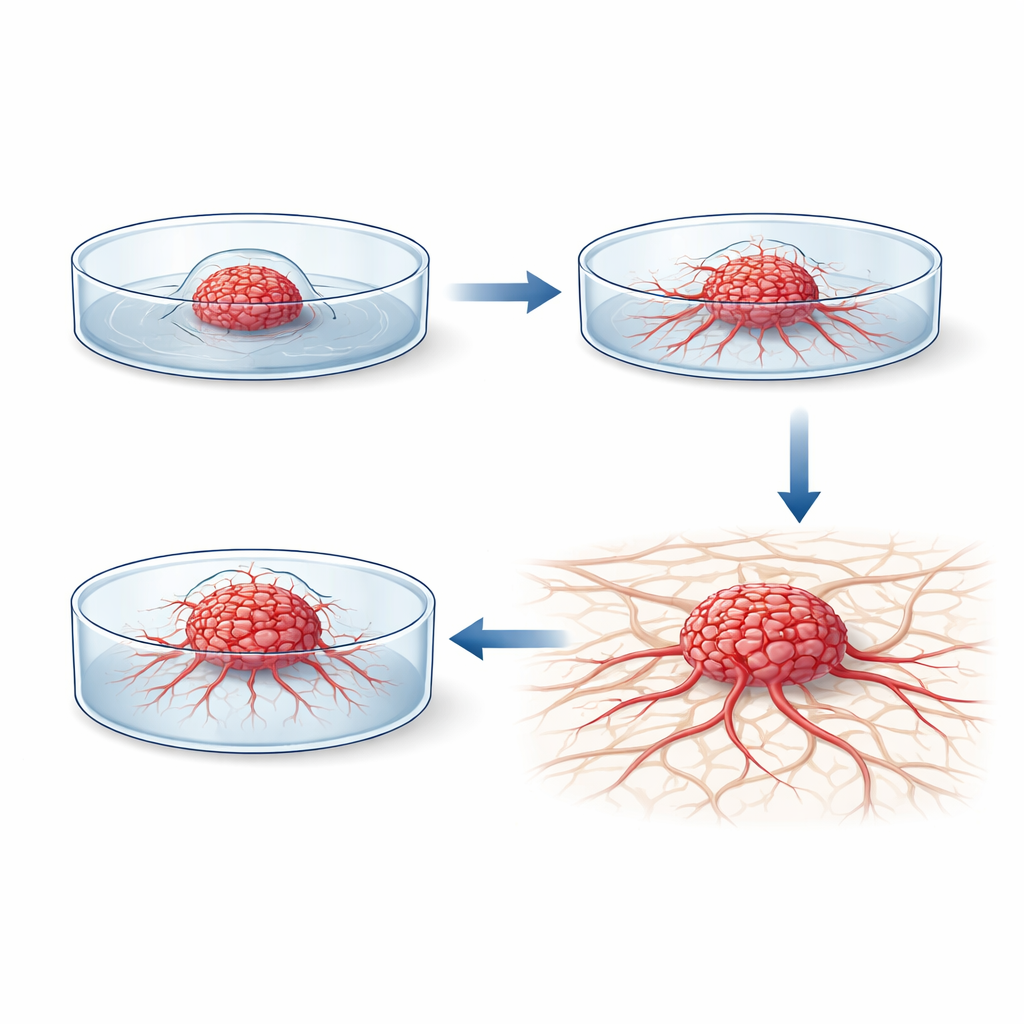
Growing realistic-looking organoids is only useful if they also behave like real tissue. To test this, the researchers implanted blood vessel organoids grown in collagen into full-thickness skin wounds in immune-deficient mice. Over about a month, the wounds healed, and the team then examined the repaired tissue. They detected human vessel-lining cells from the organoids integrated into the animals’ own blood vessels, forming mixed, or chimeric, structures that even contained red blood cells in their interior. The organoids themselves had broken apart, but their cells had clearly survived and joined the host’s vascular network, suggesting they can contribute to new vessel growth during healing.
What This Means for Future Medicine
This study shows that blood vessel organoids can be grown reliably in a simple, one-plate system using only defined, animal-origin-free materials. The method yields stable, well-structured mini-vessels that are suitable for large-scale, automated production and can integrate into living tissue after transplantation. For non-specialists, the key message is that we are getting closer to growing safe, standardized vascular building blocks that could one day help repair damaged tissues, model complex diseases such as diabetes-related vessel damage, and speed up the testing of new drugs without relying heavily on animal experiments.
Citation: Hoffmann, A., Schorn, D., Thönig, J. et al. Animal-origin-free method for generating blood vessel organoids. Sci Rep 16, 12096 (2026). https://doi.org/10.1038/s41598-026-42977-z
Keywords: blood vessel organoids, human stem cells, collagen matrix, regenerative medicine, high-throughput screening