Clear Sky Science · en
Pilot study of dual-arm absolute quantification of miR-130a and miR-365a in plasma and urine reveals 3p/5p strand-ratio shifts in prostate cancer
Why this matters for men’s health
Most men with early prostate cancer feel perfectly well, yet current tests struggle to separate harmless tumors from dangerous ones and still rely on invasive biopsies. This study explores whether tiny molecules called microRNAs, circulating in blood and urine, can provide a more precise, needle-free way to detect prostate cancer and gauge how risky it is. By looking not just at one form of these molecules but at the balance between two partner forms, the researchers suggest a new, more nuanced kind of liquid biopsy that could someday refine screening and spare some men unnecessary procedures. 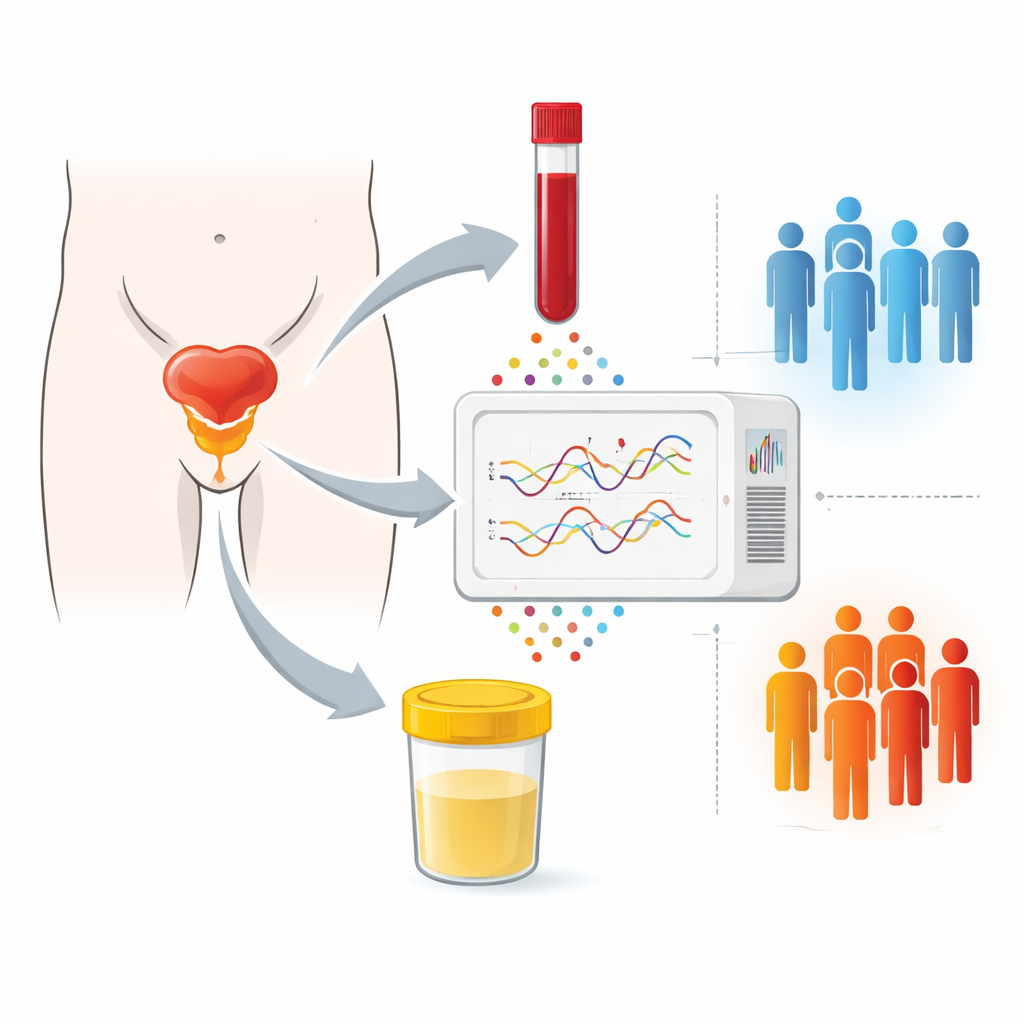
Tiny messengers in blood and urine
MicroRNAs are short pieces of genetic material that help fine‑tune which genes are turned on or off inside cells. Each microRNA is produced as a pair of strands, typically labeled “3p” and “5p.” Traditionally, scientists assumed only one strand did the real work while the other was discarded. New evidence, however, shows that both strands can matter, and that disease can shift which one dominates—a phenomenon sometimes called arm switching. Because microRNAs are unusually stable in body fluids such as blood plasma and urine, they are attractive candidates for noninvasive cancer tests that could complement or even improve on prostate‑specific antigen (PSA) blood measurements.
A closer look at two key microRNAs
This pilot study focused on two microRNAs, miR‑130a and miR‑365a, previously linked to prostate cancer in tissue and blood. The authors recruited 21 men with biopsy‑confirmed prostate cancer and 20 age‑matched men without cancer. Using a sensitive technique called RT‑qPCR together with synthetic reference molecules, they counted the absolute number of copies of each microRNA strand—3p and 5p—present in both plasma and urine. Rather than only asking whether a given strand went up or down, they also calculated the ratio between the 3p and 5p strands, reasoning that shifts in this balance might reveal changes in how cancer cells process and release microRNAs.
Distinct patterns that separate patients from controls
The results showed clear differences between men with and without prostate cancer. For miR‑130a, the main 3p strand was consistently lower in patients in both blood and urine. The partner 5p strand behaved differently depending on the fluid: it was reduced in patient plasma but increased in patient urine, hinting that the disease redistributes this strand between compartments. For miR‑365a, the 3p strand was lower in both plasma and urine of patients, while the 5p strand was often hard to detect but, when measurable in plasma, tracked closely with PSA and PSA density. Crucially, the balance between 3p and 5p strands shifted in cancer patients, especially for miR‑130a in urine, signaling altered microRNA processing or strand selection associated with the disease. 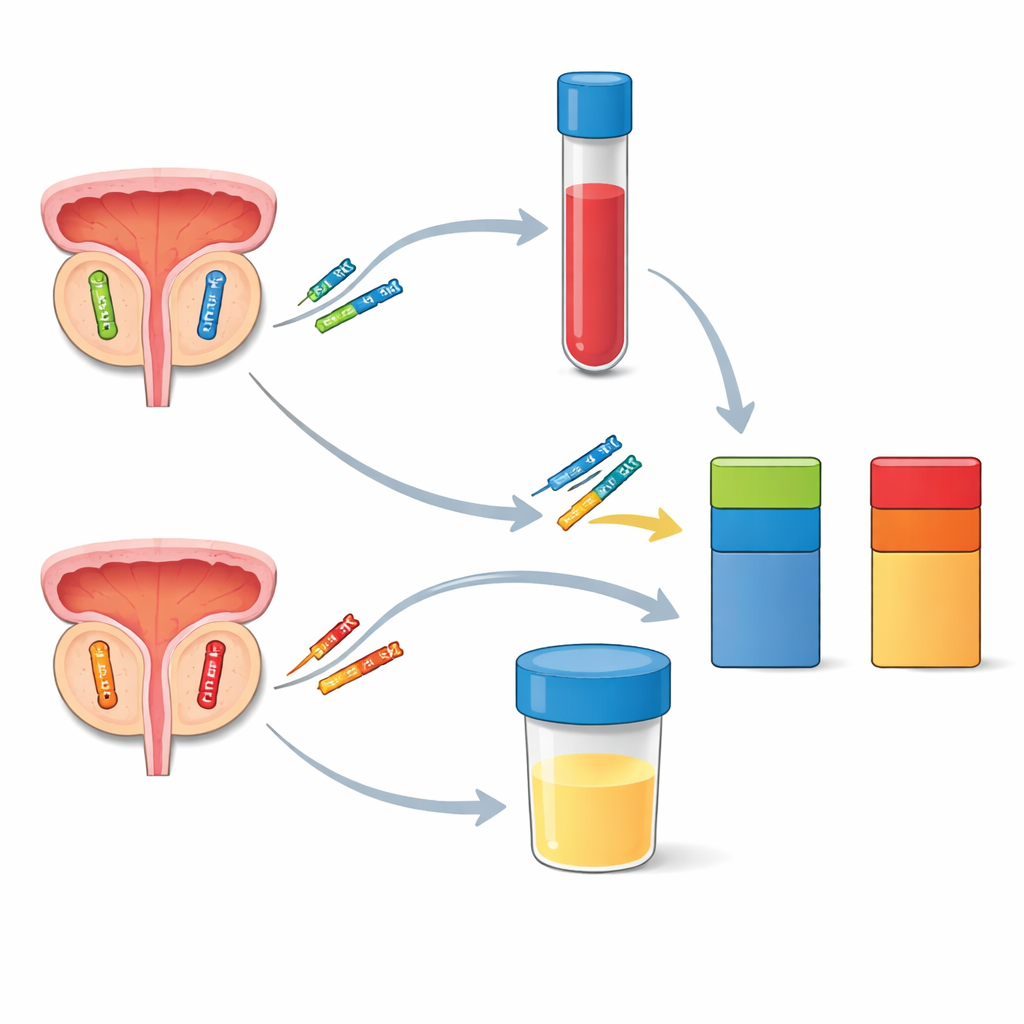
Testing diagnostic power of the signal
To understand how useful these patterns might be as tests, the team used statistical tools that estimate how well each marker distinguishes patients from controls. In plasma, both strands of miR‑130a performed exceptionally well, approaching near‑perfect separation between the two groups in this small cohort. In urine, no single strand was outstanding on its own, but the ratio of miR‑130a 3p to 5p stood out, outperforming either strand alone and even comparing favorably with some existing commercial prostate cancer tests reported in earlier studies. The researchers also mined a large public database of microRNA profiles from many tissues and fluids, confirming that the 3p/5p balance for these microRNAs varies widely by tissue type and biofluid, reinforcing the idea that strand selection is context‑dependent rather than fixed.
What this could mean for future testing
For readers, the key takeaway is that the study supports a more sophisticated view of liquid biopsies for prostate cancer. Instead of measuring a single microRNA level in blood, doctors might eventually use paired measurements of both strands in blood and urine, and especially their ratio, to gain a clearer picture of whether cancer is present and how aggressive it might be. Although this was a small, single‑center pilot and needs confirmation in larger, multi‑hospital studies, it demonstrates that dual‑strand microRNA profiling is technically feasible and biologically informative. If validated, this approach could complement PSA, reduce unnecessary biopsies, and bring us closer to a simple, accurate urine‑and‑blood test for prostate cancer risk.
Citation: Romanescu, M., Bendelic, A.I., Ciordas, P.D. et al. Pilot study of dual-arm absolute quantification of miR-130a and miR-365a in plasma and urine reveals 3p/5p strand-ratio shifts in prostate cancer. Sci Rep 16, 13785 (2026). https://doi.org/10.1038/s41598-026-42960-8
Keywords: prostate cancer, microRNA biomarkers, liquid biopsy, blood and urine testing, early cancer detection