Clear Sky Science · en
Incomplete reputation information and punishment in indirect reciprocity
Why this matters for everyday fairness
In daily life, we constantly judge others by their past behavior: who helped, who cheated, who stood up for the group. These informal reputations help communities cooperate, from sharing babysitting to paying taxes. But what happens when information about people’s past actions is patchy or slowly fades from view—and when some people are willing to punish wrongdoers at a cost to themselves? This study uses mathematical models to explore how different kinds of missing information and the threat of punishment shape our ability to sustain cooperation in large, complex societies.
How reputation keeps helping hands in play
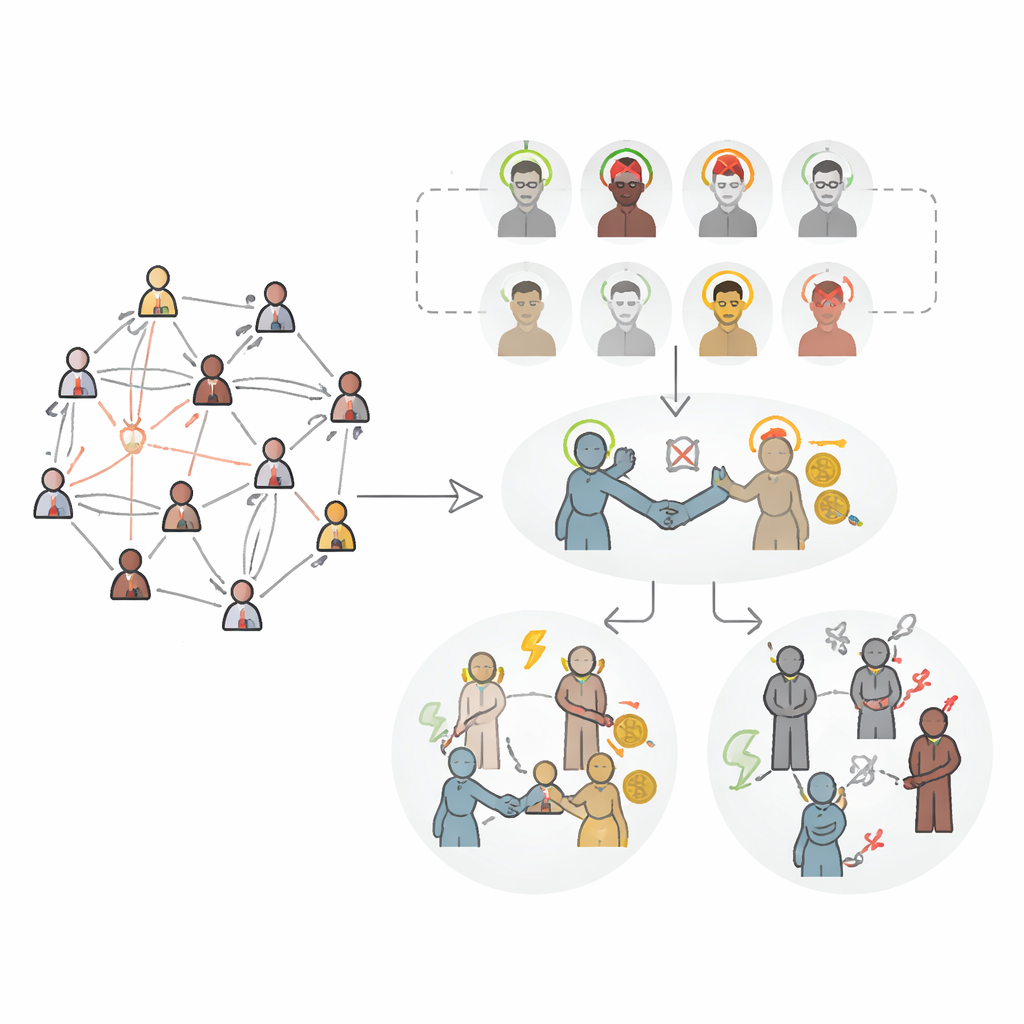
Human cooperation often relies on what researchers call indirect reciprocity: we help someone today because we believe others will help us tomorrow if we are seen as generous or fair. In the simplest models, everyone shares the same public list of who is considered “good” or “bad,” and they use social rules—or norms—to decide whom to help and how to update reputations after each interaction. Earlier work showed that to keep cooperation stable, norms must be fairly sophisticated, taking into account not just what a person did, but the situation they faced. Building on this foundation, the authors revisit how such reputation systems perform when information about people’s actions or past conduct is incomplete, as happens in large, anonymous societies.
Two ways information can go missing
The study compares two distinct forms of incomplete information that might sound similar but turn out to have very different consequences. In the first, called incomplete observation, people’s actions are only seen some of the time. If no one is watching, nothing is written into the reputation book—your current standing simply persists. In the second, called reputation fading, the problem is not whether someone saw what you did now, but whether your past reputation is still accessible at all. In many encounters, the other person’s status is treated as “unknown,” and social norms must specify how to behave toward such uncertain partners. Using recent analytical tools, the authors show that these two models, though superficially alike, push cooperation in opposite directions.
When fewer eyes do and do not hurt cooperation
Surprisingly, the authors find that incomplete observation by itself does not make cooperation harder to maintain, as long as reputations remain in place when no one is watching. When actions are seen less often, reputations last longer, so having a good name becomes more valuable. These two effects cancel out: the conditions under which cooperative norms survive are unchanged. Reputation fading, however, is a very different story. When many people’s past behavior is simply unknown, it becomes difficult to distinguish solid cooperators from free-riders. The models show that in such worlds, only societies with very high benefits from helping relative to its costs can keep cooperation stable if they rely on standard “help the good, refuse the bad, help the unknown” rules.
Punishment as a sharper signal
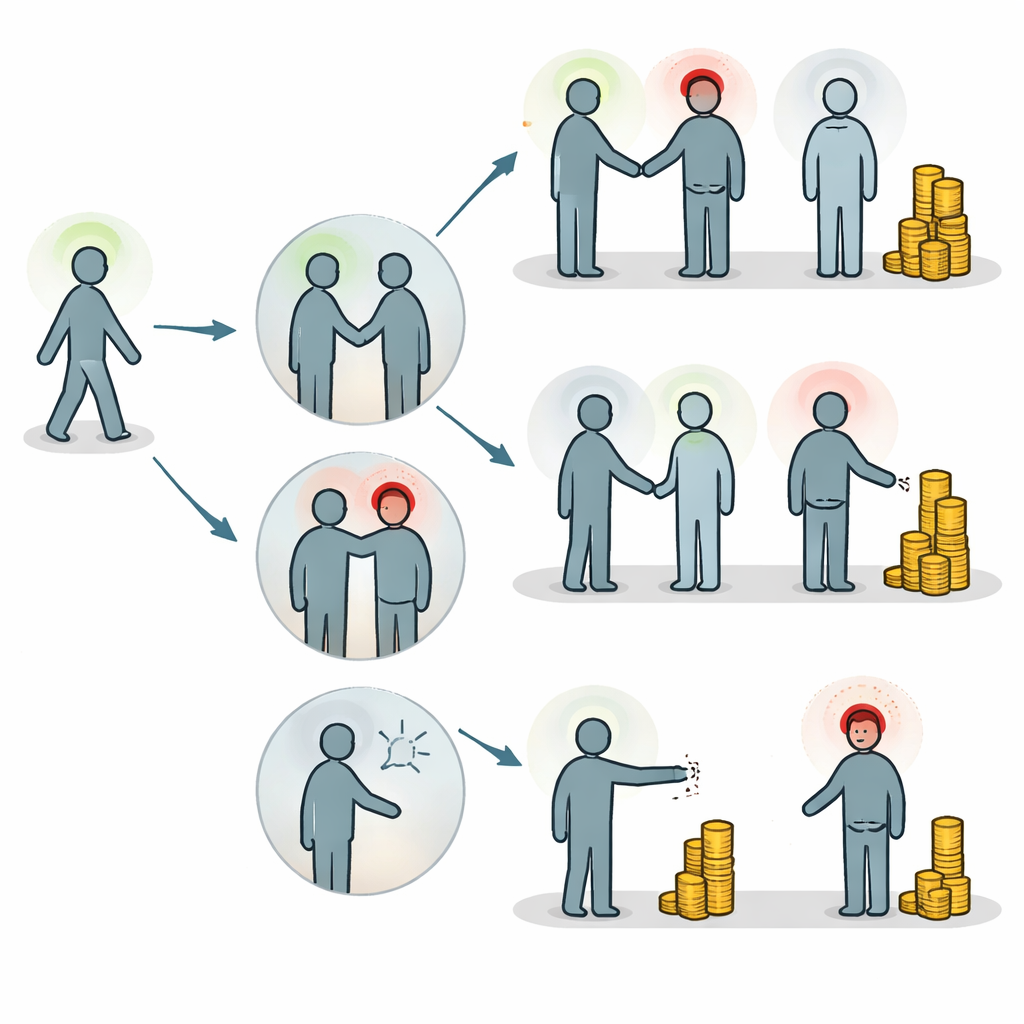
To tackle the challenge posed by fading reputations, the authors add a third possible action: costly punishment. A person can choose to penalize someone at a cost to themselves, shrinking the other’s payoff while slightly harming their own. They then compare norms that merely refuse help to known wrongdoers with those that actively punish them. Under reputation fading, punishment dramatically widens the conditions under which cooperation can persist. By making life noticeably worse for clearly bad actors, punishment increases the gap between the outcomes of being seen as good versus bad, offsetting the uncertainty created by unknown reputations. Crucially, the most effective norms treat people with unknown status as if they were good—mirroring the legal principle of “innocent until proven guilty”—and reserve punishment for those definitely known to have misbehaved.
When punishment helps, and when it backfires
The study places these results in a broader landscape of noisy information. Some kinds of errors, such as mislabeling reputations or actions not being carried out as intended, already make cooperation difficult; in those cases, adding punishment often reduces everyone’s welfare, even if it deters misbehavior on paper. By contrast, when the main problem is that free-riders are occasionally overlooked or reputations temporarily fade, punishment can be a powerful ally, stabilizing cooperation without heavy side effects because it is used sparingly. Overall, the work shows that not all information gaps are equal: understanding exactly how and where reputation breaks down is crucial for designing social norms and institutions that keep cooperation—and fair punishment—on the right side of the balance.
Citation: Kim, H., Murase, Y. Incomplete reputation information and punishment in indirect reciprocity. Sci Rep 16, 12773 (2026). https://doi.org/10.1038/s41598-026-42957-3
Keywords: indirect reciprocity, reputation systems, costly punishment, cooperation, social norms