Clear Sky Science · en
Experimental evaluation of an advanced rooted tree optimization based super twisting sliding mode power control for variable-speed wind turbine systems
Why smoother wind power matters
Wind farms are becoming a backbone of clean electricity, but the wind itself is anything but steady. Gusts and lulls cause the power coming out of a turbine to ripple and spike. These fluctuations can waste energy, stress equipment, and disturb the larger grid. This paper explores a new way to make electricity from modern variable-speed wind turbines flow more smoothly, with fewer distortions and higher efficiency, using a smarter real-time control system built on advanced algorithms.
How today’s wind turbines turn gusts into electricity
Most large wind farms now rely on variable-speed turbines whose generators can speed up or slow down as the wind changes. A popular design uses a so‑called doubly fed induction generator, where the machine’s stator is tied directly to the grid while its rotor is connected through power electronic converters. This arrangement allows the plant operator to adjust both the amount of active power delivered and the amount of reactive power that helps stabilize voltage on the grid. However, the same power electronics that grant this flexibility can inject unwanted ripples—known as harmonics—into the currents, especially when the control system has to work hard during rapid wind changes or grid disturbances. 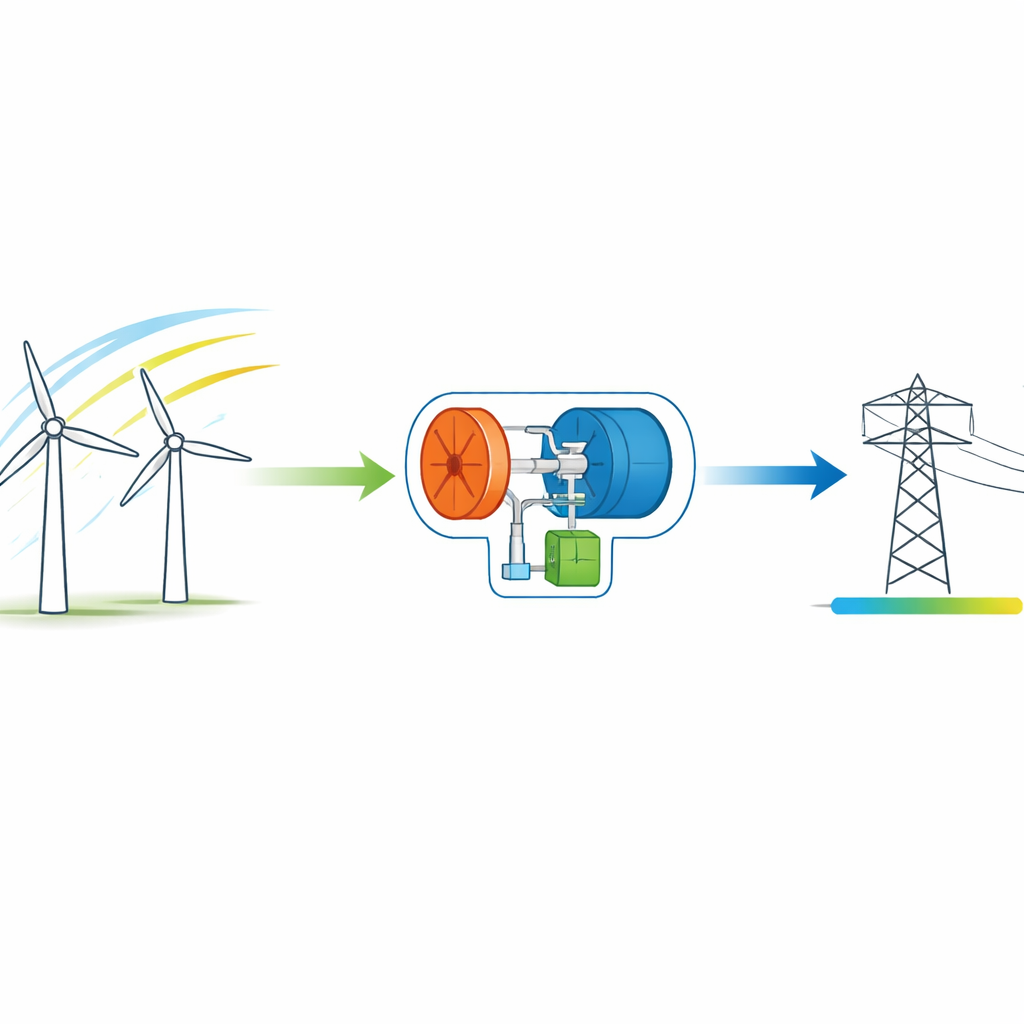
Limits of existing smart controllers
Researchers have spent years refining control strategies for these generators, from classic proportional–integral controllers to more sophisticated approaches using fuzzy logic, neural networks, or predictive control. One prominent family, called sliding mode control, is appreciated for its robustness: it can keep a system on track even when the underlying model is uncertain or the conditions are harsh. Yet traditional sliding mode control tends to create an undesirable side effect called “chattering,” a high-frequency switching behavior that shows up as extra noise and higher total harmonic distortion in the current. Many improved versions try to soften this effect, but often rely on hand-tuned settings that may not be optimal once conditions change.
A new blend of twist and tree-inspired tuning
The authors propose a hybrid controller that tackles both problems at once. At its core is a refined version of sliding mode control known as the super-twisting algorithm, which smooths the controller’s actions and greatly reduces chattering while keeping the robustness benefits. Wrapped around this is an optimization method called rooted tree optimization, inspired by how tree roots branch out, probe the soil, and redirect growth toward underground water. In the controller, each “root tip” represents a candidate set of tuning parameters. The algorithm continuously evaluates how well these parameters help the turbine track its power targets and minimize distortions, then nudges the population of candidates toward better-performing regions. In effect, the wind turbine’s controller is always self-adjusting, searching for the best response to current wind and grid conditions.
Putting the smart control to the test
To judge whether this approach works in practice, the team first built detailed computer models of a 1.5 kW wind turbine system using specialized simulation software. They subjected the virtual turbine to both steady and highly variable wind profiles and compared the new controller’s performance with several established methods. The results showed very tight tracking of active and reactive power references, a nearly unity power factor, and a substantial reduction in current distortion. Crucially, the total harmonic distortion of the currents dropped below 3%, clearly better than other sliding mode–based strategies reported in the literature, which often exceed 5%.

From computer model to laboratory hardware
Beyond simulations, the researchers implemented their controller on a real-time control board widely used in industry and research labs. They built a test bench with a doubly fed induction generator, power converters, sensors, and a wind emulator that reproduces realistic wind patterns using a separate motor drive. The control algorithm, first designed in simulation, was automatically translated into code and run on the hardware at a high sampling rate. Measurements of torque, current, voltage, and power showed that the experimental system behaved much like the simulated one: power commands were followed without overshoot, currents remained sinusoidal, and the controller stayed stable under both smooth and abrupt wind changes. Overall efficiency reached nearly 99%, with power tracking errors around one-tenth of a percent.
What this means for future wind farms
In simple terms, the study demonstrates that pairing a gentler, super-twisting version of sliding control with a tree-inspired optimization routine can make wind turbines behave more like ideal, steady power sources despite the turbulence of real wind. By cutting electrical noise, improving tracking accuracy, and maintaining stability without constant manual retuning, such smart controllers could help wind farms deliver cleaner, more grid-friendly electricity and reduce wear on expensive equipment. As wind power continues to expand, these kinds of intelligent control strategies may become a key ingredient in keeping renewable energy both reliable and efficient.
Citation: Alturki, M., Majout, B., Alqunun, K. et al. Experimental evaluation of an advanced rooted tree optimization based super twisting sliding mode power control for variable-speed wind turbine systems. Sci Rep 16, 13112 (2026). https://doi.org/10.1038/s41598-026-42956-4
Keywords: wind turbine control, doubly fed induction generator, sliding mode control, metaheuristic optimization, power quality