Clear Sky Science · en
Clinical relevance of circulating blood microaggregates and reactivation of Epstein Barr Virus in long-term Post-CoVID syndrome patients
Why lingering illness after COVID matters
Many people recover from the acute phase of COVID-19 only to find that weeks or months later they are still exhausted, short of breath, or mentally foggy. This collection of lasting problems, often called Long COVID or Post-COVID syndrome, has disrupted work, family life, and well-being for millions. The study summarized here looks under the microscope—literally—to ask whether tiny clumps in the blood and the reawakening of a common childhood virus might help explain why some people stay ill, and whether existing medicines could ease their symptoms.
Tiny clumps in the bloodstream
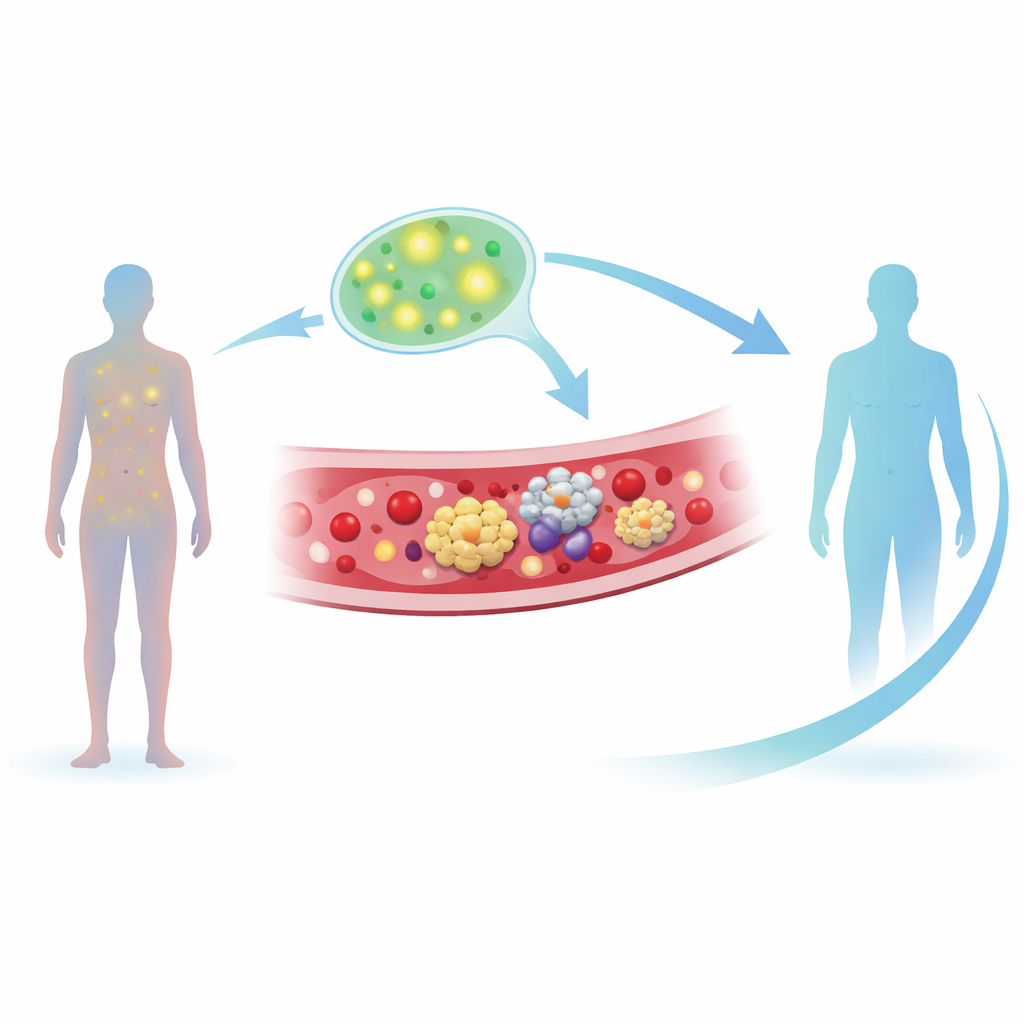
The researchers focused on patients who had experienced persistent Post-COVID symptoms for many months, especially fatigue, flu-like malaise, pain, and thinking problems. They examined blood taken from a vein and used advanced live microscopy and standard tissue-style processing to search for unusual structures. In about 40% of the 840 suspected Post-COVID patients they saw large “microaggregates” floating in the white cell layer of the blood. These globular clumps, roughly the width of a fine human hair, were made up of various white blood cells, small blood platelets, and a sticky sugar-rich material at the center. Because they are big enough to obstruct the smallest blood vessels, the team suspects they may interfere with oxygen delivery to tissues and contribute to exhaustion, brain fog, and cold, painful fingers and toes.
A sleeping virus wakes up
The study also examined the role of Epstein–Barr virus (EBV), a member of the herpesvirus family that silently lives in immune cells of about 95% of adults. EBV usually stays in a dormant state for life, held in check by the immune system. The authors reasoned that the stress of a SARS-CoV-2 infection might disturb this balance and allow EBV to partially reactivate, causing flu-like symptoms and swollen lymph nodes without the full picture of classic glandular fever. Instead of looking for antibodies, which can be hard to interpret in chronic stages, they measured whether patients’ white blood cells produced interferon gamma, a strong immune signal, when exposed to EBV building blocks in the lab. Roughly half of tested Post-COVID patients, and most of those with blood microaggregates, showed an unusually strong EBV-specific T cell response, pointing to ongoing viral activity.
Testing existing medicines in the real world
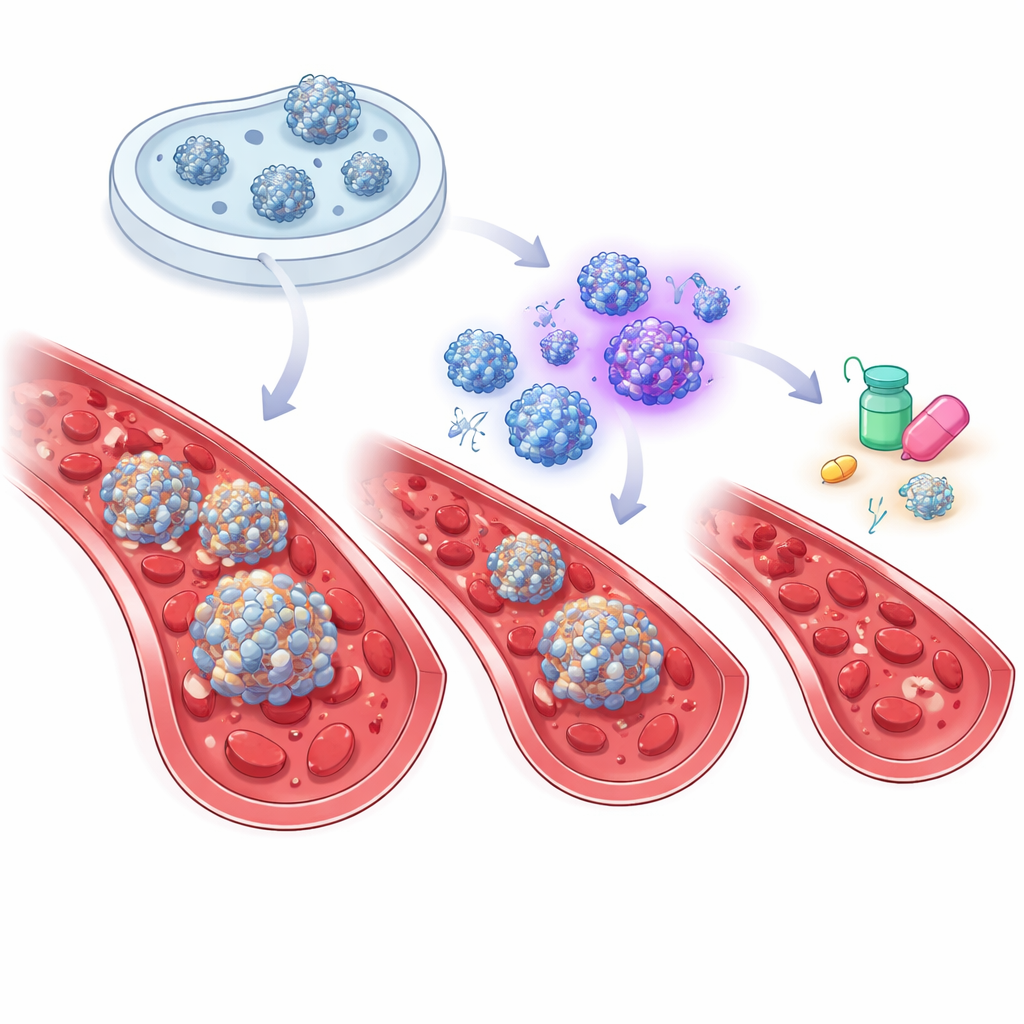
Armed with these laboratory clues, the clinicians tried a practical, though still exploratory, approach to treatment. They retrospectively analyzed small groups of patients who received drug combinations chosen to target both platelet clumping and EBV reactivation. One set of patients took medicines that make platelets less sticky, together with low-dose blood thinners. Some of them also received valaciclovir, a long-used antiviral drug active against EBV and related viruses. Over three to six months, both treatment groups reported fewer symptoms, but the combination of anti-clotting therapy plus antiviral medicine was associated with larger gains in a standard functional scale (the Bell Score) and in patients’ own ratings of how close they felt to their pre-COVID health. In a larger follow-up comparison, a regimen including common aspirin, heparin, and valaciclovir appeared to improve daily functioning and social reintegration more than an alternative platelet drug plus heparin and valaciclovir.
What this might mean for Long COVID biology
Taken together, the findings support a picture in which Post-COVID symptoms, at least in a sizable subgroup of patients, may arise from two intertwined processes: disturbed blood flow in the tiniest vessels due to microaggregates, and renewed immune battle against EBV or similar latent viruses. The microaggregates themselves seem to be complex little “capsules” made of immune cells, platelets, and sticky material rather than typical mature clots made of fibrin. They may reflect the body’s attempt to wall off something harmful in the circulation, but at the cost of blocking narrow channels that feed nerves and organs. Meanwhile, the heightened EBV-directed immune response suggests a smoldering viral presence that could keep the immune system on high alert and drive ongoing inflammation.
Where this leaves patients and doctors
This work does not yet offer a proven cure, and it is based on small, retrospective patient groups, so larger, carefully controlled trials are urgently needed. However, it provides a concrete framework: simple blood-based tests for microaggregates and EBV-specific immune activity could help identify a subset of Post-COVID patients whose illness is driven by clotting-like changes and viral reactivation. For these individuals, existing drugs that reduce platelet stickiness and suppress herpesviruses might meaningfully ease symptoms and help people return to work, school, and family life. More broadly, the study encourages clinicians to look beyond symptom relief alone and to investigate underlying biological mechanisms that can be targeted with rational, testable treatments.
Citation: Wick, N., Hermann, M., Lisch, C. et al. Clinical relevance of circulating blood microaggregates and reactivation of Epstein Barr Virus in long-term Post-CoVID syndrome patients. Sci Rep 16, 12559 (2026). https://doi.org/10.1038/s41598-026-42952-8
Keywords: Long COVID, blood microclots, Epstein–Barr virus, platelet inhibition, valaciclovir