Clear Sky Science · en
Hybrid Vigenere and elliptic curve cryptography technique over the finite field $$\mathbb{F}_{256}$$
Keeping Pictures Safe in a Connected World
Every day, billions of photos travel across the internet—from hospital scanners to home security cameras and social media feeds. While this flood of images brings convenience and insight, it also raises a simple but serious question: how do we keep sensitive pictures—such as medical scans or surveillance footage—safe from prying eyes? This paper presents a new way to scramble digital images so thoroughly that even determined attackers struggle to uncover their contents, while still allowing authorized users to restore them perfectly.
Why Ordinary Locks on Images Are No Longer Enough
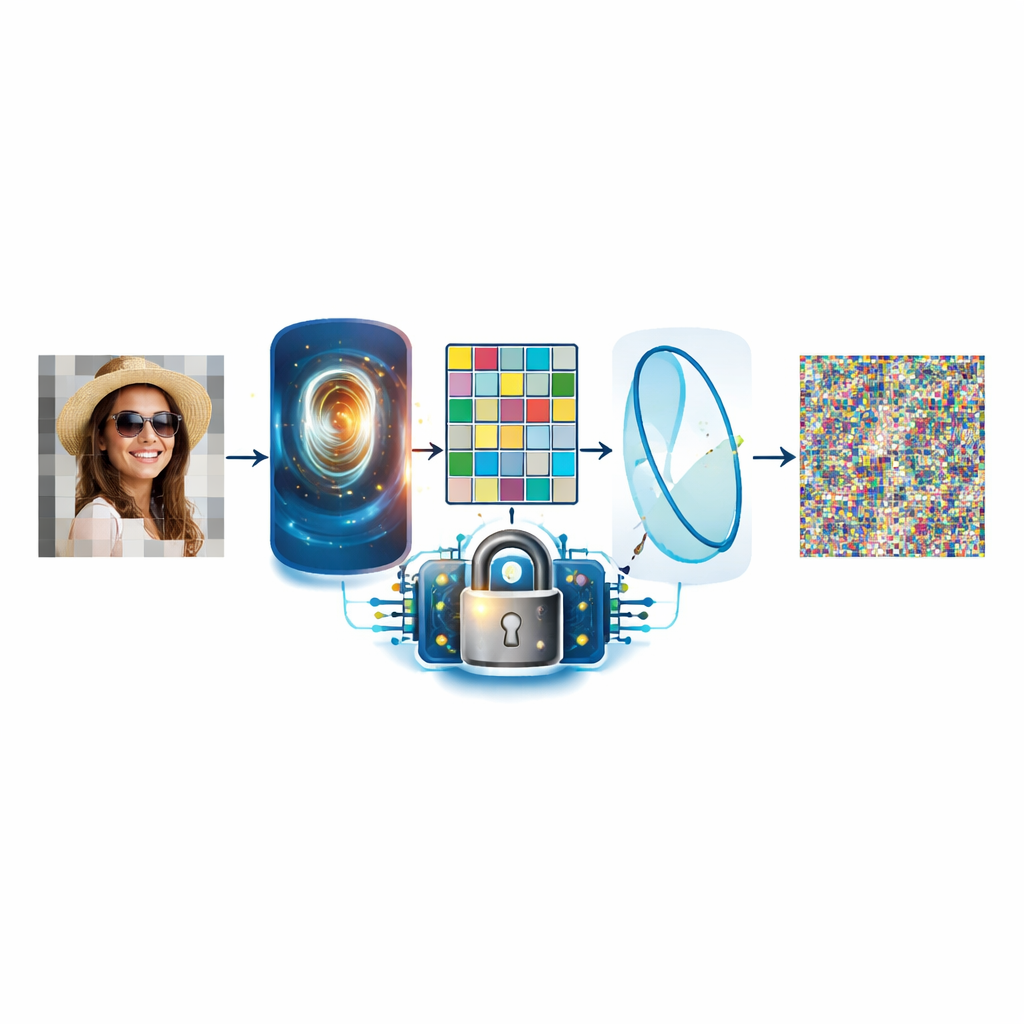
Traditional methods for hiding data, and especially images, are beginning to show their age. Classic codes such as the Vigenère cipher or schemes that treat each pixel as a simple number are now vulnerable to modern analytical attacks and the vast computing power available today. Images pose extra challenges: neighboring pixels are often very similar, and large high‑resolution pictures contain a lot of repeating structure. As a result, attackers can sometimes infer shapes and patterns from encrypted images, even if they cannot see the exact content. Many recent image‑protection methods try to fix this using chaotic maps, clever substitution tables, or elliptic‑curve cryptography, but they usually use these tools separately. That separation leaves gaps: slow processing, limited key choices, and maddeningly predictable structures that can still be exploited.
Blending Chaos, Algebra, and Curves into One Shield
The authors propose a hybrid system that tightly weaves together three ideas: a chaotic generator called the A‑J map, a carefully built algebraic playground with exactly 256 elements (matching the 256 brightness values of an 8‑bit pixel), and elliptic curves, which are the backbone of many modern secure communication systems. The chaotic map produces sequences that react dramatically to even tiny changes in initial settings, ensuring that the behavior of the system shifts wildly with any tweak to the secret key or the image itself. These chaotic outputs are then used not just as random seeds, but as steering knobs that decide how the finite‑field arithmetic is set up and how the elliptic curve is chosen and used. In other words, the chaos does not sit outside the system—it shapes its internal wiring.
How an Image Is Shuffled Beyond Recognition
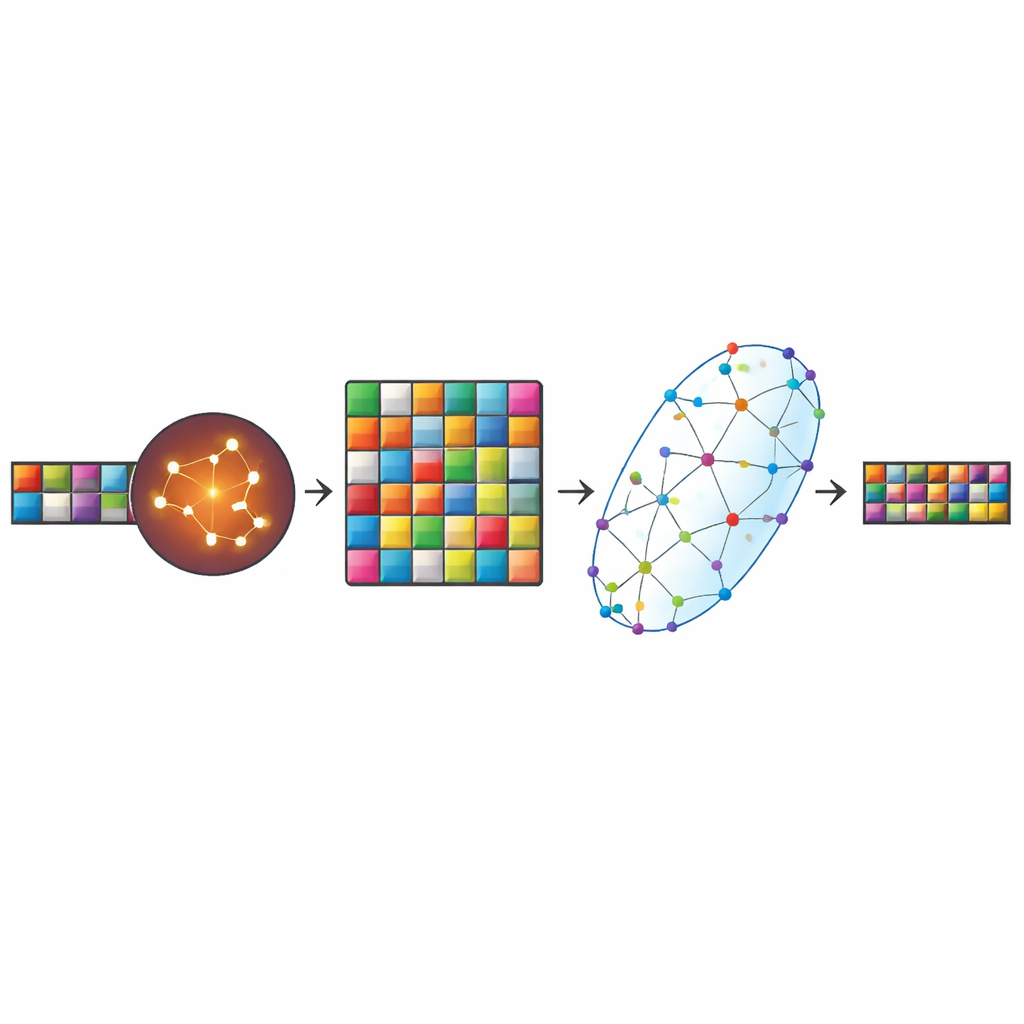
To encrypt a picture, the method first breaks the color channels into a long one‑dimensional stream of pixels. Guided by chaotic decision tables, the system reorders these pixels globally, so that neighboring pixels in the original image end up far apart. At the same time, the chaotic map selects an algebraic rule, called an irreducible polynomial, to construct the special 256‑element field, and it picks a related primitive element to generate two large substitution tables. These tables work like flexible, evolving look‑up grids that turn each pixel value into another, with the transformation changing from row to row. Next, the system defines an elliptic curve over the same 256‑element field, computes many points on that curve, and permutes them. A pseudo‑randomly chosen point on the curve, which depends on both the secret settings and the image itself, drives a Vigenère‑like step that adds yet another layer of mixing between pixels and curve points.
Testing the Strength of the Digital Lock
The authors put their design through a battery of standard cryptographic tests using well‑known images such as “Baboon” and “Peppers.” They evaluate how similar neighboring pixels remain after encryption (they should not), how evenly pixel values are spread (they should resemble pure noise), and how strongly the encrypted image changes when a single pixel or a tiny key value is altered. The results are close to the theoretical ideals: the encrypted images have almost maximum possible randomness, adjacent pixels have essentially zero correlation, and flipping a single pixel or slightly changing the key causes roughly half the bits in the encrypted image to change. The scheme also passes a demanding statistical test suite from the U.S. National Institute of Standards and Technology, and it runs fast enough that encryption time grows in direct proportion to image size, making it practical for high‑resolution pictures.
What This Means for Everyday Privacy
In simple terms, this work shows how to lock digital images inside a layered safe built from chaos and modern mathematics. Because the method adapts its behavior to each image and to tiny variations in the secret key, it becomes extremely difficult for an attacker to predict or reverse the scrambling without the correct key. At the same time, its linear processing cost and compact design make it suitable for real‑world uses, from protecting medical scans in the cloud to securing camera feeds in the Internet of Things. The authors suggest future extensions that combine this core engine with fine‑grained access control and integrity checks, but even in its current form, the scheme offers a powerful balance of security, speed, and flexibility for safeguarding visual data.
Citation: El Bourakkadi, H., Tabti, H., Chemlal, A. et al. Hybrid Vigenere and elliptic curve cryptography technique over the finite field \(\mathbb{F}_{256}\). Sci Rep 16, 12576 (2026). https://doi.org/10.1038/s41598-026-42951-9
Keywords: image encryption, elliptic curve cryptography, chaotic systems, finite fields, data security