Clear Sky Science · en
Adaptive optimization of the trade-off parameter in acoustic-contrast-control-pressure-matching for personal audio zones using genetic algorithms
Listening Without Headphones
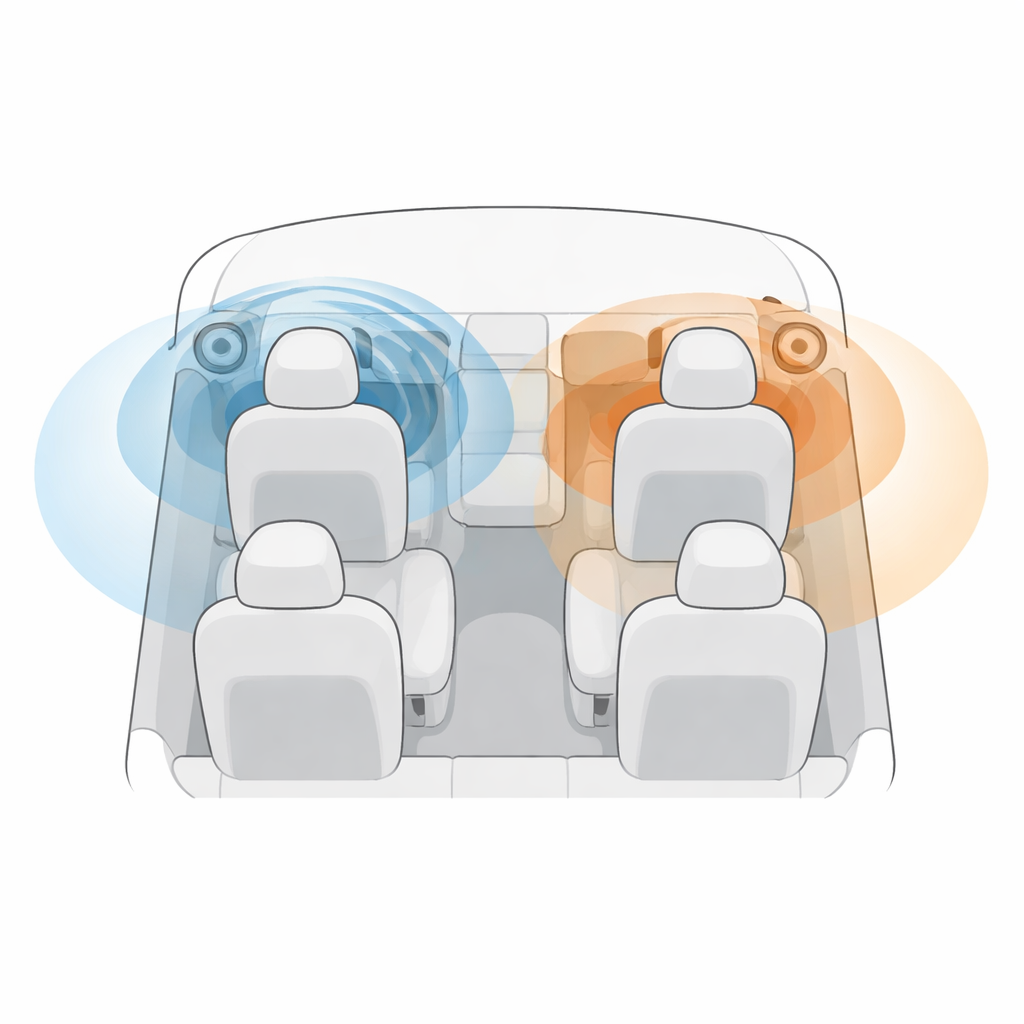
Imagine sitting in a car where each passenger hears their own music or phone call clearly, yet the person next to them is barely aware of it—all without anyone wearing headphones. This paper explores how to make that kind of “personal audio bubble” more practical and reliable by improving the way a key control knob in the underlying sound algorithm is set, using ideas borrowed from biological evolution.
How Personal Sound Bubbles Work
Personal audio zones rely on carefully arranged loudspeakers that shape sound so it is loud and clear in a chosen “bright zone” (around a listener’s head) and as quiet as possible in a nearby “dark zone.” Existing methods either focus on maximizing the difference in loudness between these two regions or on faithfully reproducing the desired sound in the bright zone. A widely used compromise method, called an acoustic contrast and quality “trade-off” algorithm, blends both goals using a single parameter that tells the system how much to favor separation versus sound quality.
The Hidden Problem With a Single Knob
In practice, engineers have often picked a mid-range value for this trade-off parameter, assuming that it gives a reasonable balance between keeping sound zones separate and maintaining good audio quality. The authors show that this assumption is shaky. When they simulated simple loudspeaker setups, small changes in the parameter sometimes caused huge jumps in performance, while larger changes did very little. Worse, certain values made the underlying calculations unstable, especially when more speakers were added. This instability means that the system may fail or behave unpredictably, even if the predicted separation between zones looks good on paper.
Letting the Parameter Evolve
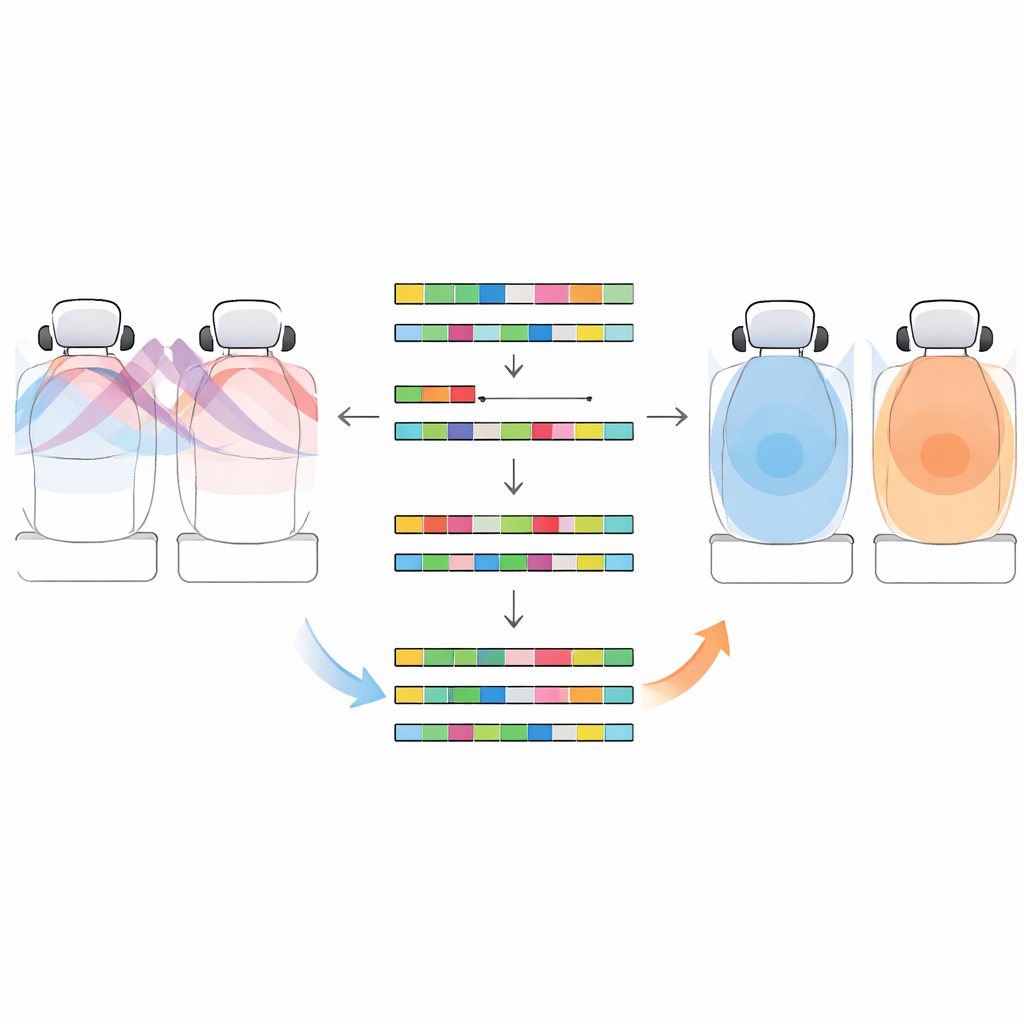
To overcome these issues, the researchers turned the problem into an evolutionary search. They treated the trade-off value as a “chromosome” and used a genetic algorithm—a computer method inspired by natural selection—to evolve better settings. Each candidate value was scored using a fitness measure that rewards three things at once: strong separation between zones, low distortion of the desired sound, and stable numerical behavior of the calculations. The algorithm starts with many random settings, repeatedly selects the better ones, and combines and mutates them until the fitness score stops improving.
Testing in Real Cars
The team then tested their optimized settings in two real car scenarios using custom headrests with built‑in speakers and dummy heads with microphones in the ear canals. In one case, the driver’s seat was the bright zone and a rear passenger seat was the dark zone; in the other, the front passenger seat was the bright zone and the driver’s seat was the dark zone. Across the audible range they studied, the “best” trade‑off value that the genetic algorithm found changed with frequency and differed strongly between the two seating layouts. In the first scenario, the evolved parameter produced both clearer separation and cleaner sound than several conventional fixed choices. In the second, the improvement was modest, but the method still helped identify safe settings that avoided instability.
What This Means for Everyday Listening
The study concludes that there is no single magic setting that works for all cars, layouts, and frequencies. Instead, the crucial trade‑off in personal audio systems should adapt to both the acoustic environment and the listening frequency, and evolutionary search is a practical way to find these values. Overall, the optimized approach generally makes the system more robust and can significantly sharpen personal sound bubbles, especially in favorable configurations. While further refinements are needed—particularly to widen the effective listening area—the work brings the idea of headphone‑free, individualized sound in cars and other spaces closer to everyday reality.
Citation: Zhu, Y., Zhang, Z., Yin, Y. et al. Adaptive optimization of the trade-off parameter in acoustic-contrast-control-pressure-matching for personal audio zones using genetic algorithms. Sci Rep 16, 13347 (2026). https://doi.org/10.1038/s41598-026-42944-8
Keywords: personal audio zones, in-car sound, genetic algorithms, sound field control, acoustic optimization