Clear Sky Science · en
Ultra-compact canvas-type acoustic metasurfaces for uniform sound field in indoor environments
Why your room does not sound the same everywhere
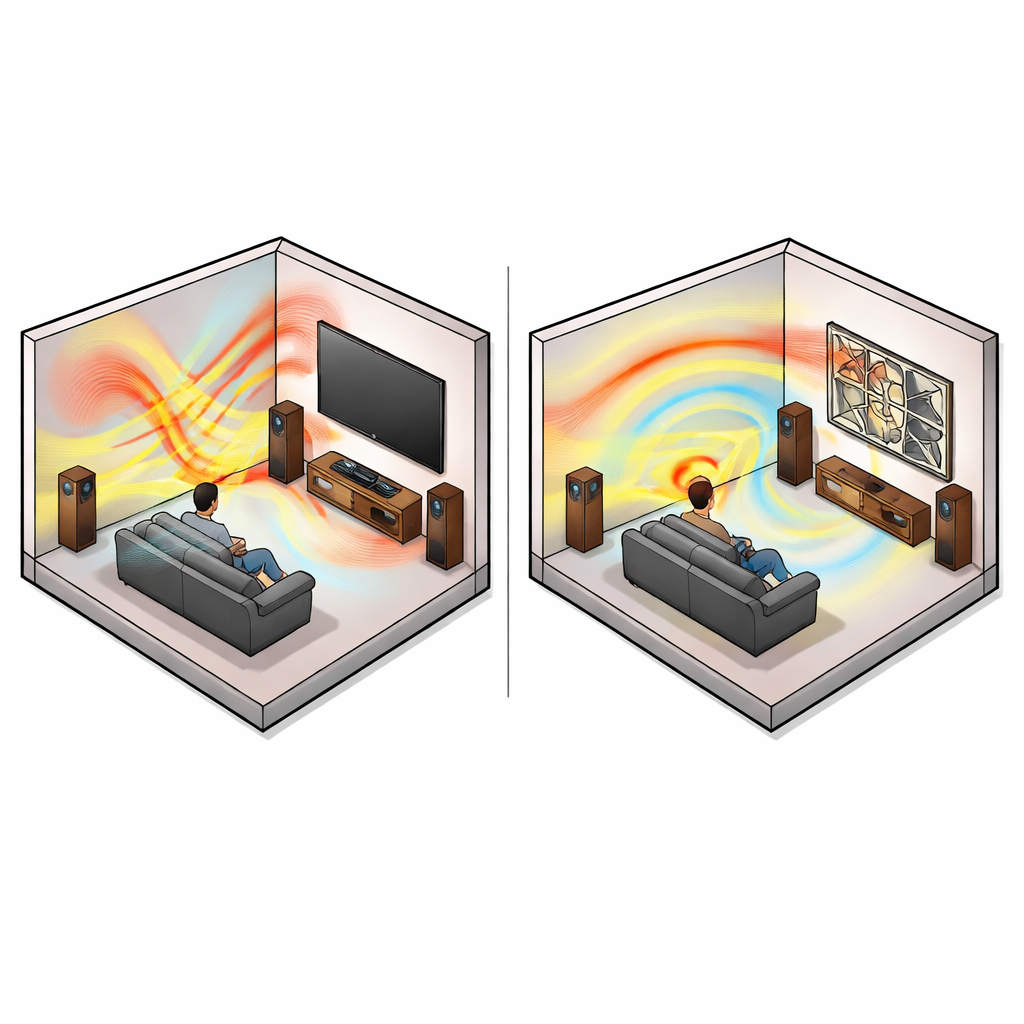
Anyone who has set up a home theater or recording corner knows the frustration: in one seat the bass booms, while a step to the side makes it almost disappear. These hot and cold spots in sound are caused by low-frequency echoes piling up in some parts of the room and cancelling out in others. This study introduces a wall-hung panel that looks like ordinary artwork but is engineered inside to smooth out these uneven sound patterns without taking up much space or deadening the room.
A hidden problem in everyday rooms
Small rooms such as living rooms, home theaters, and project studios are especially prone to uneven sound. At low tones around 100 to 150 hertz—the range of male voices and bass instruments—the room behaves like a resonant box. Standing waves form between opposite walls, creating narrow zones where the sound is either much louder or much quieter than average. Traditional fixes, like thick foam or fibrous panels, can tame these resonances but need bulky layers to affect such long wavelengths, and they often soak up higher pitches too strongly, leaving the room unnaturally dry and lifeless. Diffuser panels that scatter sound instead of absorbing it are another option, but at these low tones they also become large and impractical.
A picture frame that shapes sound
To address this, the researchers designed a thin “canvas-type” panel that doubles as an acoustic device. On the outside it is a flat surface suitable for printed artwork, with only tiny openings that cover less than five percent of the area, so the picture remains visually intact. Behind this front face, however, sit a set of small air cavities known as Helmholtz resonators, carefully sized so that the panel presents a particular resistance and springiness to passing sound waves. By tuning this so-called complex impedance, the panel can both dissipate some sound energy and shift the timing of reflections. When mounted on a side wall of a small, rectangular, home-theater-like room, the panel is aimed at making the sound level inside a chosen listening region much more even.
Designing the panel from the room backwards
The team built detailed computer models of the room and the panel that track how low-frequency waves bend around corners, scatter, and lose energy in the narrow necks of the resonators. In a first step, they treated the panel as a simple patch on the wall whose overall acoustic behavior could be adjusted continuously. Using an optimization procedure, they searched for the combination of surface resistance and reactance that minimized the variation in sound level within a three-dimensional block representing a typical sofa area. Once this target behavior was identified at the worst problem frequency, 115 hertz, they then adjusted the shapes and sizes of the internal cavities so that a real panel made from rigid material would behave as closely as possible to this ideal. A comparison between a full geometric model and the simplified surface model showed nearly identical results, confirming that this two-step approach is accurate yet efficient.
Smoother sound with far less material
When the optimized panel was added to the simulated room, the spread in sound level across the listening area dropped by about 77 percent at 115 hertz, eliminating pronounced dead zones and hot spots. Remarkably, it outperformed a scenario in which all four side walls were covered with conventional foam, even though the artwork panel used only about one eighty-fifth of the material volume. Further analysis showed why: the panel’s resistance gently absorbs energy, while its reactance changes the phase of the reflections, breaking up strong standing waves instead of merely soaking them up. The researchers then extended the idea to three different panels, each aimed at a different low tone (100, 115, and 127 hertz) and placed at optimized positions. Together, these panels improved sound uniformity at all three tones and in the neighboring frequencies, and they also flattened the overall bass response without significantly lowering the average loudness.

What this means for better sounding rooms
To a non-specialist, the main message is that the study shows how a thin, picture-like panel can quietly correct some of the most stubborn acoustic flaws of small rooms. Instead of covering large wall areas with thick, dull-looking treatment, a few strategically placed art panels can reshape low-frequency sound so that listeners in different seats hear a more consistent, balanced mix. Because these panels leave higher pitches largely untouched, they preserve the liveliness and clarity of music and speech. The work points toward future home theaters, studios, and even offices where visually pleasing wall art doubles as a precise tool for controlling how sound fills the space.
Citation: Choi, E., Kim, J. & Jeon, W. Ultra-compact canvas-type acoustic metasurfaces for uniform sound field in indoor environments. Sci Rep 16, 12884 (2026). https://doi.org/10.1038/s41598-026-42942-w
Keywords: room acoustics, soundproofing, home theater, acoustic panels, metasurfaces