Clear Sky Science · en
Hybrid neural network for personnel recognition and tracking in remote bidding evaluation monitoring
Why keeping watch on bidding rooms matters
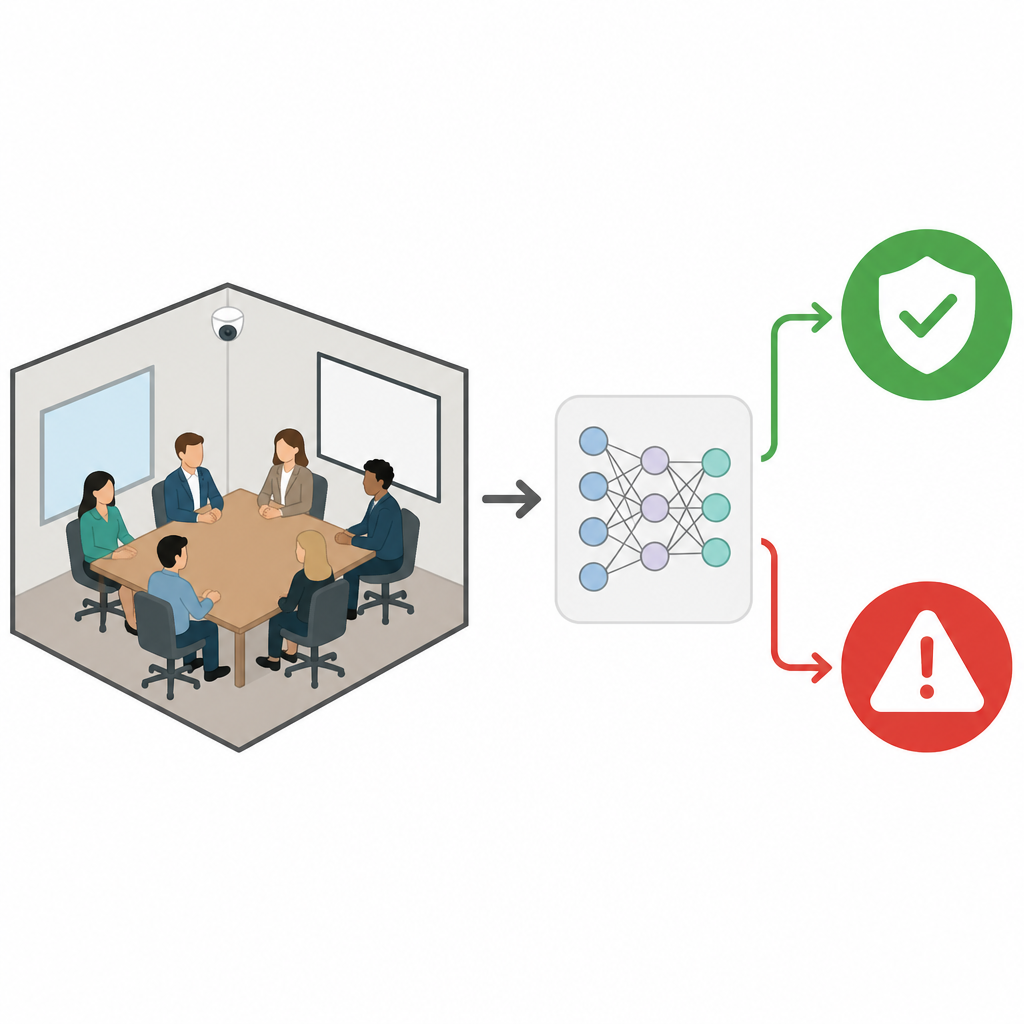
When governments or companies choose who will build a road, a bridge, or a power plant, they often rely on experts meeting in a special bidding room to judge competing offers. If an uninvited person slips in, or if an expert quietly leaves, the fairness of the whole decision can be threatened. This study shows how a smart camera system powered by artificial intelligence can automatically watch such rooms, follow who is present, and raise a warning when something looks wrong, all without needing people to stare at screens all day.
How the new smart room watcher works
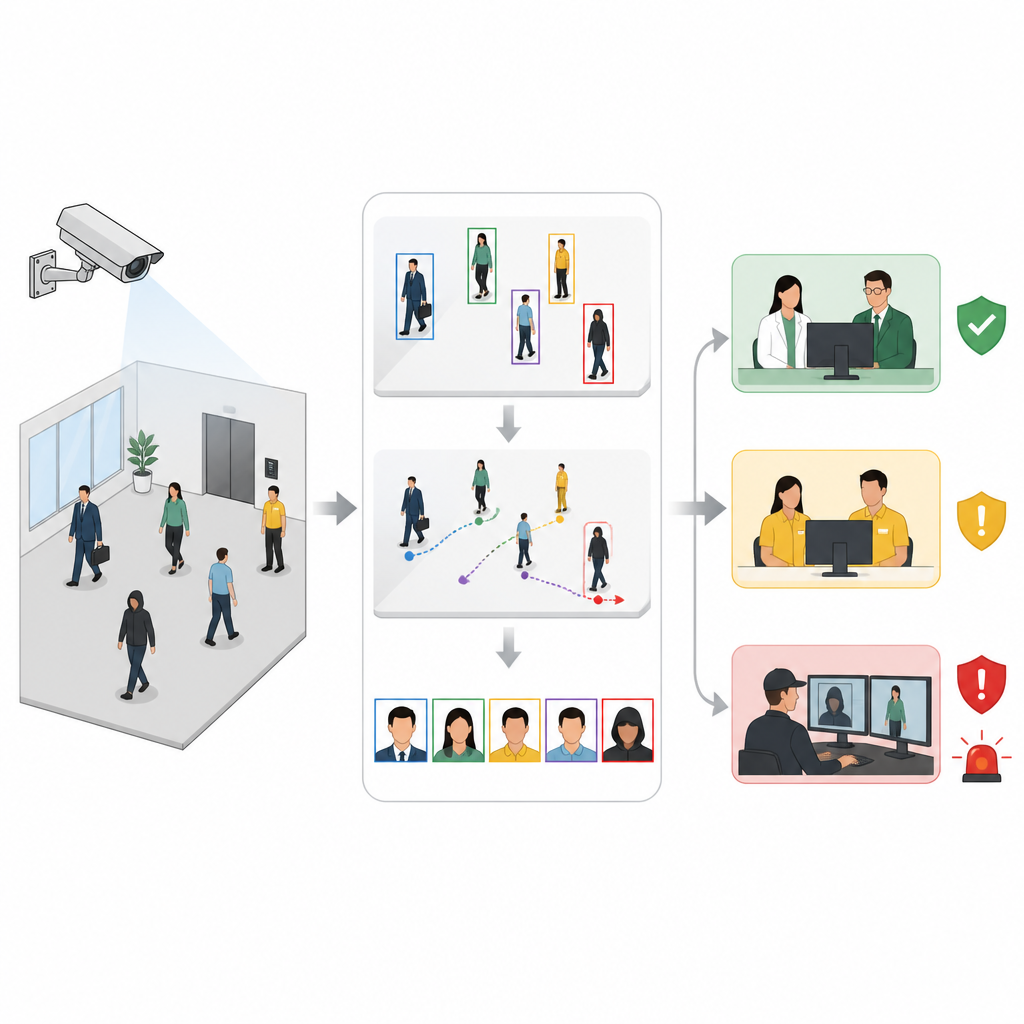
The researchers built a full monitoring system that sits on top of ordinary surveillance cameras in a bidding evaluation office. The system has four main jobs: spotting people in the video, following their movements over time, recognizing their faces, and judging what these patterns mean for security. Based on this combined view, a warning unit decides whether to stay silent or to flag events like an expert leaving for too long or a stranger entering the room. Everyday changes such as brief blocking of someone by another person, or normal staff coming and going, are recorded but do not trigger alarms.
Seeing and counting everyone in the room
To keep track of who is inside, the system first learns to detect every person in each video frame and to count how many people are present. It then links detections from one frame to the next so that each person receives a stable identity tag inside the system, even as they move around. This tracking step helps distinguish a short disappearance, such as when someone is hidden behind a colleague, from a real departure through the door. By following each person’s path, the software can tell when an expert has been gone longer than a preset time limit and treat this as a risk that deserves attention.
Recognizing faces that are tiny and far away
Bidding rooms are usually watched by cameras mounted high on the wall or ceiling, which means that faces appear small and often at awkward angles. Many existing face recognition tools work poorly in these conditions. The authors therefore combined a fast people spotting method with a refined face finder that is better at zooming in on tiny faces in crowded scenes. Once a face is located, a lightweight face matching method checks it against a stored gallery of known experts and staff. If a new face does not match any approved person within a set tolerance, the system marks that individual as a possible intruder and passes this judgment to the warning unit.
How well the system performs in real offices
The team tested their approach on real video from a bidding evaluation room in an energy company. They compared their full system with simpler approaches that only count people or track them without knowing who they are. The hybrid system proved better at telling apart four practical situations: an expert truly leaving, an expert briefly blocked from view, normal staff entering, and a stranger walking in. It achieved high accuracy in recognizing small faces, worked fast enough for real time use, and sharply reduced missed intrusions and false alarms compared with the basic methods.
What this means for fairer decisions
In plain terms, this work shows that ordinary cameras, paired with well designed artificial intelligence, can help keep sensitive decision rooms honest. The system can quietly watch who is present, spot when an expert disappears or when an unknown person shows up, and send timely alerts so human managers can respond. While it still struggles when faces are heavily covered or turned away, it already offers a practical tool to support cleaner bidding procedures and could be adapted to other workplaces that need reliable, low cost monitoring of who comes and goes.
Citation: Zhou, Z., Wang, Z., Meng, Y. et al. Hybrid neural network for personnel recognition and tracking in remote bidding evaluation monitoring. Sci Rep 16, 15769 (2026). https://doi.org/10.1038/s41598-026-42936-8
Keywords: bidding evaluation monitoring, person tracking, face recognition, video surveillance, neural network