Clear Sky Science · en
Structural dualities between the Schrödinger equation and its ultra-slow-light counterpart in one spatial and one temporal dimension
A strange world where motion nearly stops
What would physics look like in a universe where light crawls instead of races, and nothing can really move through space? This paper explores exactly that extreme limit and shows that the familiar quantum equation describing electrons and atoms has a surprising twin that lives in this ultra-slow world. By uncovering precise mathematical links between the two descriptions, the authors build a kind of translation manual that lets results from ordinary quantum mechanics be repurposed for this exotic regime—and for real systems, such as ultra-slow light in materials and emerging theories of gravity and dark energy. 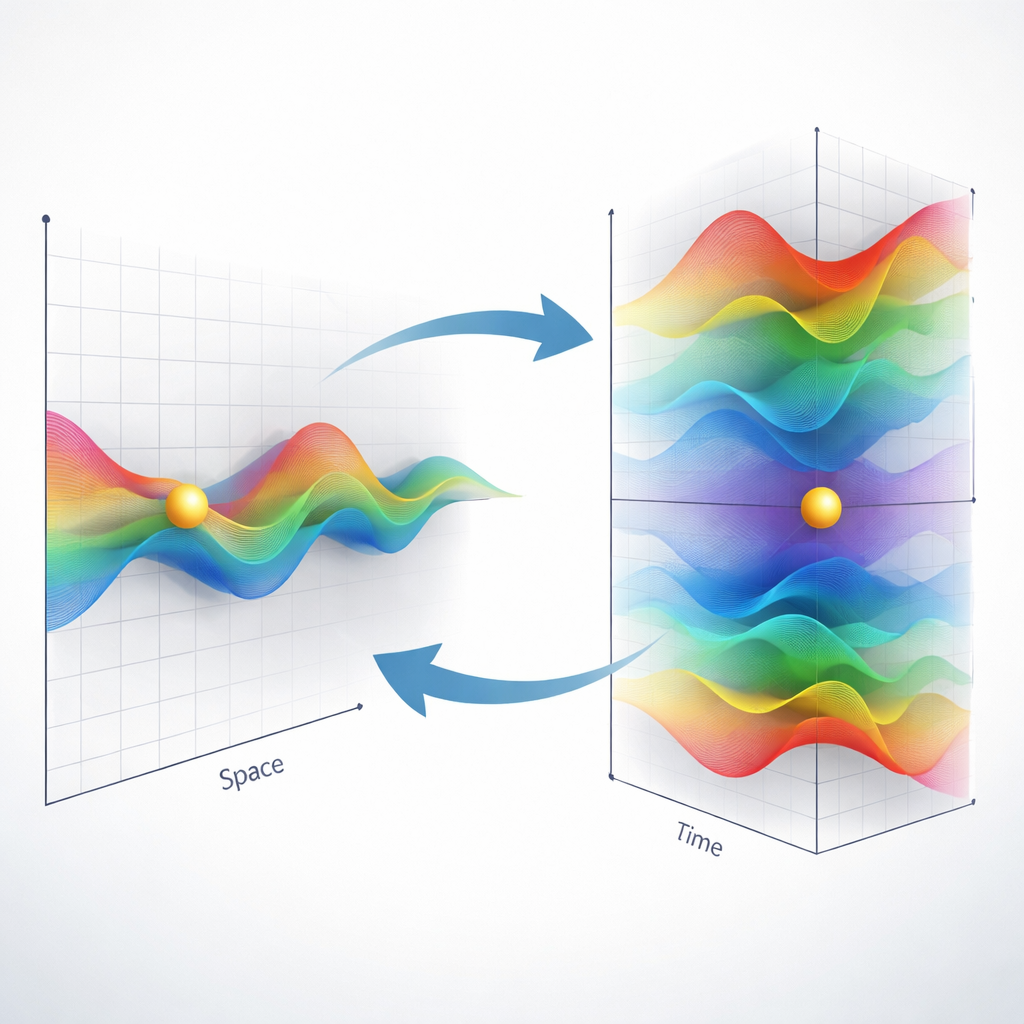
Two mirror equations for quantum waves
In everyday quantum theory, the Schrödinger equation tells us how a wave spreads in space as time flows. It is second order in space and first order in time, meaning space is treated more stiffly than time. In the ultra-slow-light, or “Carrollian,” limit the roles are flipped. Causal influences collapse onto the time axis, points in space become effectively disconnected, and motion through space ceases to make sense. The corresponding wave equation—the Carroll–Schrödinger equation—is first order in space and second order in time, a structural mirror image of the standard case. In one spatial and one temporal dimension, the free versions of the two equations are already known to be related simply by swapping space and time coordinates, but this work goes far beyond that basic symmetry.
When different quantum worlds share the same waves
The authors ask when a single wavefunction can solve both equations at once. To answer this, they rewrite each equation in terms of abstract operators and demand that the two operators “get along” in the sense that evolving with one never takes you out of the solution space of the other. This compatibility requirement tightly restricts the external forces (potentials) that can appear: in the shared-solution sector, the spatial dependence must drop out and the time-dependent pieces in the two descriptions must be equal and opposite, up to a constant shift. Under these conditions, the same mathematical wave can be viewed either as an ordinary Schrödinger solution or as a Carrollian one, even though the physical stories—motion through space versus evolution in time at fixed position—are very different.
Mapping space-dependent forces to time-dependent ones
Next, the paper attacks the more practical question of how to convert a familiar, space-dependent quantum problem into a Carrollian, time-dependent one. The key idea is a carefully chosen re-labeling of events: instead of viewing position x and time t directly, one introduces a new coordinate x = δ(t) whose shape is dictated by the Carrollian potential. With this map in place, a space-independent Carrollian problem becomes equivalent to a standard, time-independent Schrödinger problem with a new effective potential. The relation between the two potentials is encoded in a mathematical object called the Schwarzian derivative, which measures how strongly the coordinate map bends. The authors show how to invert this relation and work out explicit examples, including the harmonic oscillator, a Coulomb-like attraction, and the free particle. 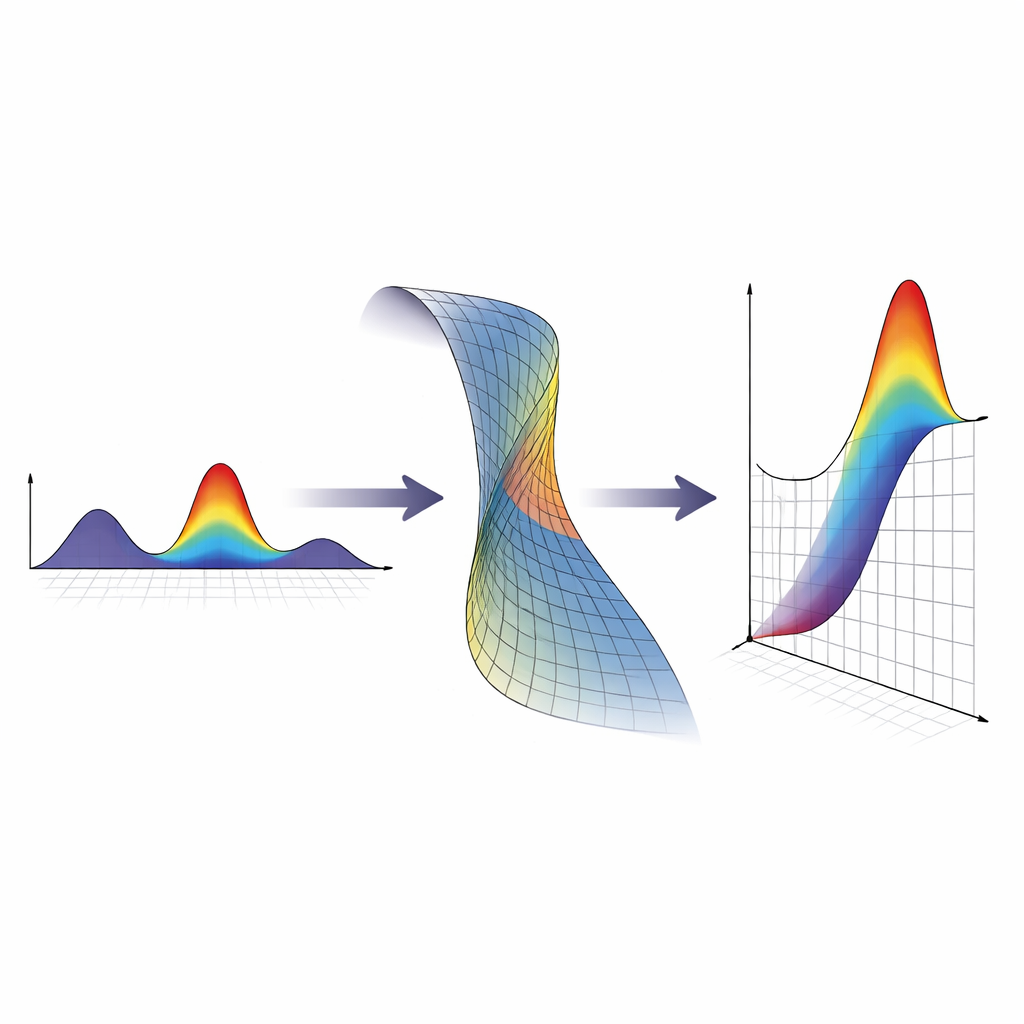
Probability, currents, and the flow of “time as space”
Because the two equations treat space and time so differently, their notions of probability flow also differ. In the Schrödinger case, probability spreads across space with a time-dependent density. In the Carrollian picture, after a simple gauge change and a swap of space and time axes, the continuity equation—the rule that total probability is conserved—takes exactly the Schrödinger form. This reveals a deep structural duality: what counts as a density in one description becomes a current in the other. Building on this, the authors reformulate Carrollian dynamics on a Hilbert space of time rather than space, prove that evolution along the spatial coordinate is unitary (so probability is preserved), and analyze concrete solutions such as Gaussian wave packets and waves confined to a finite time window, which exhibit a kind of “time quantization” analogous to energy levels in a particle-in-a-box.
Connecting to relativity and classical motion
The study also links this ultra-slow regime back to relativity and to classical mechanics. By taking an extreme Lorentz boost (formally letting the boost speed go to infinity), the authors derive the Carrollian energy–momentum relation directly from the ordinary relativistic one. Using a standard approximation method, they then extract a classical Hamilton–Jacobi equation whose particle trajectories look straight and uniform in the free case, but behave very differently once forces are introduced. In Carrollian dynamics, space plays the role of evolution parameter, so particles can even move forward or backward in time as they traverse space, and matching these paths to Newtonian ones requires a highly nontrivial relation between the underlying spatial potentials.
Why this duality matters
Altogether, the paper develops a detailed operator-level “dictionary” that translates between ordinary Schrödinger physics and its ultra-slow-light counterpart in one space and one time dimension. This framework clarifies how potentials, conserved quantities, classical limits, and even solution methods correspond across the two pictures. Beyond its mathematical elegance, the work suggests new ways to model systems where time and space play asymmetric roles—from temporal solitons in optical fibers to speculative theories of dark energy and Carrollian fluids—and lays groundwork for extending these dualities to higher dimensions and more complex quantum fields.
Citation: Rojas, J., Casanova, E. & Arias, M. Structural dualities between the Schrödinger equation and its ultra-slow-light counterpart in one spatial and one temporal dimension. Sci Rep 16, 13857 (2026). https://doi.org/10.1038/s41598-026-42922-0
Keywords: Carrollian limit, Schrödinger equation, ultra-slow light, space–time duality, quantum dynamics