Clear Sky Science · en
Dynamic response characteristics, load-bearing efficiency in multimaterial tunnel assemblies subjected to recurrent intense fluid loading
Why stronger tunnels matter
Many modern power systems rely on underground tunnels that move huge volumes of water to and from turbines. These tunnels face punishing water pressures that can crack their concrete linings, risking leaks, costly shutdowns, and even structural failure. This study explores a new way to build tunnel linings so that, even after cracking, the tunnel keeps carrying load safely and resists leakage under repeated pressurization.
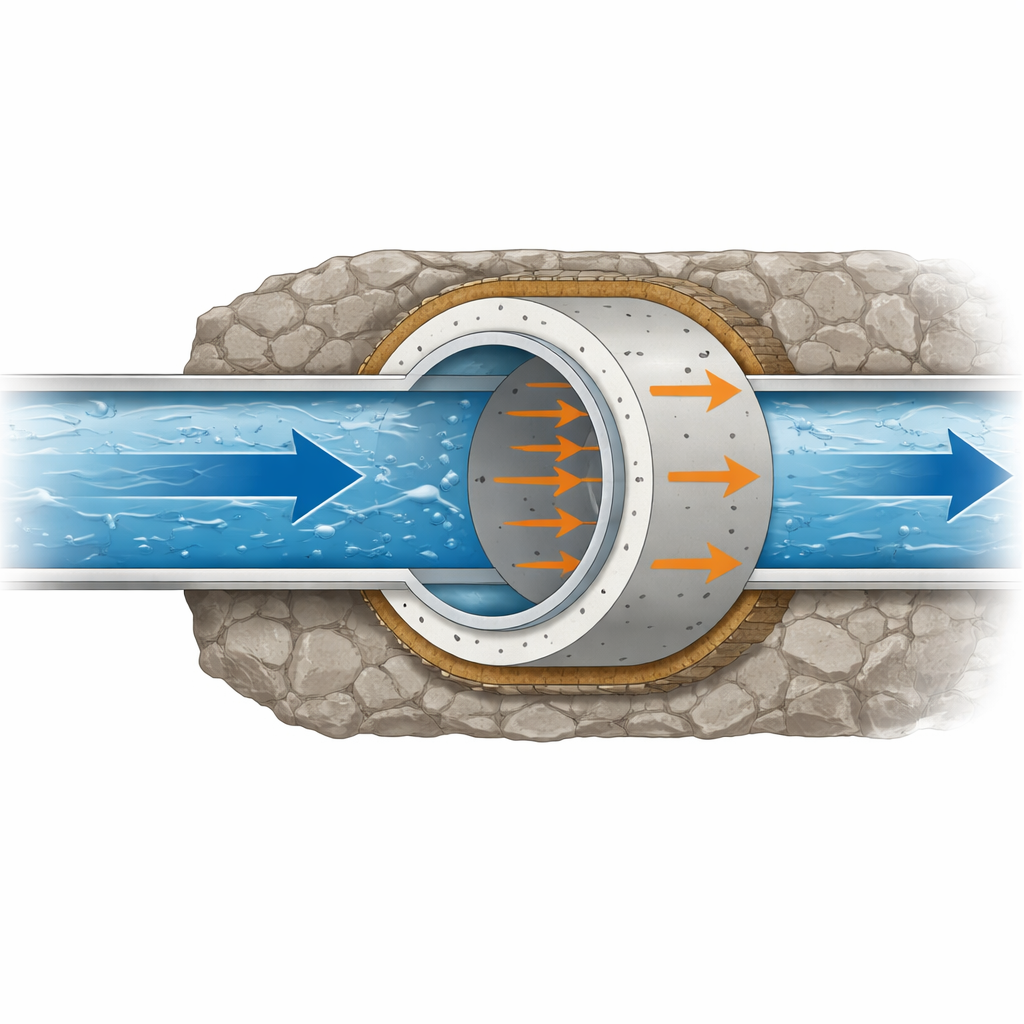
A layered shell around the tunnel
The authors propose a “sandwich” tunnel lining made of three cooperating layers: an inner ring of reinforced concrete, a thin steel plate wrapped around it, and an outer ring of reinforced concrete. Together, they form a composite shell inside the surrounding rock. Instead of relying on the steel plate alone, as in traditional steel-lined tunnels, or on concrete alone, as in simple reinforced-concrete tunnels, this design spreads the forces among all three layers. Steel bars arranged around the tunnel’s circumference are used to mechanically lock the steel plate to the concrete on both sides, helping the layers move together and transfer stresses reliably even when cracks form.
Why current tunnel linings fall short
Conventional linings each have serious drawbacks in high-pressure water tunnels. Steel plate linings are strong in tension and resist internal water pressure well, but they can buckle under high external pressure during emptying and are expensive and difficult to build. Reinforced concrete linings are cheaper and easier to construct and do not buckle easily when squeezed from the outside, but under high internal water pressure they inevitably crack, allowing water to seep into the rock and reducing the lining’s ability to carry load. Past attempts to glue steel to concrete using epoxy or fiber-reinforced polymers have run into durability problems in wet, chemically aggressive environments. This leaves a gap for a lining system that is both robust under changing pressures and durable in water-rich conditions.
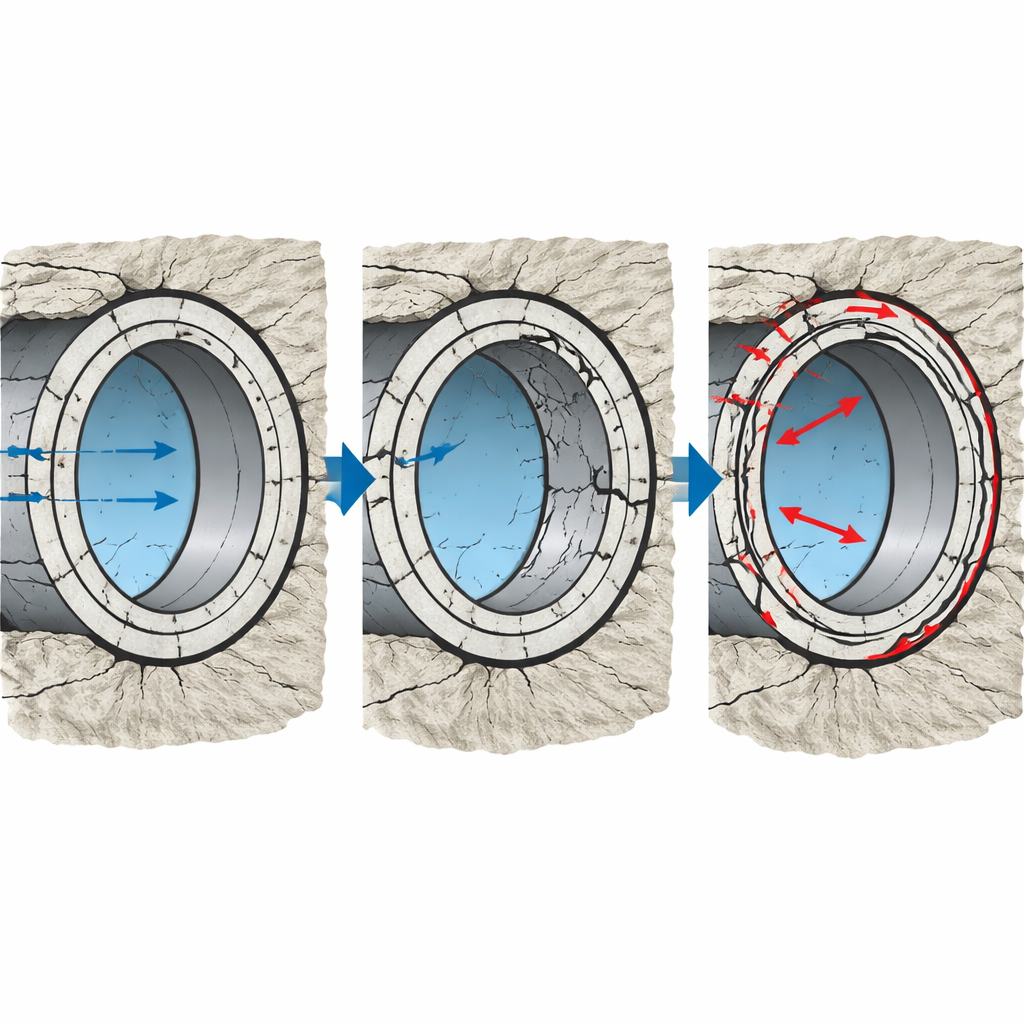
Putting the new lining to the test
To see how the new sandwich lining behaves, the researchers built a scaled physical model of a tunnel segment. The model consisted of the three-layer lining installed inside a strong steel cylinder that could be filled with water either from the inside (to simulate operating conditions) or from the outside (to simulate the tunnel being emptied while groundwater presses in). Strain gauges embedded in the inner concrete, steel plate, and outer concrete recorded how each layer stretched or compressed as pressures increased and decreased. A carefully controlled sequence of loading cycles let the team examine both intact behavior and the response once cracking started in the concrete rings.
How forces shift as water pressure cycles
Under external water pressure, all three layers were in compression, with the outer concrete taking about 43–45% of the hoop load, the inner concrete about 40–42%, and the steel plate only 13–16%. The steel stress stayed far below the level at which buckling would be expected, especially since the surrounding concrete constrained the plate. Under internal water pressure, the picture changed. Before cracking, the surrounding rock, inner concrete, outer concrete, and steel all shared the tension. Once the inner concrete cracked at around 0.94 MPa, its share of the circumferential force dropped sharply, and the steel plate’s share jumped from roughly 15% to about 25%. When the outer concrete later cracked, the steel’s share again rose, up to roughly one quarter to one third of the total, while the cracked concrete rings carried less. Even during a second round of external and internal pressurization after cracking, the steel plate continued to alternate between carrying compression and tension, helping the damaged concrete and limiting permanent deformation.
What this means for real tunnels
Overall, the experiments show that the sandwich lining can keep working safely even after its concrete rings crack under high internal water pressure. Instead of a sudden loss of capacity, the structure redirects more of the load into the steel plate, while the concrete continues to provide stiffness and support against buckling. Within the limited number of laboratory pressure cycles tested, the system remained stable and reduced the risk of leakage and instability compared with traditional linings. Although long-term issues like corrosion, fatigue, and behavior in real rock masses still need full-scale study, the work suggests a promising path toward safer, more resilient high-pressure water tunnels in pumped-storage and similar hydropower projects.
Citation: Pei, J., Deng, Z. Dynamic response characteristics, load-bearing efficiency in multimaterial tunnel assemblies subjected to recurrent intense fluid loading. Sci Rep 16, 12079 (2026). https://doi.org/10.1038/s41598-026-42916-y
Keywords: hydraulic tunnels, reinforced concrete, steel plate lining, water pressure loading, structural durability