Clear Sky Science · en
Photovoltaic power forecasting based on secondary decomposition strategy and hybrid model
Why smarter solar forecasts matter
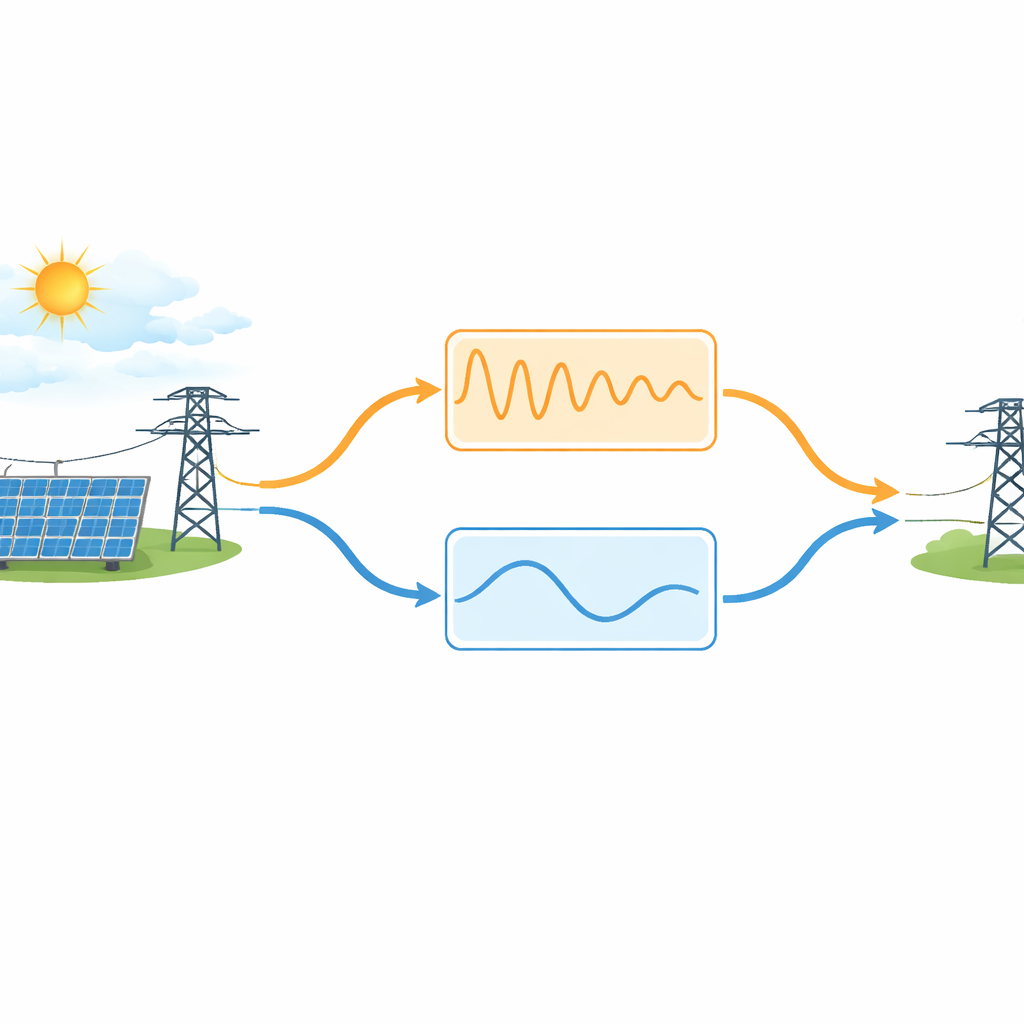
As more homes, businesses, and utilities plug into solar power, the electric grid faces a new challenge: sunshine is anything but steady. Passing clouds, changing seasons, and shifting weather can make solar output jump up and down from minute to minute. Grid operators must still keep lights on and equipment safe, so they need very accurate, very fast predictions of how much power solar panels will produce in the next few minutes. This study presents a new way to make those ultra-short-term forecasts much more precise, helping grids run more smoothly and making better use of clean energy.
Solar power’s bumpy ride
Solar power plants convert sunlight directly into electricity without moving parts, fuel, or smoke stacks. That makes them clean and reliable over many years—but not always predictable from one moment to the next. Their output depends strongly on local weather: clouds, haze, temperature, humidity, and wind can all nudge power up or down. For grid operators who must constantly balance supply and demand, this volatility makes scheduling backup plants, batteries, and reserves more complex and expensive. Existing forecasting methods either lean on physics-based models of weather and solar panels or on statistical formulas and machine learning. While these approaches work reasonably well over hours or days, they often struggle to capture the rapid, jagged swings that matter for minute‑by‑minute control.
Breaking a messy signal into cleaner pieces
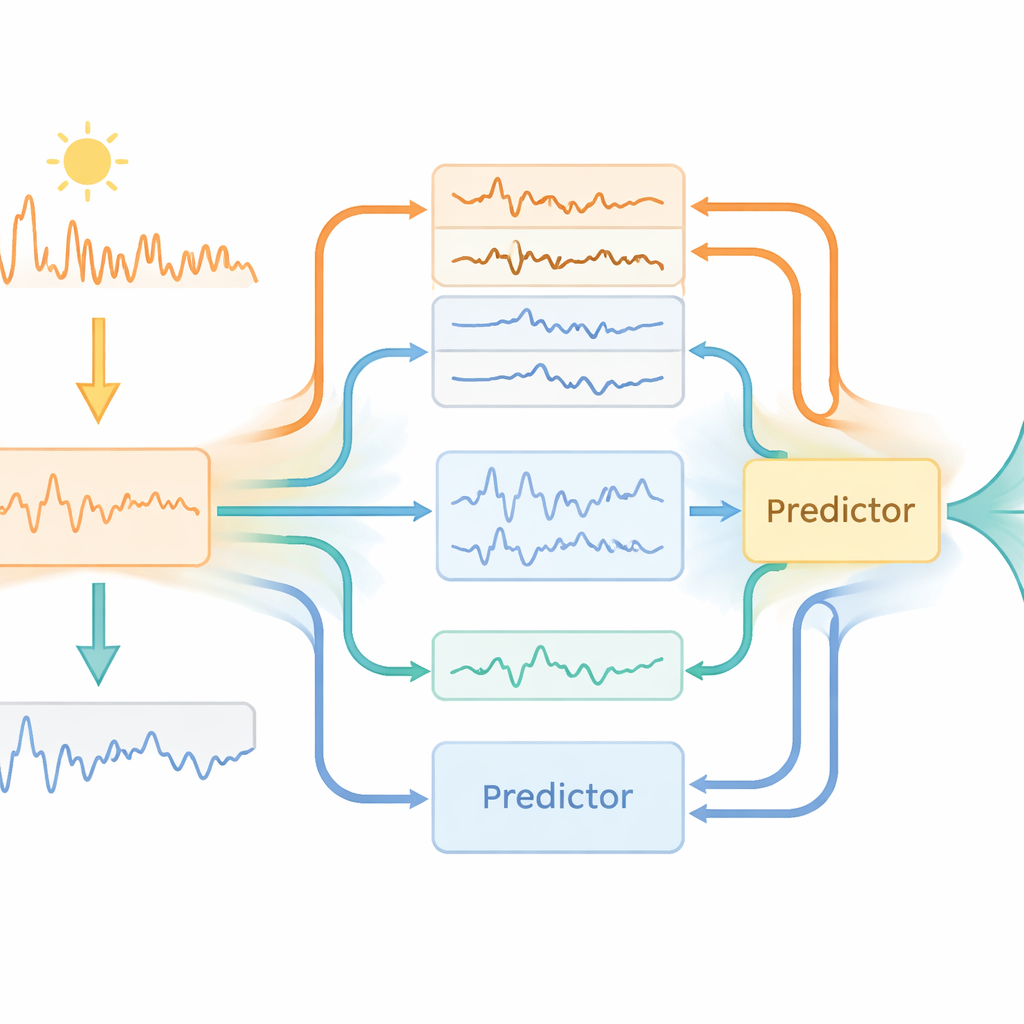
The authors tackle this problem by first reshaping the raw solar power data before any learning takes place. Instead of feeding a single, noisy power curve into one big model, they split the signal into several simpler building blocks, each capturing different types of behavior. An advanced technique called CEEMDAN pulls the original power series apart into multiple components with different rhythms. These pieces are then grouped into two families: fast, jittery fluctuations and slower, smoother trends. The most restless pieces go through a second round of refinement using another method (VMD), whose internal settings are no longer picked by guesswork but automatically tuned by an optimization scheme inspired by the hunting behavior of a bird species. This two-step “decomposition” process turns a tangled, hard-to-predict curve into cleaner sub-signals that are each easier to handle.
Two specialized learning paths
Once the solar power signal has been separated into fast and slow components, the model assigns each group to a different learning tool that fits its character. The high‑frequency pieces, which change quickly and can drift over time, are given to a lightweight algorithm that can be updated online as new data arrive. This design helps it adapt rapidly to sudden changes, such as a line of clouds crossing a solar farm. The low‑frequency pieces, which describe the broader rise and fall of power through the day, are fed into a hybrid system that combines a pattern‑recognizing network with a memory‑rich reservoir. One part focuses on spotting shapes in short windows of data, while the other keeps track of how those shapes evolve over time. Finally, the predictions from both branches are added back together to form a single forecast for the next time step.
Testing across different skies
To see whether this scheme works in the real world, the researchers applied it to data from two very different solar plants: one in Ningxia, China, and another in the Australian desert. These sites experience distinct climates and seasons, providing a tough test of flexibility. The new model’s forecasts were compared with a wide range of modern competitors, including popular deep-learning approaches such as recurrent networks, temporal convolutions, and recent Transformer‑based designs. On every accuracy measure, and especially in capturing sharp ramps and dips, the hybrid decomposition‑plus‑learning framework came out ahead. In one key test, it explained about 99.7% of the variation in solar power output, while also slashing typical errors far below those of the strongest baseline models.
What this means for the grid
In plain terms, the study shows that treating solar power as a mixture of fast noise and slower trends—and giving each part a tailored forecasting engine—can yield far more reliable minute‑scale predictions than one‑size‑fits‑all models. For grid operators, better forecasts mean fewer surprises, less wasted backup energy, and more confidence in leaning on solar as a major resource. Over time, this kind of smarter forecasting could reduce operating costs, cut curtailment of clean power, and help grids absorb even higher levels of renewables without sacrificing stability.
Citation: Xue, S., Li, L. Photovoltaic power forecasting based on secondary decomposition strategy and hybrid model. Sci Rep 16, 12915 (2026). https://doi.org/10.1038/s41598-026-42896-z
Keywords: solar power forecasting, photovoltaic energy, smart grid, renewable energy integration, time series modeling