Clear Sky Science · en
Fitness costs of sublethal cyantraniliprole exposure: life-history trade-offs in the non-target insect Musca domestica
Why this matters for everyday life
Pesticides help protect our food crops, but they rarely disappear right after spraying. As they break down, their strength drops to levels that no longer kill insects outright—but can still change how those insects live and reproduce. This study looks at how a widely used insecticide, cyantraniliprole, affects the common house fly, a familiar visitor to farms and homes that also plays roles as a pollinator and nectar feeder. Understanding these quiet, hidden effects helps us weigh the benefits of pest control against its long-term impacts on insects and ecosystems.
Invisible leftovers after spraying
When farmers spray fields, sunlight, temperature, and rain slowly weaken the chemicals. Instead of a single blast of poison, insects often face a lingering haze of “sublethal” doses—too low to kill them, but high enough to stress their bodies. Cyantraniliprole is designed to paralyze harmful crop pests by disrupting calcium signals in their muscles. Yet house flies living near fields can also contact these residues as they feed or lay eggs. Because house flies have short generations and flexible genetics, they are a useful model for seeing how these low doses might affect survival, reproduction, and even the potential for resistance to develop over time. 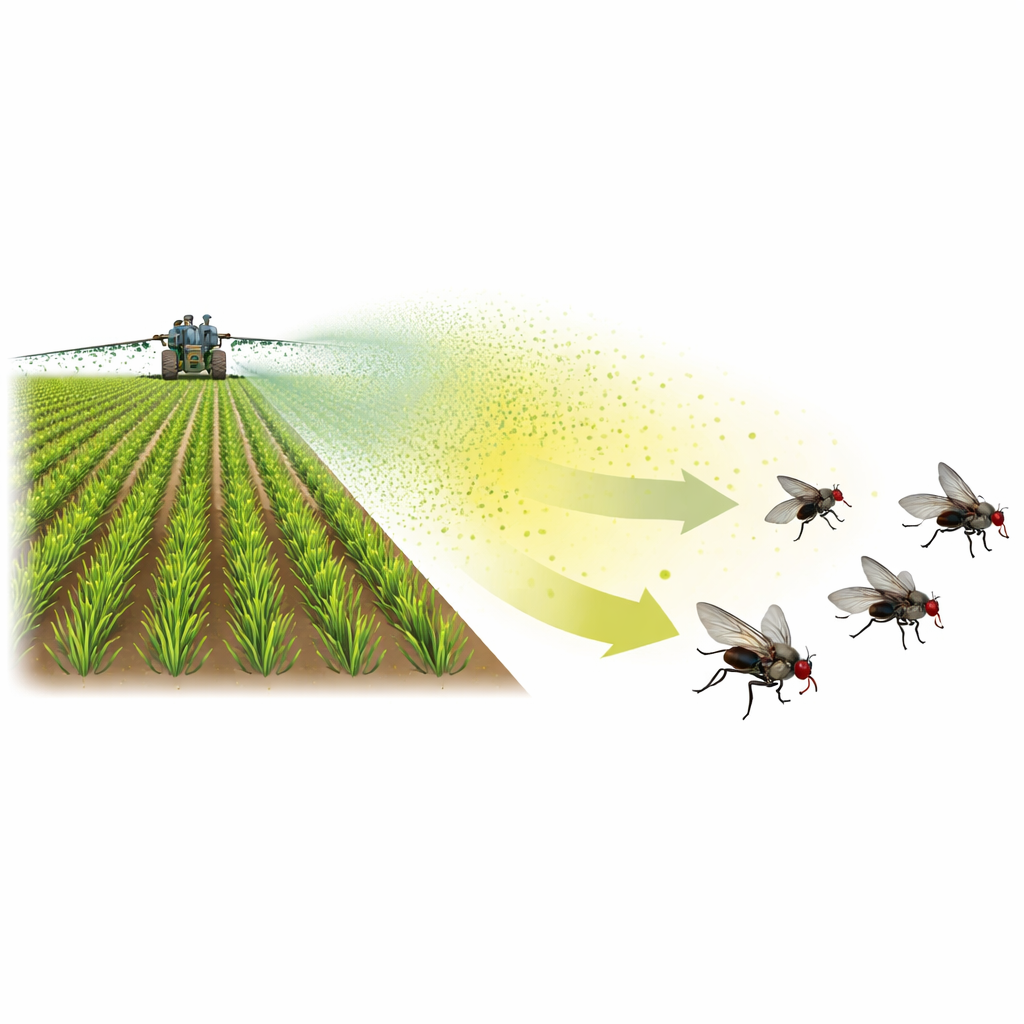
How the experiment was set up
The researchers collected house flies from agricultural fields in Pakistan and reared them under controlled lab conditions on a standard diet. They then mixed different low levels of cyantraniliprole (12.5, 25, and 50 parts per million) into the food of fly larvae, while another group received no insecticide. After the exposed larvae grew into adults, the scientists followed their complete life histories—from egg to larva to pupa to adult—for the next generation. Each egg was tracked individually, and the team recorded how long each stage lasted, how many flies survived, how many eggs females laid, and how quickly the overall population could grow under each treatment.
Short lives, fewer young—and a twist
The highest sublethal dose, 50 ppm, clearly harmed the flies. Fewer young made it from egg to adulthood, and this group had the lowest pre-adult survival. Females at this dose lived relatively long but laid far fewer eggs, and the number of days they spent laying eggs was sharply reduced. As a result, standard measures of population health—such as how many offspring each female produces and how fast numbers can increase—dropped noticeably at 50 ppm. These changes suggest that even when cyantraniliprole does not kill outright, it can sap the energy flies need for growth and reproduction, likely because detoxifying the chemical strains their bodies.
When a little poison helps
Surprisingly, one of the lower doses, 25 ppm, showed signs of “hormesis,” a pattern where a small amount of stress actually boosts performance. Flies at this level lived longer overall and, in some cases, laid almost as many eggs as the untreated flies or even more, and they had more days available for egg-laying. This mixed response—harm at high doses but a slight boost at some lower ones—has been reported for other insects exposed to pesticides. It may reflect an adaptive adjustment, where insects shift resources to reproduction when mildly stressed. However, this short-term advantage could complicate pest control by temporarily helping some individuals thrive. 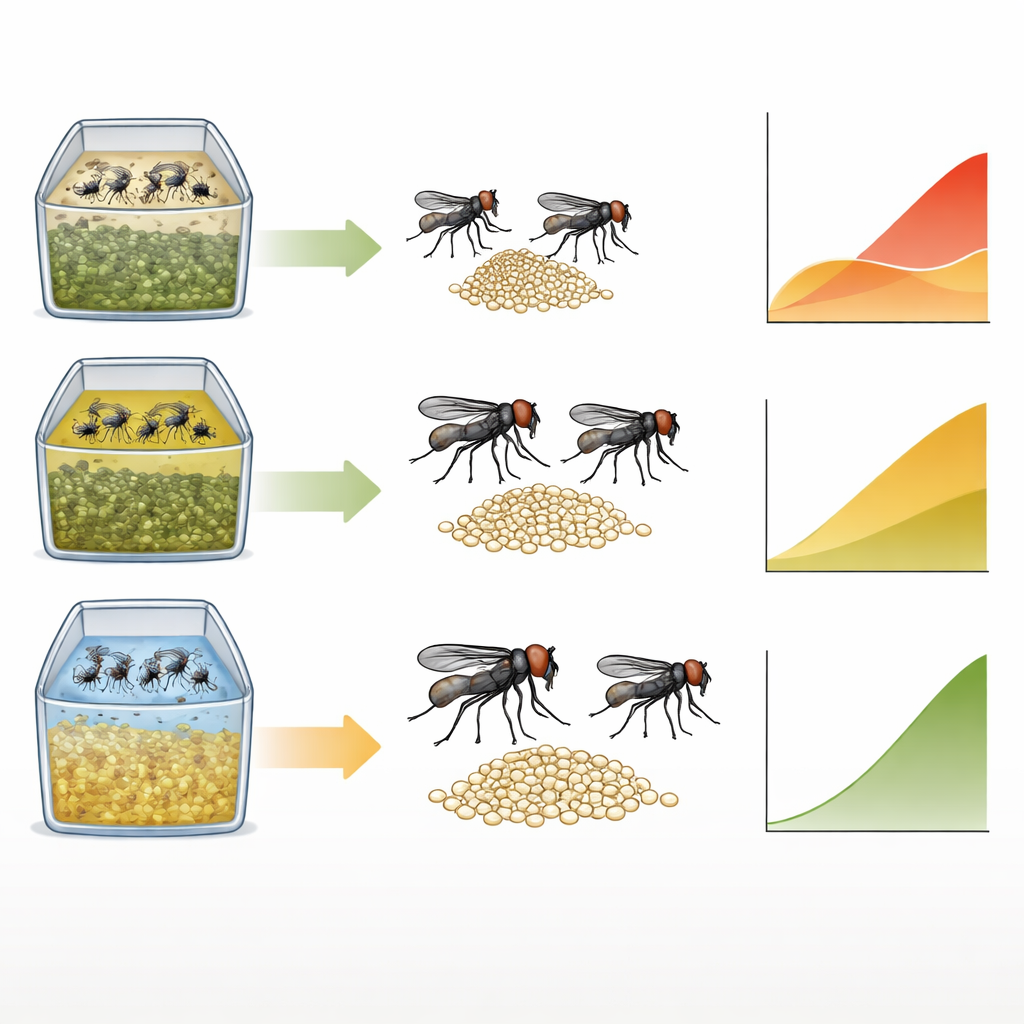
What this means for pest management
By analyzing detailed survival and reproduction patterns, the study shows that sublethal cyantraniliprole can both weaken house fly populations at higher residues and unexpectedly enhance certain traits at lower ones. Overall, the insecticide reduced key growth rates at the strongest dose, pointing to real “fitness costs” for exposed flies. For a layperson, the takeaway is that pesticides are not simply on–off switches for insect life: even when they do not kill, they can reshape how insects grow, reproduce, and persist over generations. For integrated pest management, this means that risk assessments should include these subtle, long-term effects on non-target insects, helping farmers choose strategies that control pests while better protecting the wider ecological community.
Citation: Amir, A., Iqbal, N., Sadiq, N. et al. Fitness costs of sublethal cyantraniliprole exposure: life-history trade-offs in the non-target insect Musca domestica. Sci Rep 16, 14054 (2026). https://doi.org/10.1038/s41598-026-42884-3
Keywords: pesticides, house flies, sublethal effects, population dynamics, integrated pest management