Clear Sky Science · en
Diagnostic uncertainty of clinical T2 disease and its impact on treatment stratification in upper tract urothelial carcinoma: a multicenter retrospective study
Why this matters for patients
When doctors diagnose cancers of the kidney’s drainage system, they rely heavily on scans to judge how deeply the tumor has grown. That judgment, called staging, guides life-changing choices: whether to use chemotherapy around surgery, how closely to monitor, and how hopeful patients can be about the future. This study asks a simple but crucial question: how often are doctors’ pre-surgery estimates wrong, and what does that mean for patients?

Looking closely at a tricky cancer
The research focuses on upper tract urothelial carcinoma, a relatively uncommon cancer that arises in the inner lining of the kidney’s drainage system and ureter. Standard treatment is removal of the kidney and ureter on the affected side. Before surgery, doctors use CT scans to assign a clinical stage that describes how far the cancer seems to have invaded nearby tissue. In everyday practice, a mid-range category called “T2” often becomes a catch-all when scans suggest something more serious than very early disease but not clearly advanced. The authors wanted to know how well this clinical T2 label matches what pathologists actually find under the microscope after surgery, and how any mismatch affects survival and treatment decisions.
What the study team did
Using a large regional database from 10 academic centers in Japan, the team reviewed 739 people who had surgery for upper tract urothelial carcinoma between 1994 and 2024 and had no visible spread to lymph nodes or distant organs. They excluded patients who had chemotherapy before surgery to avoid blurring the true stage. For each patient, they compared the stage suggested by preoperative scans with the final stage determined when the removed tissue was examined. They also tracked who received additional treatment after surgery and how long patients lived without metastasis and overall.
A blurry middle ground in staging
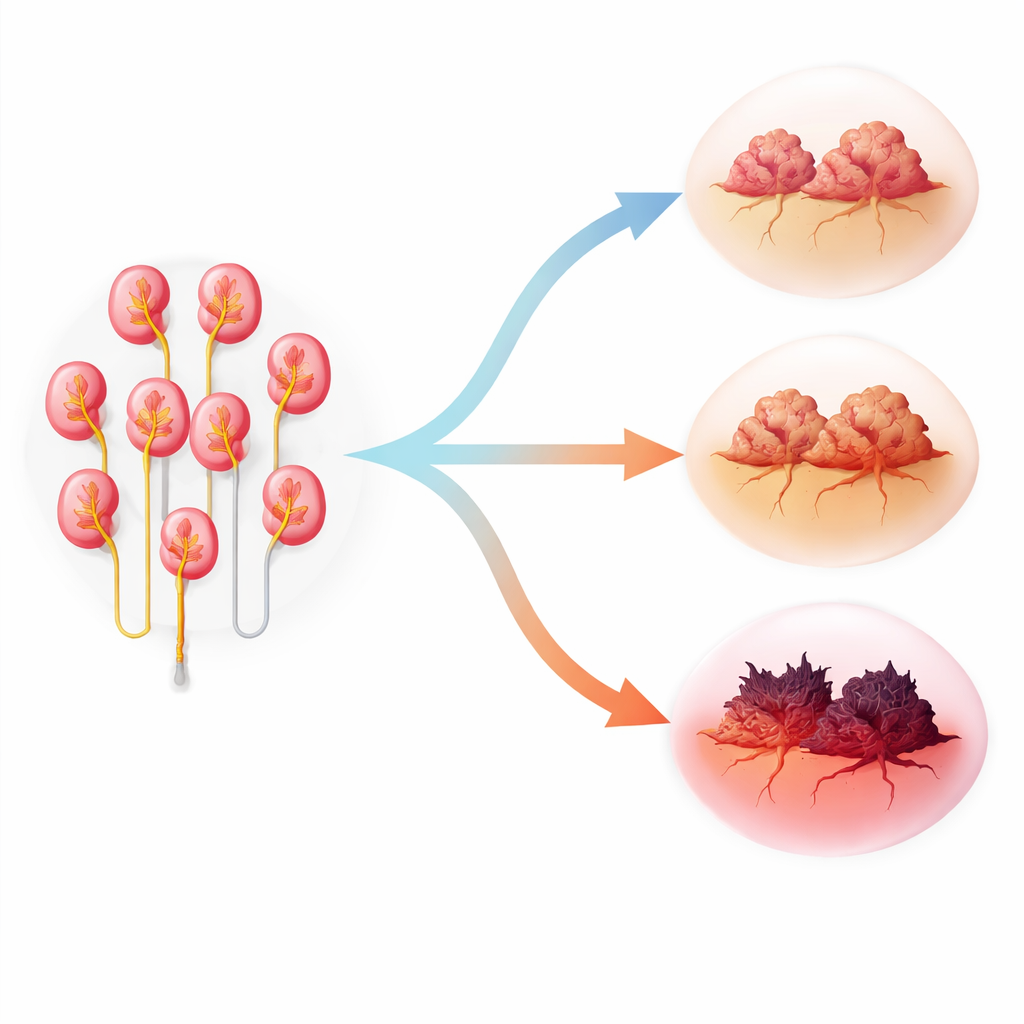
Overall, fewer than half of patients had perfect agreement between what scans suggested and what pathology later confirmed. The biggest problem was the clinical T2 group. Only about one in six people labeled T2 on scans actually had a mid-depth T2 tumor under the microscope. Nearly half turned out to have more superficial disease, and more than a third already had deeper invasion than expected. Survival closely followed the true stage: people whose cancers were pathologically more advanced did markedly worse than those with earlier-stage disease, even though they had all been placed in the same T2 basket before surgery. This shows that the T2 label hides a mix of low- and high-risk cancers that look similar on imaging but behave very differently.
What drives risk in more advanced tumors
The researchers next zoomed in on patients whose tumors were confirmed as deeply invasive (pathological T3). In this high-risk group, how the tumor had been labeled on scans before surgery no longer mattered much for predicting outcomes. Instead, specific microscopic features and treatments made the difference. The presence of cancer cells within tiny blood or lymph channels—a sign called lymphovascular invasion—was linked to worse survival. In contrast, patients who received chemotherapy after surgery tended to live longer and stay free of metastases. Yet only about one-third of people with these dangerous T3 tumors actually received such additional treatment, highlighting a sizable treatment gap.
What this means for care today
For patients and clinicians, the study sends a clear message: the mid-range clinical T2 label for upper tract urothelial cancer is unreliable as a guide to true tumor depth and risk. Many people in this category either have less aggressive disease than feared or, more worryingly, much more advanced cancer than scans suggest. Because of this uncertainty, treatment decisions based solely on pre-surgery imaging may miss chances to offer timely chemotherapy to those who need it most. The authors argue that careful interpretation of staging—combined with detailed pathology, and in future, better imaging and molecular tests—is essential to match each patient with the right intensity of treatment and follow-up.
Citation: Shiga, M., Kandori, S., Hatakeyama, S. et al. Diagnostic uncertainty of clinical T2 disease and its impact on treatment stratification in upper tract urothelial carcinoma: a multicenter retrospective study. Sci Rep 16, 12848 (2026). https://doi.org/10.1038/s41598-026-42876-3
Keywords: upper tract urothelial carcinoma, cancer staging, diagnostic accuracy, kidney and ureter cancer, adjuvant chemotherapy