Clear Sky Science · en
Comparative study of ACO, dijkstra, and NN for routing efficiency in waste collection networks
Why smarter trash routes matter
Behind every garbage truck that passes your street lies a complex puzzle: how to visit many bins and neighborhoods while driving as little as possible. With cities generating billions of tons of waste and fuel costs and emissions climbing, even small improvements in routing can save money, cut pollution, and ease traffic. This paper asks a practical question for modern cities: among three popular ways to compute routes for waste trucks, which one really works best when networks get larger and busier?
Three ways to find a way
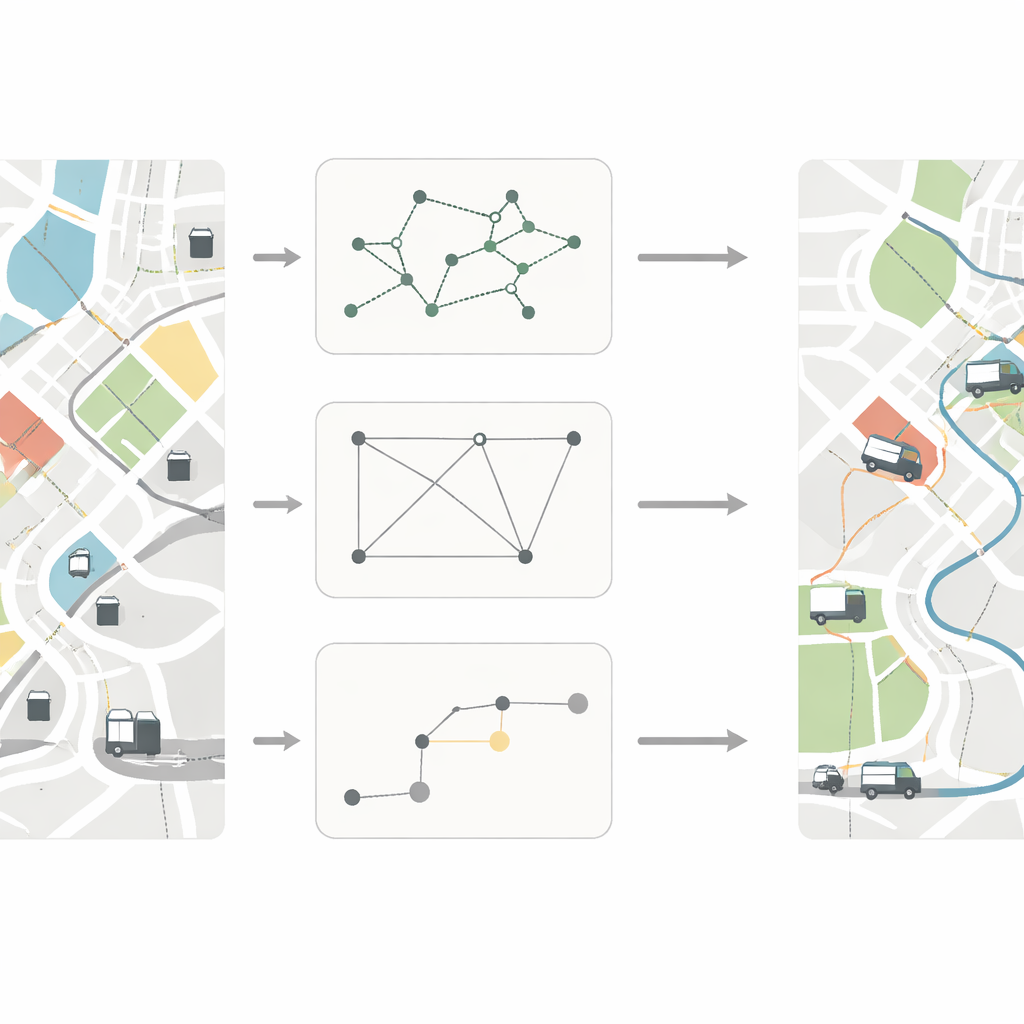
The study compares three families of routing methods, each mirroring a different style of decision making. The first, called Ant Colony Optimization (ACO), is inspired by how real ants lay and follow pheromone trails: promising paths get reinforced over time, while weaker ones fade. The second, Dijkstra’s algorithm, is a classic mathematical recipe that always finds the shortest path in a network when conditions are fixed and known. The third, the Nearest Neighbour approach, mimics a quick human guess: from where you are now, simply go to the closest unvisited point, then repeat. All three are applied to the same kind of abstract city map, where intersections and waste pickup points are represented as nodes connected by roads with costs that reflect distance and congestion.
Building virtual cities to test the ideas
Instead of relying on one particular town, the authors construct synthetic road networks that resemble typical urban layouts. These networks are sparse, with each point connected to only a few others, and include a range of sizes from 10 up to more than 50 locations to mimic small districts up to sizable city zones. Road segments carry “congestion-weighted” costs, so busier or longer roads are effectively more expensive to use. On each of these virtual maps, the three algorithms are asked to find low-cost paths between a chosen start and end point. To keep the comparison fair, all three use the same underlying cost structure, and the more random methods are run many times so researchers can measure both their average performance and their variability.
What the head-to-head tests reveal
The results show a clear pattern. Across small, medium, and large networks, ACO consistently discovers routes with the lowest average total cost. Its ants wander, learn from experience, and gradually concentrate on cheaper paths, which proves especially valuable as networks get larger and road costs become more uneven. Dijkstra’s algorithm is extremely stable: given the same map and costs, it always returns the same path, with very little spread in outcomes. However, when congestion-weighted costs and more complex layouts are considered, its routes are slightly more expensive than those found by a well-tuned ACO. The Nearest Neighbour method is fastest to run but performs worst: by always chasing the next closest point, it tends to overlook smarter long-term shortcuts and produces the most expensive and most inconsistent routes.
Checking that differences are real
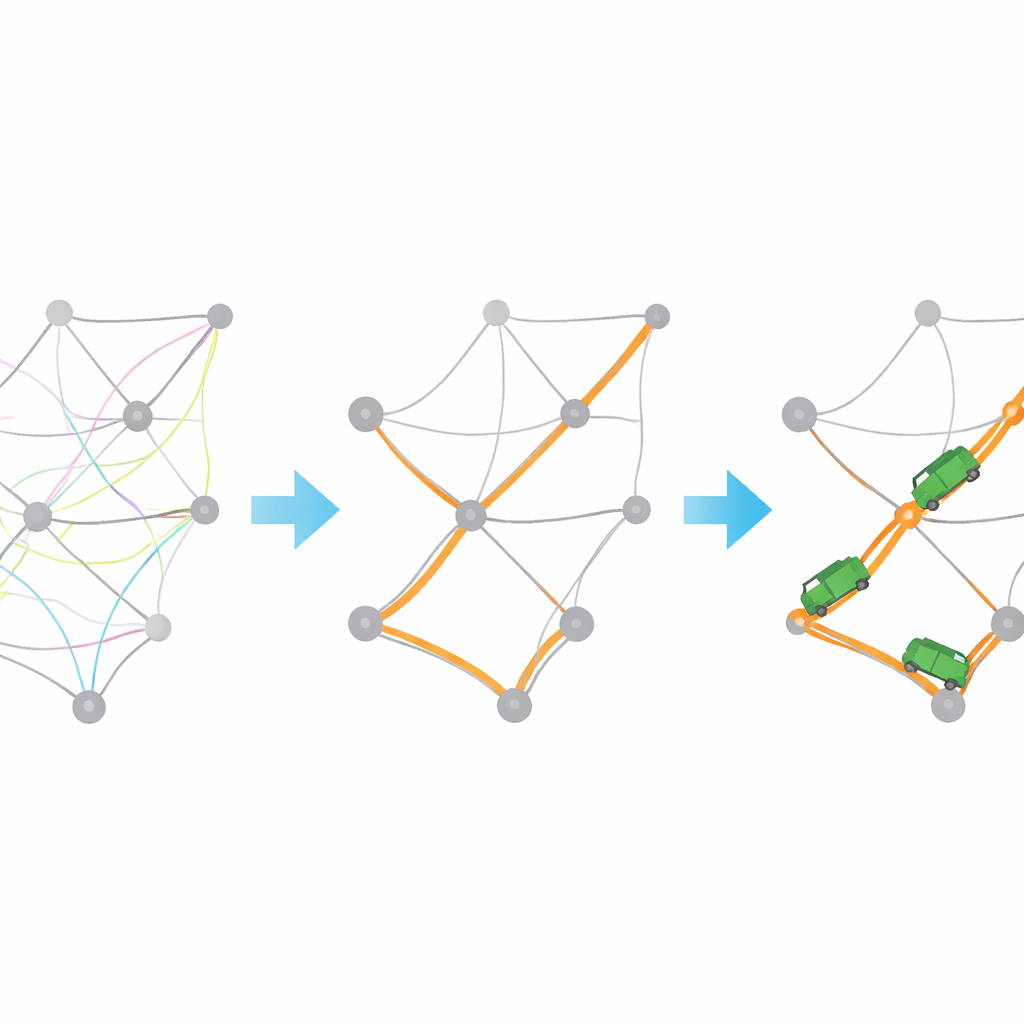
To make sure these performance gaps are not just flukes of random variation, the authors use a statistical tool known as the Wilcoxon signed-rank test. This test compares paired results from the algorithms on the same network instances without assuming that the data follow a bell-shaped curve. In every network size they study, the test indicates that ACO’s cost savings over Dijkstra and Nearest Neighbour are statistically significant rather than accidental. At the same time, measures of spread show the trade-off between stability and flexibility: Dijkstra’s paths hardly vary at all, while ACO’s outcomes shift slightly from run to run as it explores alternatives before settling near the best routes.
What this means for city streets
For city managers, the paper’s message is both practical and intuitive. If the road network is small and conditions are fairly stable, a classic shortest-path method like Dijkstra’s is simple and dependable. When networks are larger and congestion or other costs change across space, an ant-inspired approach can squeeze out noticeably cheaper routes, even if it takes more computing effort behind the scenes. The quick-and-dirty Nearest Neighbour strategy, while tempting for its speed, consistently leaves money and fuel on the table. Overall, the study provides a tested guide: choose deterministic methods for small, predictable settings, but favor adaptive, swarm-based optimization when planning cost-effective, scalable waste collection in modern, growing cities.
Citation: Anitha, R., Parthiban, A. Comparative study of ACO, dijkstra, and NN for routing efficiency in waste collection networks. Sci Rep 16, 13346 (2026). https://doi.org/10.1038/s41598-026-42866-5
Keywords: urban waste collection, route optimization, ant colony optimization, shortest path algorithms, smart city logistics