Clear Sky Science · en
Enhanced solution absorption of free-base over protonated nicotine in aerosols
Why This Matters for Smokers and Patients
Nicotine is best known as the chemical that keeps smokers hooked, but it is also being explored as a possible treatment for brain disorders such as Alzheimer’s and Parkinson’s disease. To use nicotine more safely—whether in e-cigarettes or future medicines—scientists need to know how easily different forms of nicotine actually enter the body. This study asks a simple but important question: when nicotine is carried in tiny airborne droplets, which version slips into liquid more readily—the “free” form or the “salt” form—and what does that mean for both addiction and therapy?
Two Faces of the Same Molecule
Nicotine can take on two main personalities. In its free-base form, it is electrically neutral and more volatile, meaning it can move into the air phase more easily. In its protonated form, often called a nicotine salt, it carries electrical charge and behaves more like a dissolved salt. E-cigarette products and other nicotine devices can be engineered to favor one form or the other, which in turn influences how harsh the vapor feels, how quickly nicotine is delivered, and how addictive or therapeutic the experience may be. Past studies, however, have disagreed on which form is absorbed faster in people, partly because human biology adds many layers of complexity.
A Lab Setup That Mimics a Puff
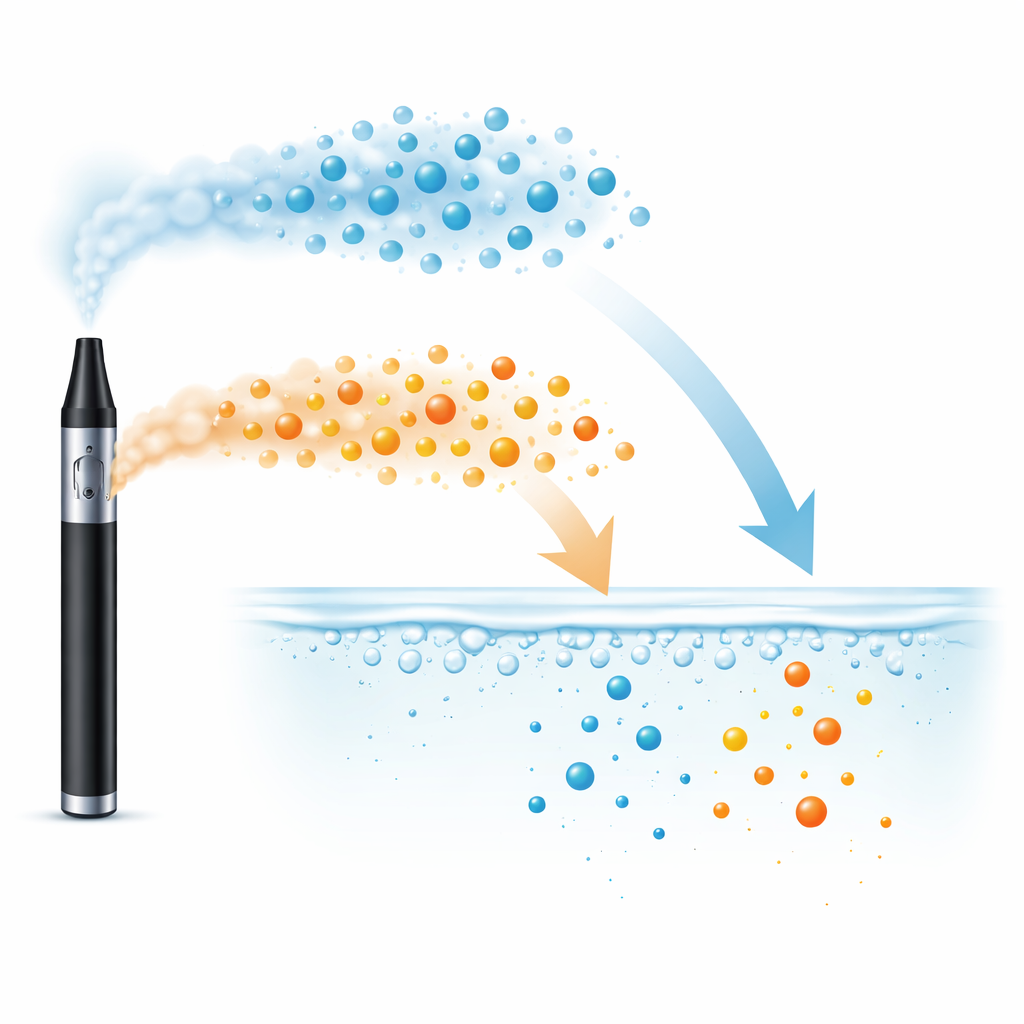
To isolate the effect of nicotine’s form itself, the researchers built a controlled “aerosol delivery” system that mimics an e-cigarette puff but removes the complications of living tissues. They prepared two test liquids with identical nicotine content: one containing free-base nicotine and the other containing nicotine benzoate, a common nicotine salt. An aerosol generator turned these liquids into clouds of microscopic droplets, which were then drawn, puff by puff, through a warm bottle containing either ethanol or water-based test solutions, set to different acidity levels. Any particles that did not dissolve in the solution were captured on a highly efficient filter, allowing the team to compare how much nicotine stayed with the droplets versus how much ended up dissolved in the liquid.
Tracking Where the Nicotine Goes
In ethanol-based solutions, the scientists could directly measure the nicotine that entered the liquid and the amount stuck to the filter. They found that, under all acidity conditions, a larger share of nicotine salt remained on the filter compared with free-base nicotine. Put differently, free-base nicotine left fewer remnants behind, meaning more of it had entered the liquid. Experiments in water-based solutions required a slightly different approach: the team normalized the amount of nicotine left on the filter by how much test liquid was consumed. Again, across plain water, acidic, and alkaline conditions, nicotine salt consistently showed higher residues, signaling weaker penetration into the solution compared with the free-base form.
How the Pathway Shapes Absorption
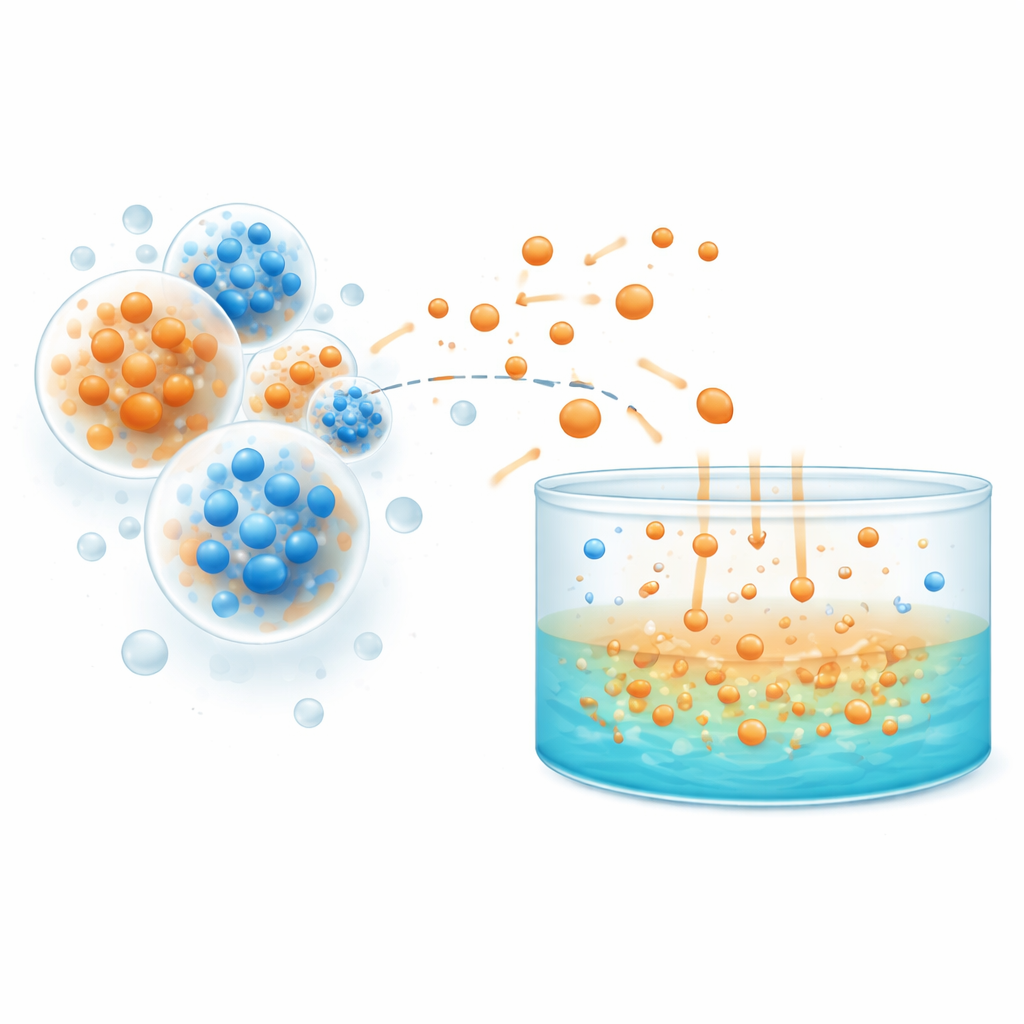
Why does the free-base form get into solution more efficiently? The authors point to two competing pathways. Free-base nicotine, being less polar and more volatile, can escape from its particle home into the surrounding gas phase. From there, it crosses the gas–liquid boundary and dissolves into the test solution. Nicotine salt, by contrast, is strongly bound in ionic form and hardly evaporates at all. It depends mainly on direct contact between aerosol particles and the liquid surface, followed by slower solid–liquid dissolution. Changes in solvent type and acidity altered the total amount of nicotine absorbed, but they did not change the basic pattern: free-base nicotine outperformed the salt form in every case because it could exploit the additional gas-phase diffusion route.
What This Means for Health and Future Medicines
For a non-specialist, the takeaway is that the way nicotine is packaged at the molecular level strongly influences how easily it can move from inhaled droplets into body-like fluids. In this carefully controlled lab model, free-base nicotine consistently penetrated solutions more effectively than protonated nicotine, regardless of whether the medium resembled alcohol-based or water-based environments, or whether it was acidic or alkaline. This suggests that products rich in free-base nicotine may deliver nicotine more efficiently, possibly increasing both therapeutic impact and addiction risk, while salt forms may be less readily absorbed under the same conditions. Although real human tissues are more complex than a bottle of liquid, these results provide a clear mechanistic foundation for future studies aiming to fine-tune nicotine delivery—either to reduce harm in tobacco use or to harness nicotine’s potential benefits in brain disease without amplifying its dependence-forming power.
Citation: Wang, Z., Cui, H., Tuo, S. et al. Enhanced solution absorption of free-base over protonated nicotine in aerosols. Sci Rep 16, 12400 (2026). https://doi.org/10.1038/s41598-026-42860-x
Keywords: nicotine absorption, aerosol chemistry, e-cigarettes, nicotine salts, drug delivery