Clear Sky Science · en
QRGEC: quantum reinforcement learning with golden jackal optimization for resilient edge cloud coordination in internet computing
Smarter Traffic Cops for the Internet
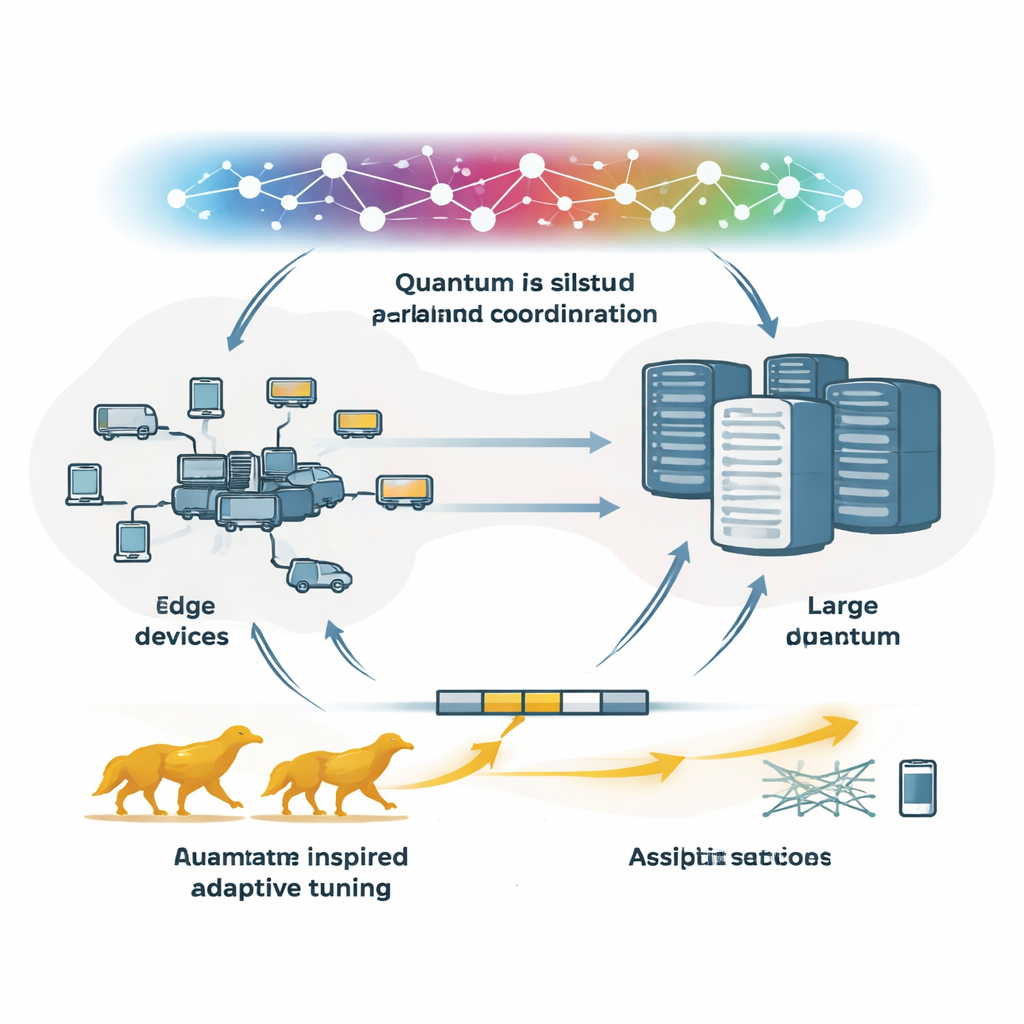
The apps we use every day—navigation, video calls, smart cameras, factory sensors—depend on thousands of tiny computers at the network’s edge working smoothly with giant cloud data centers. When this invisible traffic system gets congested or parts of it fail, we feel it as lag, poor video, or even service outages. This paper introduces a new way to coordinate all those edge and cloud machines so they stay fast, energy‑efficient, and resilient, borrowing ideas from both quantum physics and animal behavior.
Why Today’s Networks Struggle
Modern Internet services no longer run only in distant data centers. They also rely on nearby "edge" machines sitting in base stations, roadside units, or local hubs that handle time‑critical tasks such as autonomous driving or industrial control. These environments are messy and unpredictable: devices join and leave, workloads surge in bursts, and communication links slow down or fail. Traditional optimization and machine‑learning methods can plan reasonably well in small or stable settings, but they tend to react too slowly, explore too narrowly, and become brittle when the network is constantly changing.
Mixing Quantum Ideas with Animal Instinct
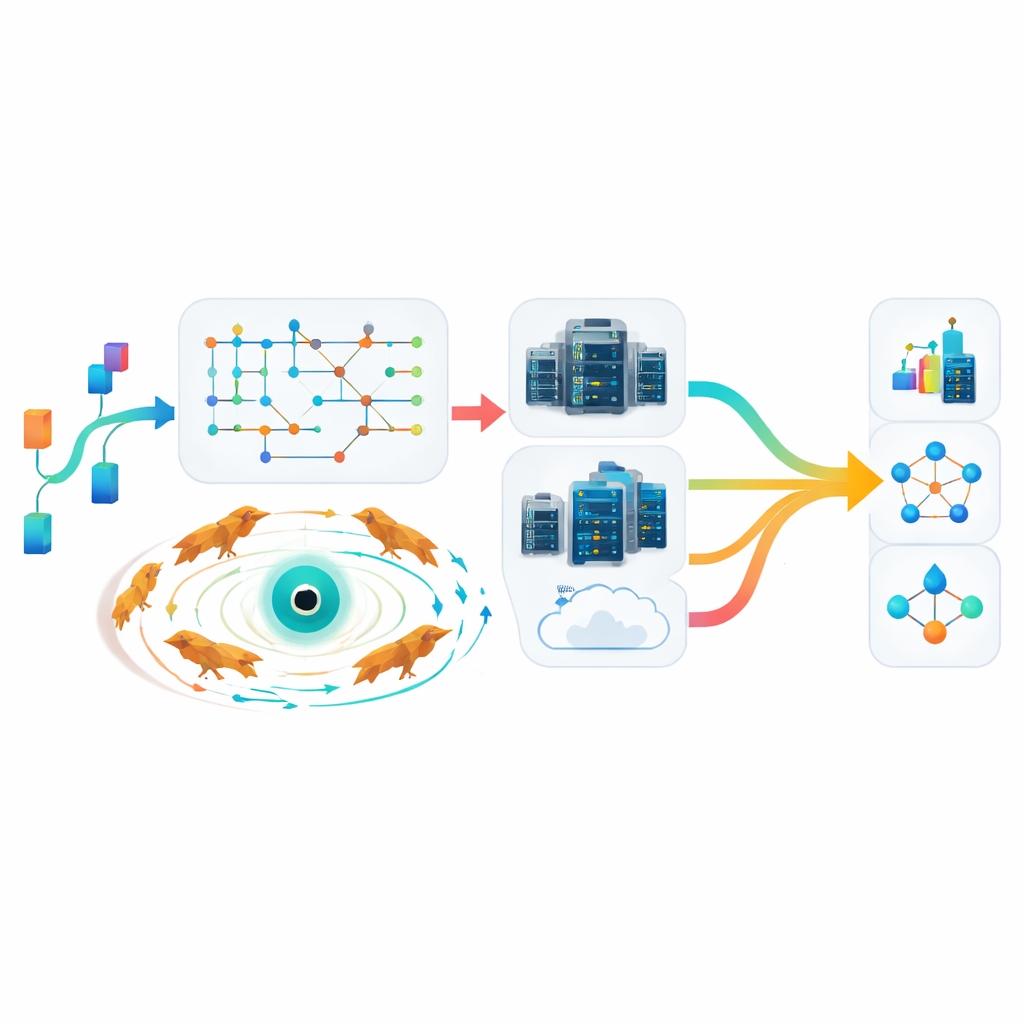
The authors propose a framework called QRGEC that combines two unconventional inspirations. First, they use quantum‑style learning, where the "state" of the system is represented as a superposition—many possibilities at once—inside a simulated quantum circuit. This allows the learning agent to explore many scheduling options in parallel before choosing how to route tasks across edge and cloud. Second, they adapt a bio‑inspired search method modeled on the hunting strategies of golden jackals. In nature, these animals alternate between wide exploration and tightly coordinated attacks. In QRGEC, this idea is turned into a mathematical procedure that automatically adjusts the learning rate and other parameters so the algorithm can both search widely and then quickly home in on good solutions.
Balancing Speed, Power, and Recovery
QRGEC does not focus on just one goal. It tries to keep response times low, energy use modest, and the system’s ability to recover from trouble high. To do this, the framework builds a detailed model of how long tasks wait in queues, how much power processors and communication links consume, and how likely different nodes are to fail and be repaired. These ingredients are combined into a single score that rewards fast, green, and reliable behavior, while penalizing broken service agreements, costly task migrations, and network congestion. The quantum‑based learner repeatedly simulates the network, tries out scheduling actions, and receives rewards shaped by this score, while the jackal‑inspired component keeps tuning its internal knobs for better stability and convergence.
How Well the New Approach Performs
To test QRGEC, the authors ran extensive simulations with realistic traces from Internet‑of‑Things sensors, Google data center logs, and wide‑area network measurements. They compared their method with several advanced baselines, including deep reinforcement learning schedulers, bio‑inspired optimizers, quantum‑inspired algorithms, and a fault‑tolerant coordination scheme. Across a range of scenarios—balanced, skewed, bursty, and extremely dense workloads—QRGEC consistently delivered lower delays, higher energy savings, and better use of available hardware. It kept about 94% of edge and cloud resources productively busy, cut latency by roughly one‑third to one‑half, and significantly boosted the system’s ability to recover from congestion and failures.
Limits Today and Hopes for Tomorrow
Although QRGEC draws on quantum computing concepts, the current work runs entirely on software simulators rather than real quantum hardware. That means the results should be seen as proof that quantum‑inspired learning strategies can be powerful, not yet as a demonstration of hardware‑level quantum advantage. Still, the study suggests a promising direction: future networks might coordinate themselves using a blend of quantum parallelism and nature‑inspired adaptation, leading to Internet services that remain fast, efficient, and self‑healing even as they grow more complex and widespread.
Citation: Lella, K.K., Krishna, M.S.R. QRGEC: quantum reinforcement learning with golden jackal optimization for resilient edge cloud coordination in internet computing. Sci Rep 16, 12766 (2026). https://doi.org/10.1038/s41598-026-42859-4
Keywords: edge cloud computing, quantum reinforcement learning, intelligent scheduling, energy efficient networks, resilient internet systems