Clear Sky Science · en
Cross-media style transfer in art: preserving artistic intent in diverse media using GANs
Why teaching AI about art styles matters
Imagine asking an AI to paint “a sunset over a quiet lake” as if Monet, Picasso, or a pop artist had each taken a turn with the brush. Today’s text-to-image systems can follow the words of that request, but they often stumble when it comes to the subtleties that make each artistic style feel authentic. This paper explores a new way to give AI a richer sense of style, so that it can generate digital art that stays true to both the written prompt and the artistic movement it is meant to echo.
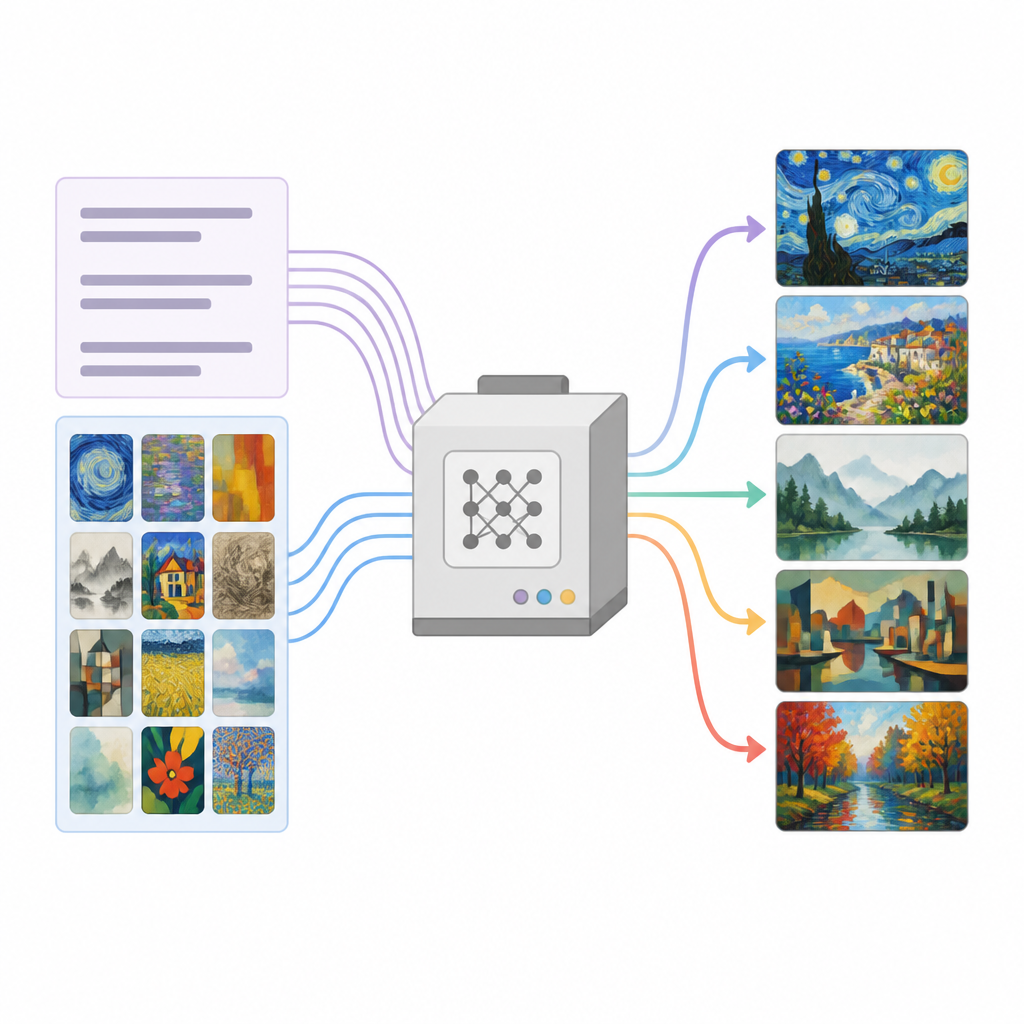
From words and noise to pictures
Modern image generators based on diffusion models start from random noise and gradually sculpt an image that matches a short text description. They are remarkably good at placing the right objects in the right places, yet struggle with the “how” of painting: the textures, color choices, and brushwork that define Impressionism or Cubism. Previous attempts to fix this often relied on many example images for each style, heavy fine tuning of large models, or complicated multi-step systems. These approaches can be powerful, but they are slow, expensive, and difficult for everyday artists or designers to use.
Teaching styles as compact memories
The study introduces a simpler idea called dynamic style embeddings. Instead of retraining the whole model for every new style, the system learns just one compact numerical “token” per style. There are 27 such tokens, each corresponding to a style from the WikiArt collection, including Impressionism, Cubism, Realism, and Pop Art. When the model generates an image, it reads both the text caption and the chosen style token, and fuses them into a single guiding signal. This signal tells the model not only what to draw, but also how the result should look in terms of color, texture, and overall mood. Because the style is stored as a tiny vector, new styles can be added or mixed with little extra cost.
Balancing style, content, and smooth mixing
To train this system, the authors first used another AI tool to write captions for around eight thousand paintings taken from the much larger WikiArt database. They then designed a training recipe that pushes the generator to juggle three goals at once. A style loss encourages the output to share patterns and textures with a reference painting. A perceptual loss nudges the result to preserve the main shapes and objects described in the caption. A blending loss teaches the model to glide smoothly between two styles when their tokens are mixed, so that a picture can gradually shift, for example, from Impressionism to Pop Art without jarring breaks. All of this happens inside a standard Stable Diffusion model, without adding extra networks or needing style example images at generation time.
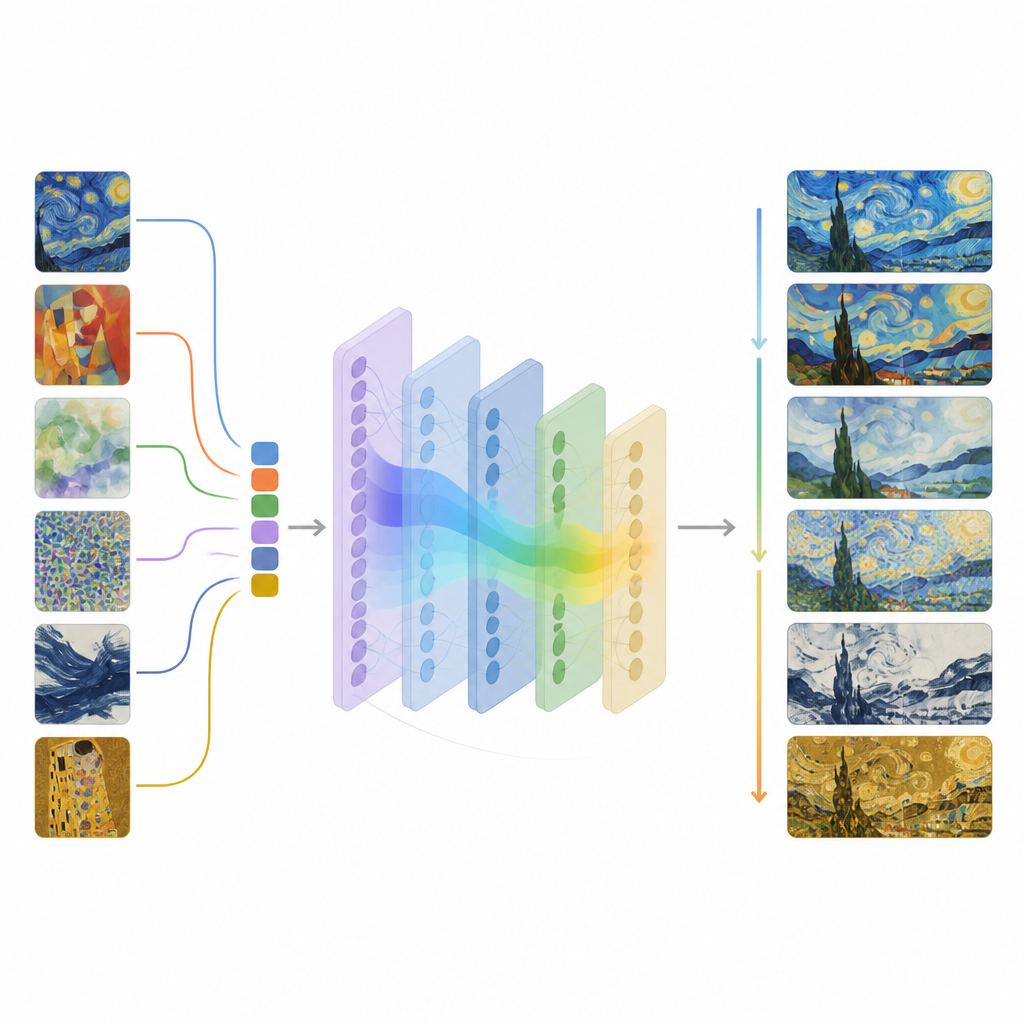
How well the AI learns the look of art
The researchers evaluated their method in several ways. They compared its images with real artworks using a standard measure that checks how similar the overall distribution of generated images is to that of the original dataset. Their approach scored better than an untuned Stable Diffusion baseline, suggesting closer alignment with real art. They also used a vision–language model to see how well an image matched both its caption and its intended style name, and reached nearly 90% accuracy when automatically classifying styles of generated images. Visual comparisons with other style transfer systems showed that the new method better preserved subject matter, avoided odd artifacts along edges, and captured hallmark traits such as loose Impressionist brushwork or bold abstract color fields.
What this means for everyday creativity
For non-specialists, the key result is that the system can turn simple text prompts into images that feel convincingly tied to specific art movements, without needing hand-picked reference pictures or intricate model surgery. A user can request a scene in one of many styles, or even slide between styles by mixing their tokens, and the system responds with images that respect both the written idea and the chosen visual language. In plain terms, the work shows that storing each style as a small learnable code, carefully trained to balance style and content, can make AI-powered art tools more flexible, efficient, and faithful to artistic intent.
Citation: Cao, X. Cross-media style transfer in art: preserving artistic intent in diverse media using GANs. Sci Rep 16, 15585 (2026). https://doi.org/10.1038/s41598-026-42852-x
Keywords: artistic style transfer, text to image, stable diffusion, creative AI, digital art