Clear Sky Science · en
Multifunctional chitosan/polyvinyl pyrrolidone/iron vanadate nanocomposites: insights into structural, optical, electrical, and dielectric properties for sustainable applications
Turning Everyday Materials into Smarter Power Storage
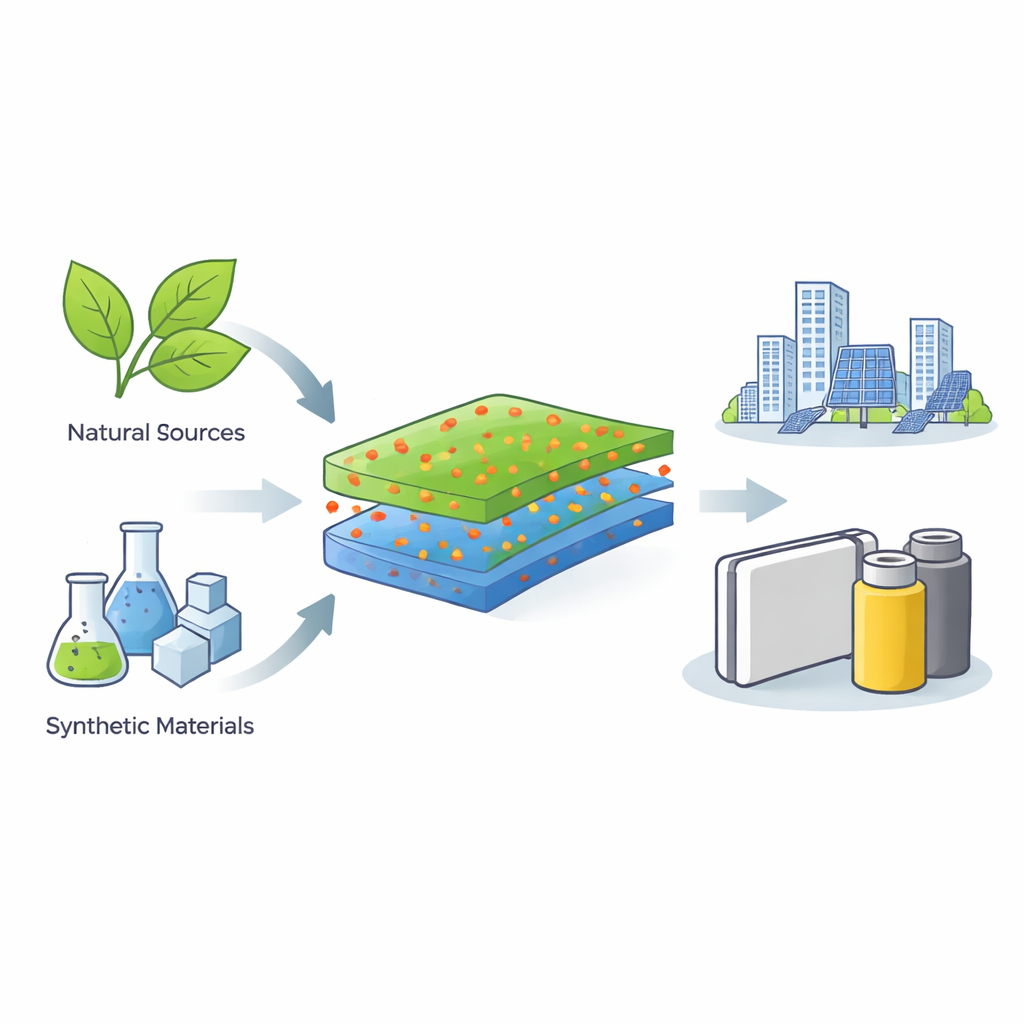
Modern life runs on stored energy, from phone batteries to backup power for solar panels. But many of the materials used today are either costly, rigid, or environmentally unfriendly. This study explores how a blend of a natural biopolymer from shellfish waste and a common synthetic polymer, enhanced with tiny iron-based particles, can form thin films that store electrical energy more efficiently—offering a path toward greener, flexible components for future electronic and energy devices.
Blending Nature and the Lab Bench
The researchers started with two polymers that complement each other. Chitosan, derived from crustacean shells, is biodegradable, biocompatible, and rich in chemical groups that can interact with other substances, but it is brittle and poorly conducting. Polyvinyl pyrrolidone, a widely used synthetic polymer, is flexible, easy to process, and has a high ability to respond to electric fields. By dissolving equal amounts of these two ingredients in water and acetic acid, then mixing in carefully measured amounts of iron vanadate nanoparticles, the team cast smooth, thin composite films and dried them into solid sheets just a quarter of a millimeter thick.
Reshaping the Inner Structure for Easier Charge Flow
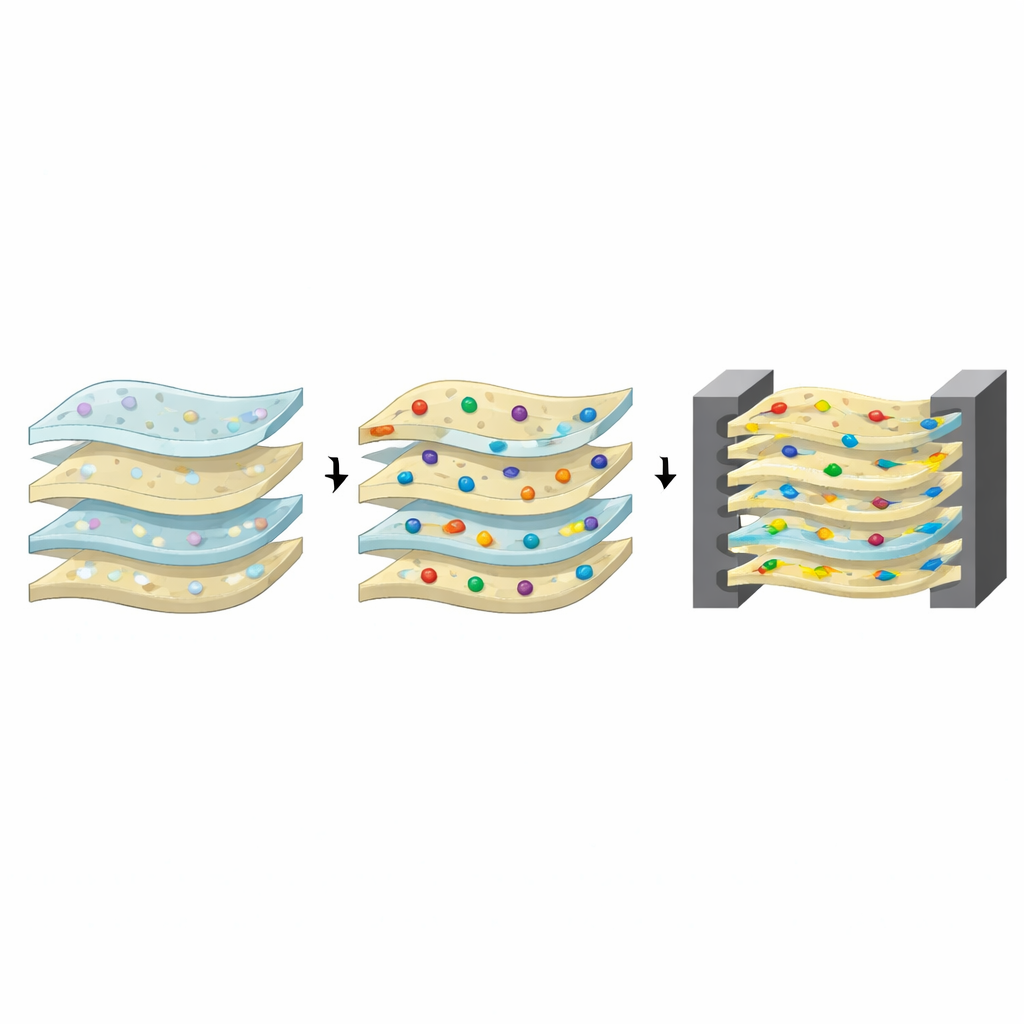
To see what was happening inside the films, the scientists used X-ray diffraction and infrared spectroscopy. These measurements revealed that adding small amounts of iron vanadate made the internal structure more disordered, or "amorphous," up to an optimal level. In polymers, this controlled disorder actually helps ions and charges move more freely, improving conductivity. The analysis also showed that the chemical groups of chitosan and PVP form hydrogen bonds with each other and interact strongly with the nanoparticles, confirming that the three components are well mixed rather than separating into clumps. This well-integrated structure sets the stage for enhanced electrical and optical behavior.
Capturing Light and Narrowing the Energy Barrier
The team next examined how the films absorb light and how easily electrons can be excited within them. Ultraviolet–visible measurements showed that films containing iron vanadate absorb more strongly, especially when the nanoparticle content is about 1.2 percent by weight. At the same time, the energy gap that electrons must overcome to move and conduct electricity shrank markedly—from about 4.4 electron volts in the pure polymer blend to roughly 3.0 electron volts at the optimal loading. This narrowing of the gap is linked to new, localized energy states created by the nanoparticles, which make it easier for electrons to hop between energy levels and contribute to electrical conduction.
From Better Conductivity to Higher Energy Density
Electrical tests across a wide range of frequencies revealed that both the direct and alternating current conductivity rose dramatically as more nanoparticles were added, peaking at about 1.2 percent by weight before declining when too many particles disrupted the uniform network. At this sweet spot, the nanoparticles form continuous paths that allow charges to move efficiently, while still maintaining good contact with the surrounding polymer chains. The films also showed a strong dielectric response—their ability to polarize in an electric field—especially at low frequencies. From these measurements, the researchers calculated that the energy density, a key figure of merit for capacitors and other storage devices, more than tripled compared to the pure polymer blend, reaching about 1.35×10⁻⁶ joules per cubic meter.
What This Means for Future Devices
In everyday terms, the study demonstrates that thin, flexible films made from a mix of natural chitosan, common PVP, and a small amount of iron vanadate can store more electrical energy and conduct charges more readily than the base polymers alone. By fine-tuning the nanoparticle content, the researchers boosted both conductivity and the ability to hold charge without sacrificing processability or moving away from largely eco-friendly ingredients. These multifunctional nanocomposite films could serve as promising building blocks for next-generation energy storage components, such as solid electrolytes, high-permittivity capacitor layers, and parts of solar cells or light-emitting devices, helping bridge the gap between sustainable materials and high-performance electronics.
Citation: Al-Harthi, A.M., Rajeh, A. Multifunctional chitosan/polyvinyl pyrrolidone/iron vanadate nanocomposites: insights into structural, optical, electrical, and dielectric properties for sustainable applications. Sci Rep 16, 12840 (2026). https://doi.org/10.1038/s41598-026-42851-y
Keywords: polymer nanocomposites, chitosan-based electrolytes, iron vanadate nanoparticles, dielectric energy storage, flexible electronics