Clear Sky Science · en
Duck lncRNA lnc455 enhances RIG-I/MAVS type I interferon signaling by modulating hnRNPAB-mediated regulation of MAVS signaling
How Ducks Help Us Understand Flu Resistance
Ducks live comfortably with bird flu viruses that can be deadly to chickens and dangerous to humans. This unusual resilience has long puzzled scientists and has big implications for predicting and preventing future pandemics. In this study, researchers uncover a previously unknown piece of the duck’s antiviral toolkit: a long non‑coding RNA, called lnc455, that helps fine‑tune the first wave of the immune response and may explain part of why ducks cope so well with influenza A viruses.
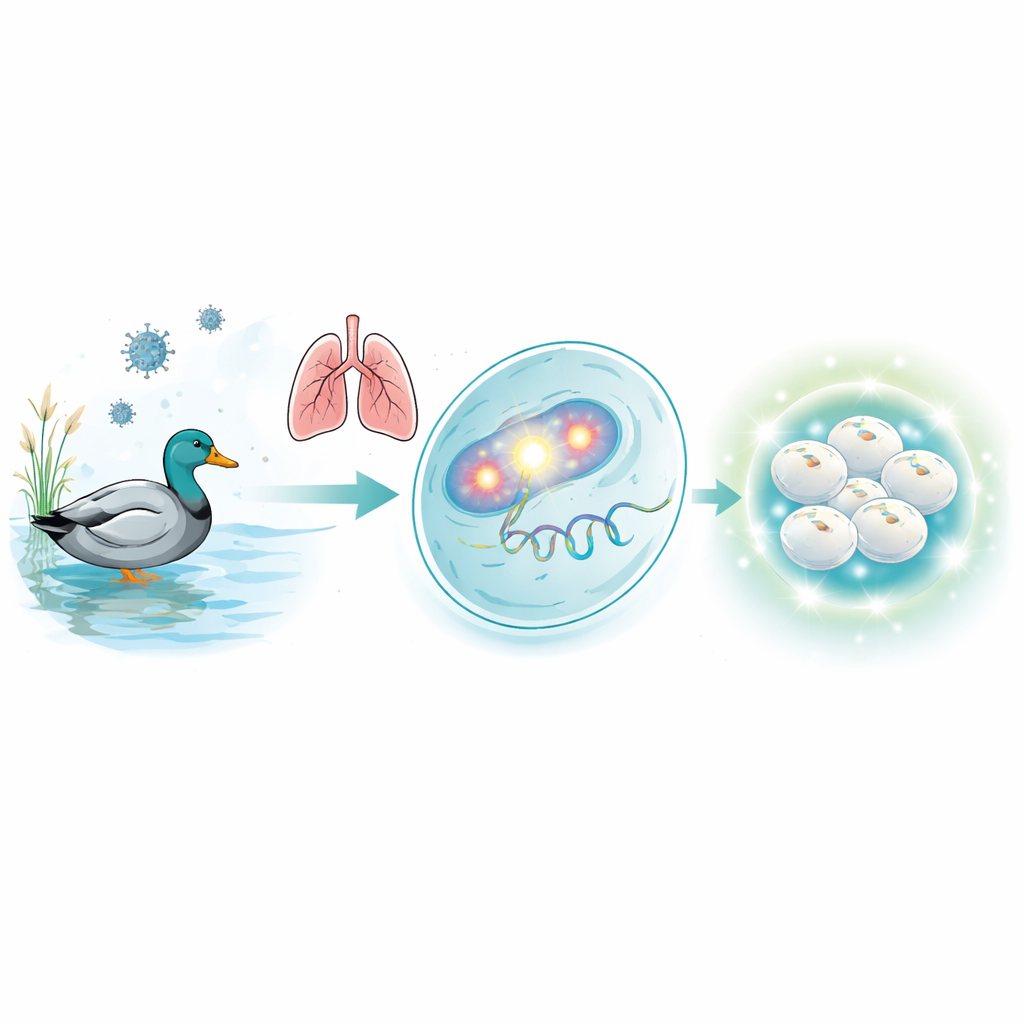
A Hidden Helper in the Duck Genome
Most people think of genes as blueprints for proteins, but much of our genetic material never makes proteins at all. Instead, it produces RNA molecules that act as regulators. Long non‑coding RNAs are part of this “dark matter” of the genome. The authors started by sifting through gene activity data from duck lungs infected with a highly pathogenic H5N1 bird flu strain. They looked for non‑coding RNAs that switched on and off in tandem with interferon‑beta, a key alarm signal that triggers hundreds of antiviral defenses. Among thousands of RNAs, one stood out: lnc455, a duck‑specific RNA that spiked early after infection and then faded, mirroring classic interferon‑stimulated genes.
Tracing the Antiviral Signal Inside the Cell
When a flu virus enters a cell, special sensors recognize its RNA and kick off a signaling cascade. In ducks, one major sensor is RIG‑I, which detects viral RNA and passes the message to a protein called MAVS anchored on the surface of mitochondria. MAVS then activates a chain of enzymes that culminates in interferon production. Because many known long non‑coding RNAs act right on these sensors, the team first asked whether lnc455 physically binds RIG‑I or MAVS. Computational tools initially suggested possible contact, but more rigorous tests—shuffling lnc455’s sequence and doing biochemical pull‑down experiments—failed to find direct binding. That pushed the researchers to consider that lnc455 might work more indirectly, influencing proteins that sit around MAVS rather than MAVS itself.
Rebuilding the Duck Pathway in Chicken Cells
To test lnc455’s function, the team turned to chicken fibroblast cells, which naturally lack RIG‑I and the duck version of lnc455. This provided a clean background in which they could “rebuild” the duck signaling system by adding duck RIG‑I, MAVS, and other components one by one. Using a reporter that glows when the interferon‑beta promoter is active, they showed that introducing lnc455 consistently boosted the signal when the RIG‑I–MAVS pathway was turned on, even without viral RNA present. Another duck non‑coding RNA used as a control showed only a weak and inconsistent effect, suggesting that lnc455 is a genuine enhancer rather than a general boost from extra RNA in the cell.
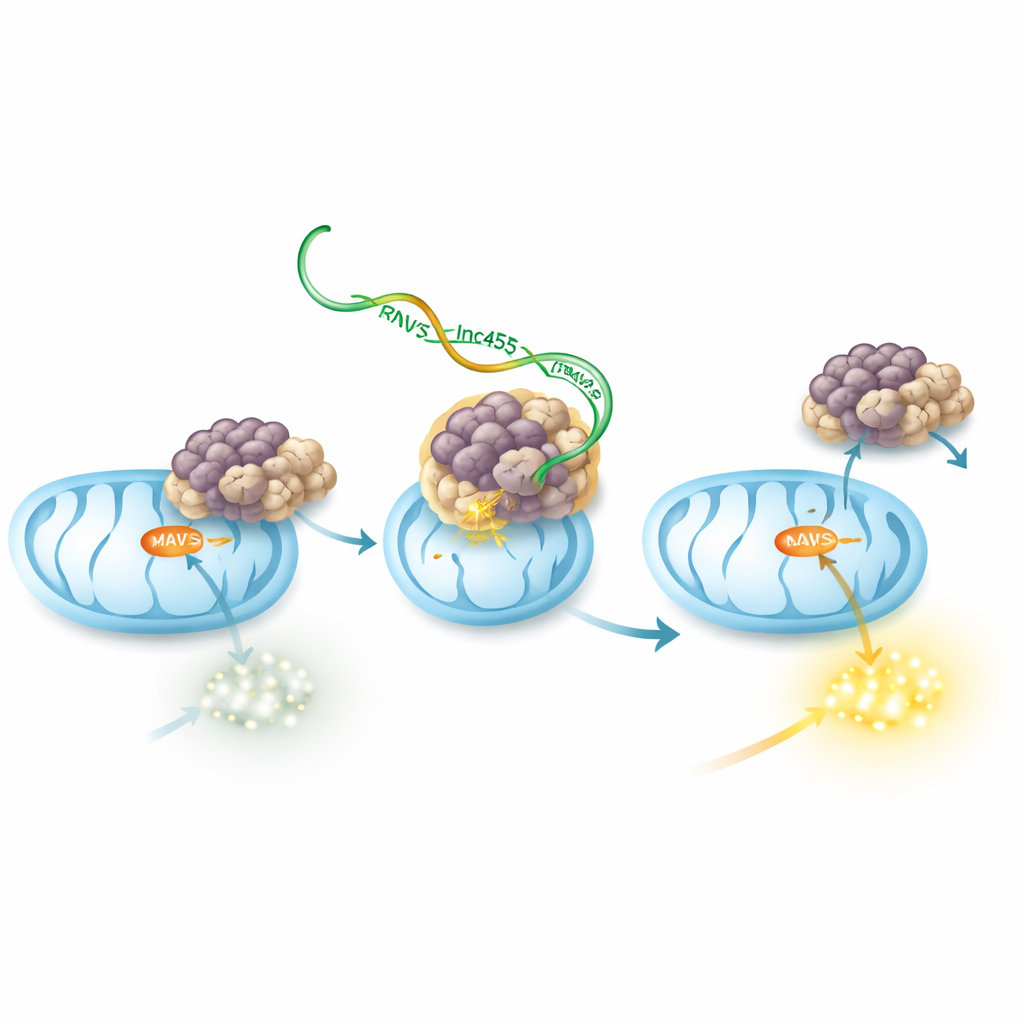
Relieving a Molecular Brake on Antiviral Defense
To understand how lnc455 works, the researchers used a technique that fishes out proteins attached to the RNA and identifies them by mass spectrometry. This revealed a small network of proteins previously linked to dialing down interferon responses, including a factor called HNRNPAB. In fish and birds, HNRNPAB family proteins are known to curb antiviral pathways. When the team overexpressed either duck or chicken HNRNPAB together with duck MAVS, the interferon signal dropped and MAVS protein levels fell. Strikingly, adding lnc455 partially restored both MAVS abundance and signaling, as if it were loosening a molecular brake. Further experiments showed that lnc455 associates with HNRNPAB in cells, supporting a model where the RNA reshapes or distracts this negative regulator right at the MAVS step, without affecting later components of the pathway.
What This Means for Ducks and for Us
Put together, the work paints lnc455 as a duck‑specific fine‑tuner of innate immunity. Rather than directly grabbing the virus sensor, it seems to protect a key signaling hub—MAVS—from being dampened by HNRNPAB and possibly other regulatory proteins. This helps ensure a strong but controlled interferon burst early in infection, which may contribute to ducks’ ability to coexist with flu viruses that devastate other species. While much remains to be learned—especially whether lnc455 is essential in live animals and how its partner proteins behave in different tissues—the discovery adds to a growing picture in which non‑coding RNAs act as subtle “mixing boards” for antiviral responses. Understanding these hidden regulators in natural reservoir hosts like ducks could ultimately improve how we design vaccines, predict viral jumps between species, and manage future influenza outbreaks.
Citation: Legaspi, R.J., Magor, K.E. Duck lncRNA lnc455 enhances RIG-I/MAVS type I interferon signaling by modulating hnRNPAB-mediated regulation of MAVS signaling. Sci Rep 16, 12925 (2026). https://doi.org/10.1038/s41598-026-42849-6
Keywords: duck antiviral immunity, long non-coding RNA, RIG-I MAVS signaling, type I interferon, avian influenza A