Clear Sky Science · en
Compressive and shear behaviour of high-water quick-setting material modified collapsible loess subgrade
Stronger Roads on Unsteady Ground
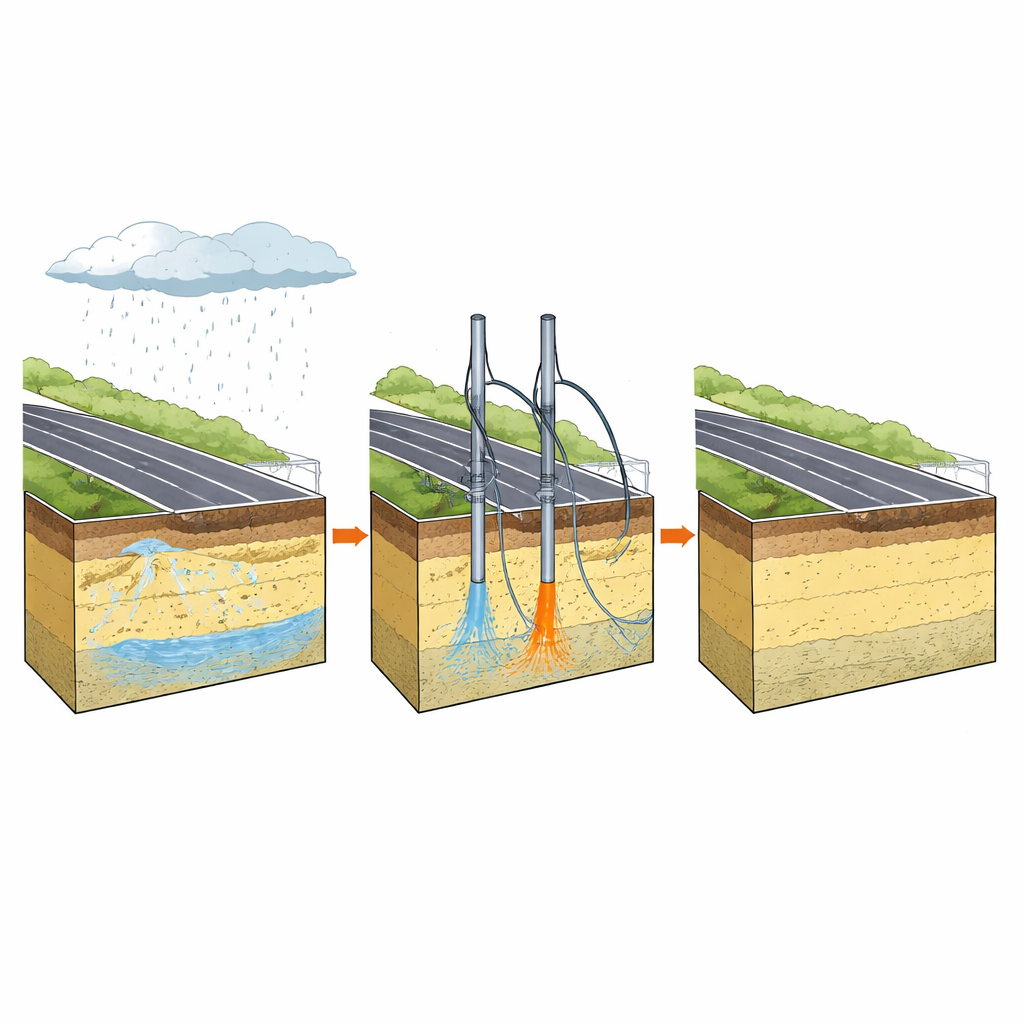
In many dry regions of the world, highways are built on a special kind of wind-blown soil called loess. When this soil gets soaked by rain or rising groundwater, it can suddenly collapse, cracking the road above and threatening traffic safety. This study explores a new, fast-acting material that can be mixed into loess to turn a weak, water‑sensitive foundation into a dense, stable base for roads in a matter of hours rather than weeks.
Why Some Soils Secretly Collapse
Loess forms from fine dust that has been piled up over long periods of time. In Xinjiang’s Ili region in western China, thick layers of this soil underlie key highway routes. Although loess looks solid when dry, it contains open, fragile structures and many pores. When water seeps in, these delicate bridges between grains can dissolve or soften, and the soil skeleton can suddenly give way. Traditional fixes such as adding cement or lime do work, but they gain strength slowly, often needing one to four weeks of curing under carefully controlled moisture. That delay is a serious drawback for busy highways that must be reopened quickly after repairs.
A Fast-Acting Mix for Weak Roadbeds
The researchers tested a “high-water quick-setting” material originally developed for underground mining. It comes as two powders that, when mixed with water, create a fluid slurry that sets within minutes and gains most of its strength within the first week. In this study, the slurry was mixed with Ili loess at different water-to-binder ratios (how wet the mixture is) and soil-to-binder ratios (how much additive is used). Cylindrical samples were prepared and cured for only 24 hours before being pushed to failure in compression and in shear, mimicking the squeezing and sliding forces that roadbeds experience under traffic.
From Weak Powder to Stiff, Crack-Resistant Ground
The tests showed that even after just one day, the treated loess reached compressive strengths of more than 3 megapascals for certain mix ratios—strong enough to meet or exceed design requirements for many highway base layers. The mixtures behaved like compact, stiff columns: they resisted deformation well but failed suddenly once they reached their load limit. Shear tests, which measure how easily soil layers slide past each other, revealed that both the bonding between grains (cohesion) and their resistance to sliding (internal friction) increased sharply compared to untreated loess. The best combinations were found when the mixture contained relatively little water and a moderate amount of binder, which created a dense, well‑connected skeleton inside the soil.
What Happens Inside the Soil
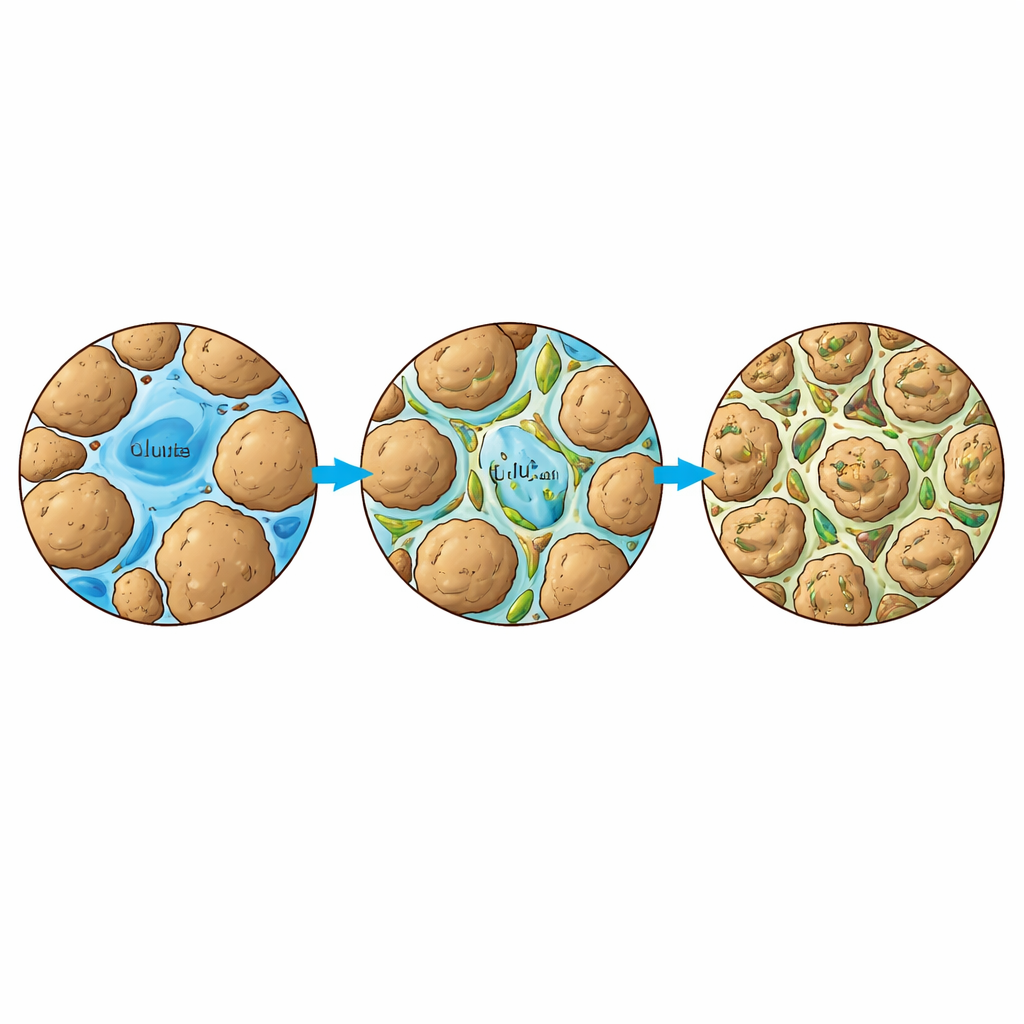
To understand why the new material worked so well, the team examined the treated loess with electron microscopes and nuclear magnetic resonance (NMR). Under high magnification, untreated loess appears as loose clusters of grains with large voids. After treatment, those voids are bridged by fine, needle‑like crystals and gel‑like films that thread between particles and pack the pores. These new solid phases, known to engineers as ettringite and C‑S‑H gel, knit the grains into a three‑dimensional network. NMR measurements, which sense water in pores, confirmed that with the right mix the overall pore space shrinks and shifts toward smaller pores, signaling a tighter, less collapsible structure. If too much water is used, however, the network becomes coarser again, strength drops, and the soil becomes more vulnerable when saturated.
Road Designs That Balance Speed, Strength, and Cost
Beyond lab tests, the authors translated their findings into practical mix recipes for road builders. For emergency repairs, a relatively rich mix with low water content delivers very high one‑day strength and good resistance to soaking, allowing damaged road sections to reopen quickly. For long‑term permanent subgrades, a slightly leaner recipe still achieves strong 28‑day performance and excellent durability while saving on binder. A more economical, higher‑water mix can be used in temporary works if extra waterproofing is provided. Across these options, keeping water content modest and using a moderate binder dose proved key to achieving strong, durable ground improvement without excessive material use.
From Laboratory Insight to Safer Highways
In plain terms, this study shows that a specially formulated quick‑setting grout can transform problem loess from a collapsible, water‑sensitive powder into a solid, stone‑like base in a very short time. By fine‑tuning how much water and binder are added, engineers can build or repair roadbeds that meet strength standards, stand up to soaking, and minimize delays for motorists. The work suggests that this high‑water quick‑setting material could become a practical, more sustainable alternative to ordinary cement for stabilizing fragile soils beneath highways in loess regions and similar landscapes worldwide.
Citation: Tang, X., Zhang, Z., Liu, Y. et al. Compressive and shear behaviour of high-water quick-setting material modified collapsible loess subgrade. Sci Rep 16, 14578 (2026). https://doi.org/10.1038/s41598-026-42841-0
Keywords: loess subgrade, soil stabilization, quick-setting binder, road foundation, ground improvement