Clear Sky Science · en
Agent-based simulation for multi-resource-constrained scheduling of scattered atypical repetitive projects
Why planning scattered projects is so hard
When a phone company rolls out dozens of new cell towers across a country, or a utility upgrades scattered substations, the work looks simple on paper: repeat similar tasks at many sites. In reality, planners must juggle crews driving long distances, unpredictable delays, and tight deadlines. Traditional tools like spreadsheets and Gantt charts struggle to capture this moving puzzle, often leading to wasted travel, idle crews, and projects that run far longer than expected. This paper presents a new computer-based planning approach that treats crews and sites as digital "agents" moving on a map, showing how smarter routing and scheduling can dramatically shorten these complex programs.
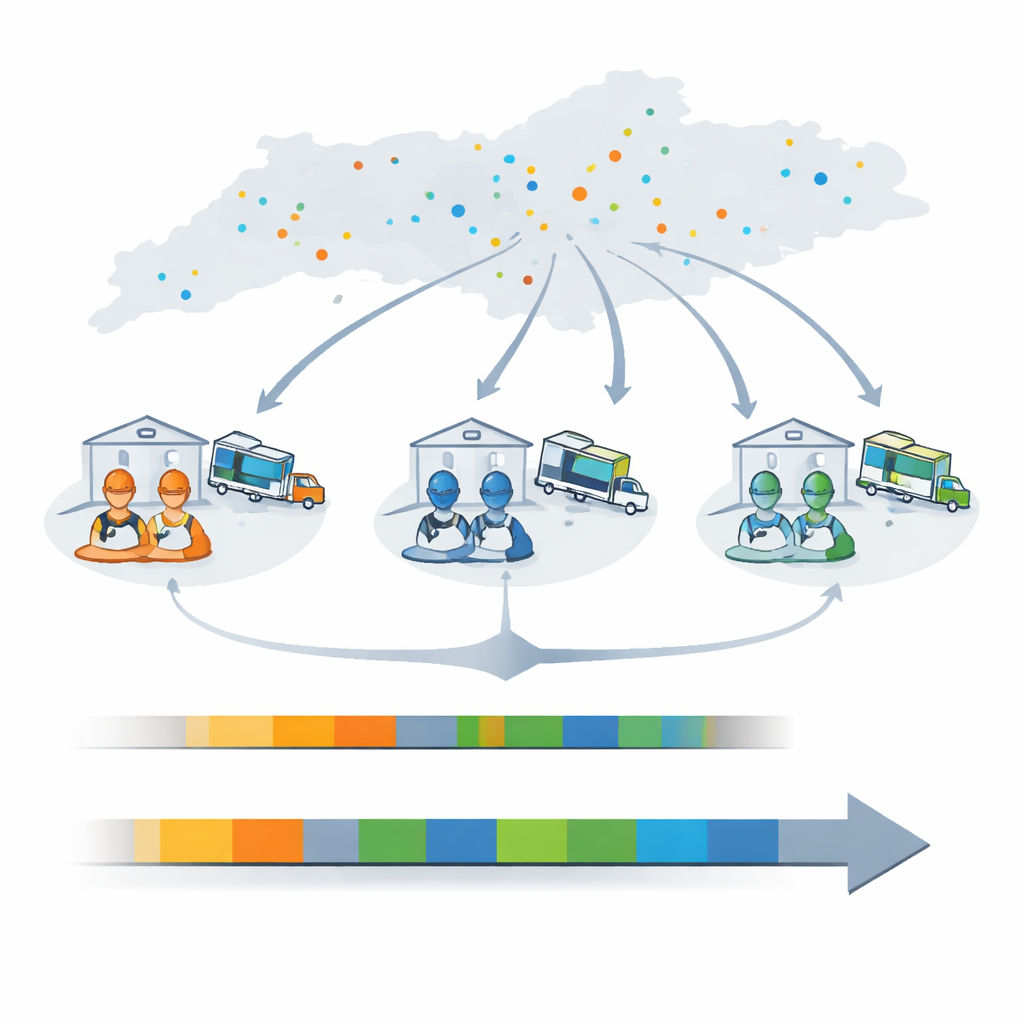
Many small jobs, big logistical headaches
The study focuses on what the authors call scattered atypical repetitive projects: think 100-plus telecom towers spread over cities, deserts, and villages, each with slightly different designs and build times. The challenge is not just deciding when to start each site, but which contractor should handle which location, in what order, and how to keep crews working steadily instead of sitting in trucks or waiting for paperwork. Classic planning methods like the Critical Path Method or Line of Balance work well for straight highways or identical apartment floors, but they falter when sites are far apart, conditions vary, and unexpected disruptions—such as permit delays or access issues—are common.
Turning crews and sites into digital actors
To tackle this, the authors build an agent-based simulation model linked to real geographic data. Every construction site is a software agent with its own location, type (for example, a new tower on open land versus equipment added to an existing structure), and expected duration. Every contractor is another agent, defined by where its crews start from, what kinds of sites they are qualified to build, and how many jobs they can run at once. These agents "live" inside a map-based environment and follow simple rules: when a crew finishes one site, it looks for the nearest unfinished site it is allowed to work on and moves there. The model also sprinkles in random delays to reflect weather, permits, or delivery problems, so each simulation run produces a slightly different, but realistic, project history.
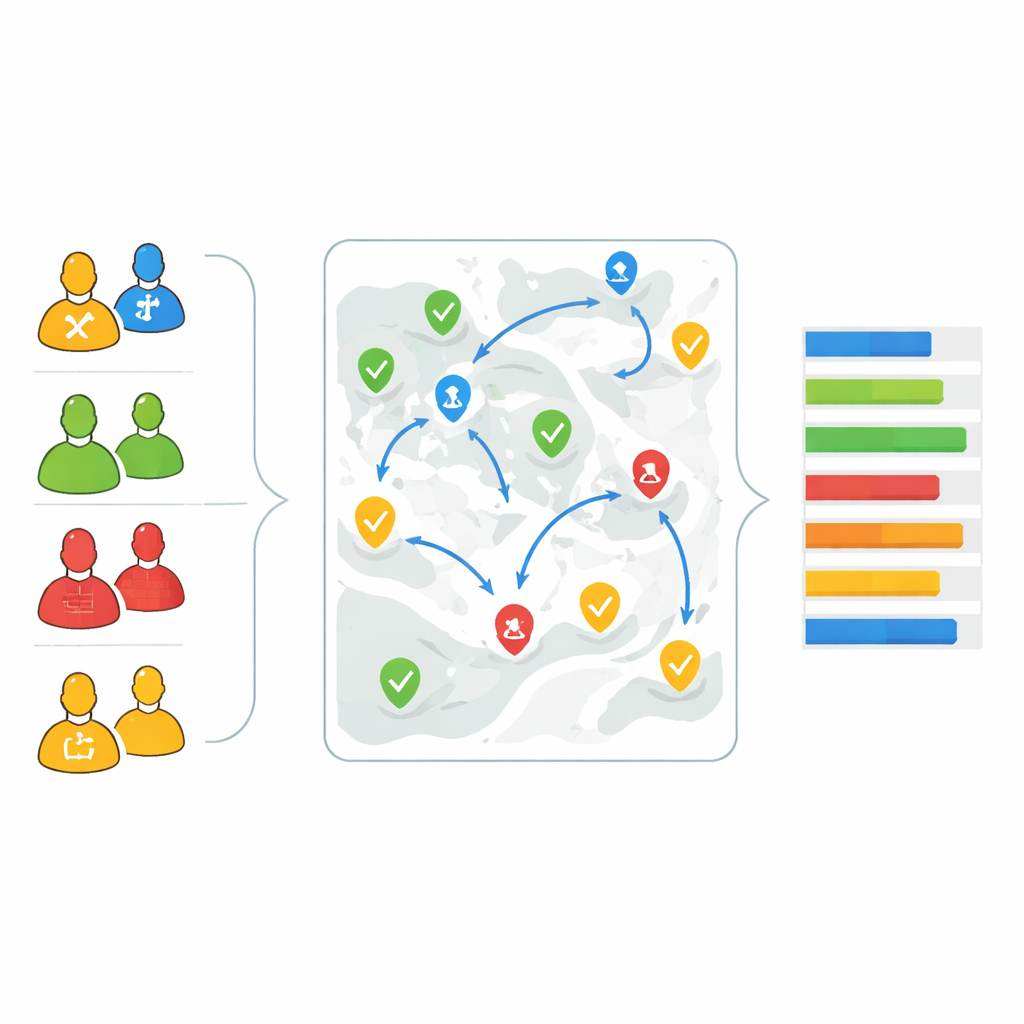
Adding smart search on top of simulation
Because there are many ways to assign dozens of sites to multiple contractors, the researchers add an optimization layer inspired by biological evolution. The computer generates many alternative assignment patterns—different ways to divide the site pool among contractors—and for each one, it runs the simulation repeatedly to see how long the overall program takes. Over many cycles, it keeps the better-performing patterns and mixes them to create new ones, gradually homing in on crew–site combinations and routing patterns that finish sooner. Along the way, the model automatically records performance measures such as how much time each crew spends traveling, how often they are idle, and how heavily they are utilized.
Real-world telecom rollout as a test bed
The framework is tested on a large telecom deployment program in Egypt involving 138 tower sites of three main types: full new-build Greenfield towers, rooftop towers, and quick "sharing" upgrades on existing structures. The authors use actual site coordinates, contractor depots, realistic calendars, and delay statistics drawn from project logs. They then compare their simulated schedules with the company’s original Excel-based plan, which assumed about 100 days to finish the program. Using the same contractors and field constraints, the agent-based approach consistently completes the work in roughly 49–56 days across twenty independent simulation runs, cutting the average duration to about 54 days—a reduction of 46 percent. The model also reveals which contractors travel the most, where long-distance assignments still occur, and how well crews are kept busy under different capacity and specialization scenarios.
What this means for future projects
In plain terms, the study shows that treating crews and sites as interacting actors on a map—and letting a computer explore many routing and assignment options under uncertainty—can turn a sprawling, scattered program into a far more efficient operation. Instead of hand-built spreadsheets that ignore geography and randomness, planners can use this framework to test "what if" scenarios, see how travel and delays ripple through the schedule, and choose crew allocations that reliably finish sooner. While the current model focuses on time and does not yet optimize costs or fuel use, its success on a real telecom rollout suggests that agent-based, map-aware simulation paired with optimization can become a practical decision tool for many kinds of geographically dispersed construction and infrastructure programs.
Citation: Sultan, R.A., Hamdy, K. & Essawy, Y.A.S. Agent-based simulation for multi-resource-constrained scheduling of scattered atypical repetitive projects. Sci Rep 16, 11759 (2026). https://doi.org/10.1038/s41598-026-42832-1
Keywords: agent-based simulation, construction scheduling, geographically dispersed projects, crew allocation, telecom infrastructure