Clear Sky Science · en
The deubiquitinating enzyme Otu1 releases substrates from the conserved initiation complex of the Cdc48/p97 ATPase for proteasomal degradation
How Cells Decide Which Proteins to Destroy
Inside every cell, thousands of proteins are constantly made, used, and then discarded. To stay healthy, the cell must decide which proteins to recycle and which to keep. This paper uncovers how a little-known helper enzyme, Otu1, keeps this cleanup system from getting stuck, ensuring that unwanted proteins are actually destroyed instead of endlessly circling in a molecular traffic jam.
Tagging Proteins for the Cellular Trash System
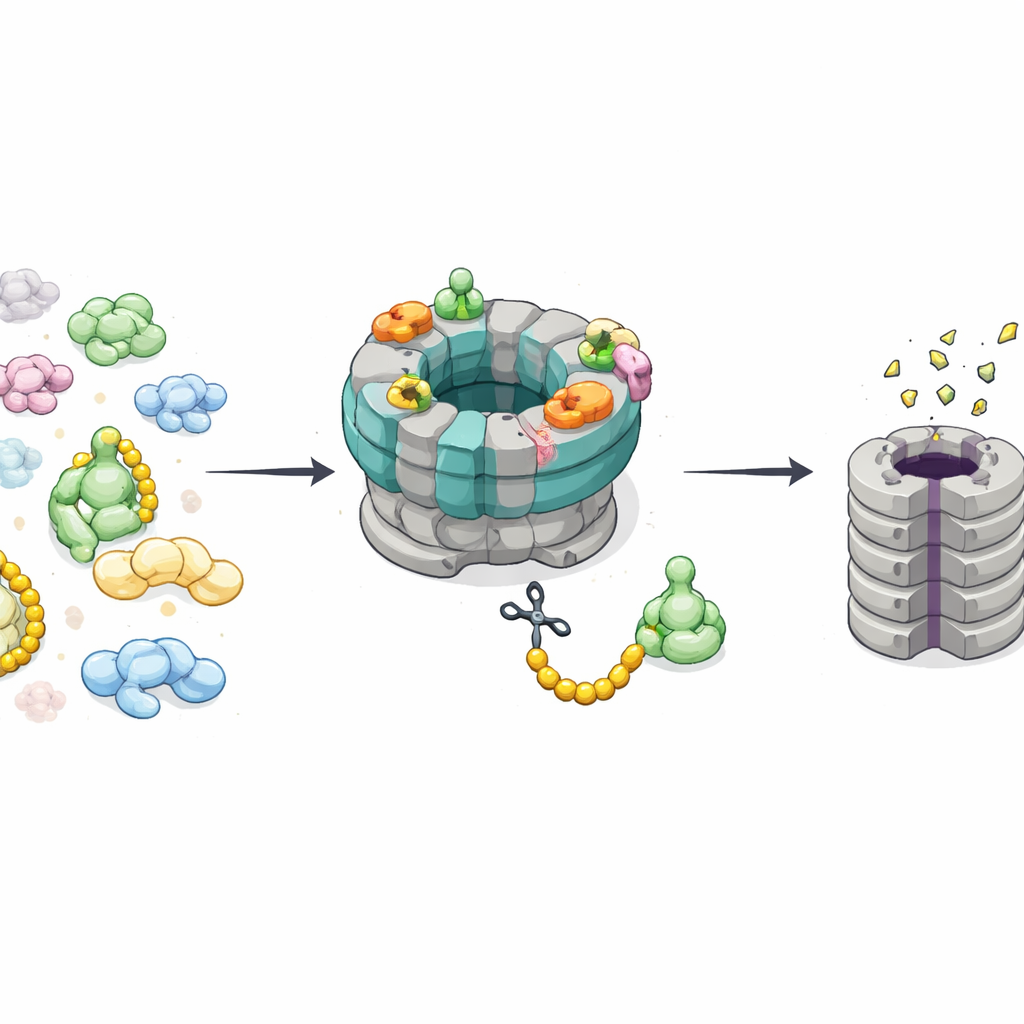
Cells mark proteins for destruction by attaching a small molecule called ubiquitin in a chain, like a string of beads. Once tagged, these proteins can be handled by two major machines: Cdc48 (called p97 in humans), which helps unfold sturdy, well-folded proteins, and the 26S proteasome, which chews them up into small pieces. Some proteins can go directly to the proteasome, but many first have to be pulled apart by Cdc48/p97 before they are ready to be fed into the cellular shredder.
When Good Cleanup Turns Into a Futile Cycle
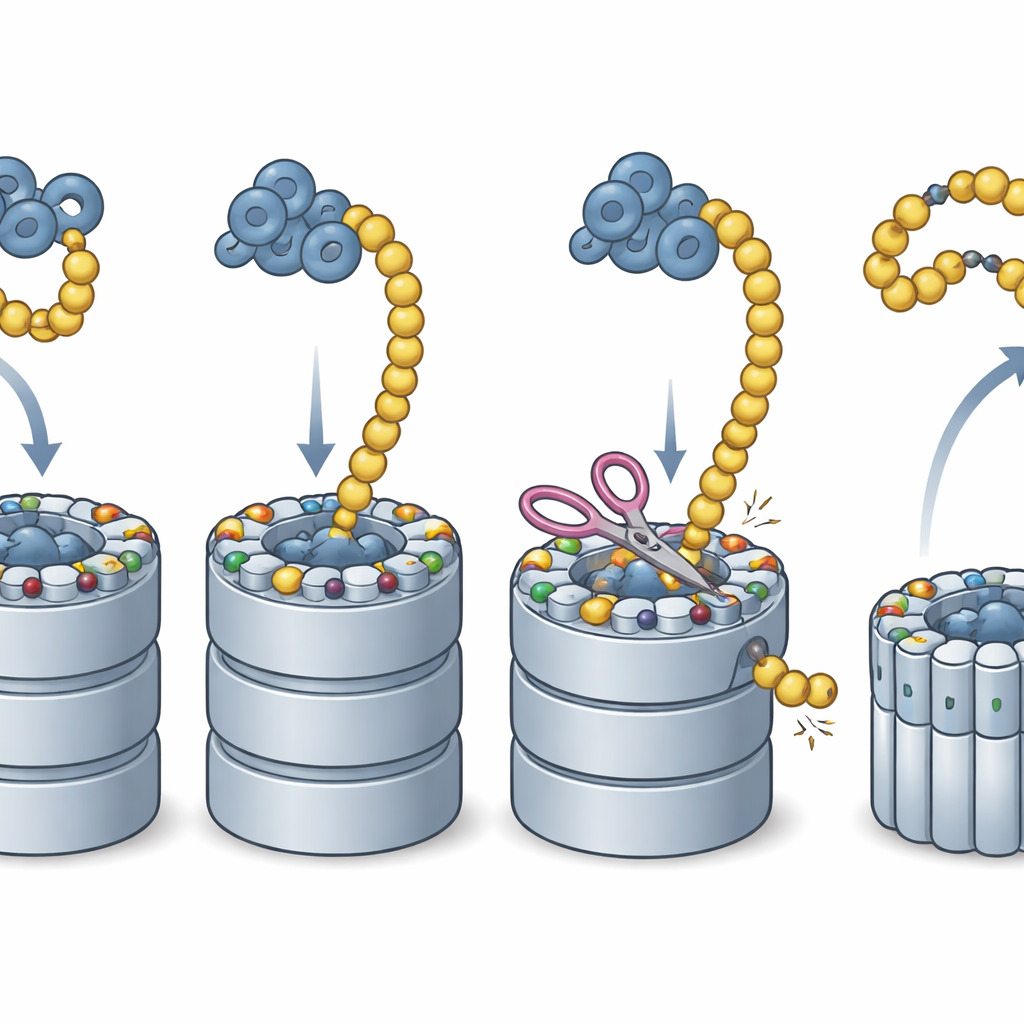
Cdc48/p97 grabs the ubiquitin chain through a set of helper proteins and begins pulling on one ubiquitin unit, threading it and then the attached protein through a central pore. After this mechanical tug-of-war, both ubiquitin and the protein can end up refolded on the far side of the machine. The problem is that the same tagged protein can then reattach to Cdc48/p97 and be pulled again, creating a futile cycle where the protein is repeatedly processed but not handed off efficiently to the proteasome for destruction.
A Molecular Trimmer That Breaks the Loop
The authors reconstituted the system in a test tube with purified proteins to find out how this cycle is broken. They focused on Otu1 (and its human cousin Yod1), an enzyme that can cut ubiquitin chains. Their experiments show that Otu1 does not strip the tag off entirely; instead, it trims the chain down. This subtle shortening is enough to weaken the protein’s grip on Cdc48/p97 while still leaving enough ubiquitin for the proteasome to recognize and degrade the protein. In other words, Otu1 acts like a precise trimmer that encourages tagged proteins to leave Cdc48/p97 and move on to the proteasome.
A Conserved Machine Seen in Atomic Detail
To see how this process looks in human cells, the researchers used cryo-electron microscopy to determine a high-resolution structure of the human p97 complex with its cofactors and a ubiquitin-tagged substrate. The structure shows a ubiquitin molecule in the chain partially unfolded and threaded straight through the central pore of p97, just as seen previously in yeast. This confirms that the basic mechanism—unfolding a single ubiquitin as the starting handle and then pulling the rest of the chain and the substrate—has been conserved across evolution. The structure also reveals that multiple helper proteins, including the human Otu1 equivalent Yod1 and the Ubx5 equivalent UBXN7, can bind p97 at the same time, forming a large, coordinated complex.
Implications for Protein Quality Control and Cancer Drugs
The work shows that Otu1 is part of a select group of enzymes that actually promote protein destruction instead of blocking it, by fine-tuning the ubiquitin tags so that substrates are released from Cdc48/p97 at the right moment. Because human p97 is a major target for cancer drugs, the detailed structural snapshots of how it grips unfolded ubiquitin suggest new ways to design therapies: for example, molecules that block the binding groove for unfolded ubiquitin and selectively disrupt this powerful unfolding machine.
Citation: Li, H., Guan, H. & Rapoport, T.A. The deubiquitinating enzyme Otu1 releases substrates from the conserved initiation complex of the Cdc48/p97 ATPase for proteasomal degradation. Sci Rep 16, 12548 (2026). https://doi.org/10.1038/s41598-026-42811-6
Keywords: protein degradation, ubiquitin, proteasome, p97 Cdc48, deubiquitinating enzyme