Clear Sky Science · en
Identification of cellular ion channels that facilitate Hazara nairovirus infection enables selection of clinically approved compounds with anti-nairoviral properties
Why this matters
Crimean Congo haemorrhagic fever is a tick borne disease that can kill a large fraction of the people it infects, yet there are no approved treatments. To study this threat safely, scientists use a closely related virus called Hazara virus that can be handled in lower security labs. This study asks a simple but powerful question: can we weaken such viruses not by targeting the virus itself, but by tweaking the tiny electrical gates in our own cells that the virus depends on to get inside?
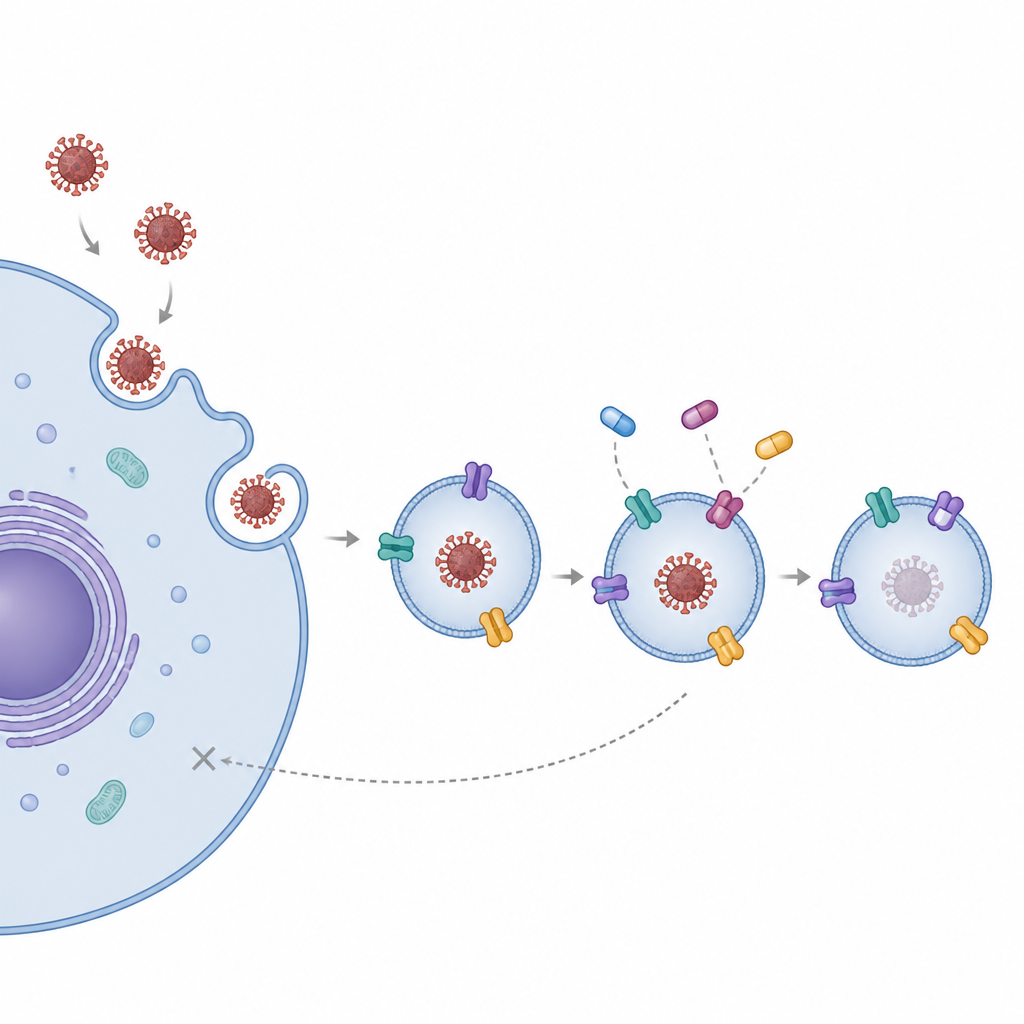
Viruses that ride the cell’s inner conveyor belt
Many enveloped viruses, including Hazara virus, do not drill straight through the outer cell membrane. Instead, they are swallowed into small internal bubbles called endosomes, which gradually change as they move deeper into the cell. Inside these bubbles, the concentration of hydrogen and potassium ions shifts, changing acidity and electrical balance. Those subtle shifts trigger shape changes in viral surface proteins that allow the virus to fuse with the endosome membrane and release its genetic material into the cell interior. Because human ion channels control these ion levels, they offer a potential handle for slowing or blocking infection.
Searching cell gates that viruses rely on
The researchers systematically switched off 88 different human ion channels in lung derived cells using small interfering RNAs, then infected the cells with a fluorescent version of Hazara virus. By tracking green glow as a stand in for viral growth, they identified which channels the virus relied on most. Almost half of the strongest hits were potassium channels, with several calcium channels and a few sodium and non selective channels also playing a role. This pattern suggested that potassium and calcium movement across endosomal membranes is especially important for successful Hazara virus multiplication.
Everyday drugs that quietly slow the virus
Armed with this map of vulnerable channels, the team turned to a practical next step: testing clinically approved drugs that already target these channels. Several potassium channel blockers, including quinidine and quinine, and the anti arrhythmic drug dronedarone, all reduced viral protein production and the release of new virus particles without harming the cells at the tested doses. Calcium channel blockers such as tetrandrine and nifedipine also lowered viral activity, while sodium channel blockers had little effect. Careful timing experiments revealed that potassium channel inhibition worked best when drugs were present during the earliest hours of infection, pointing to a key role during the entry phase rather than later steps like assembly or exit.
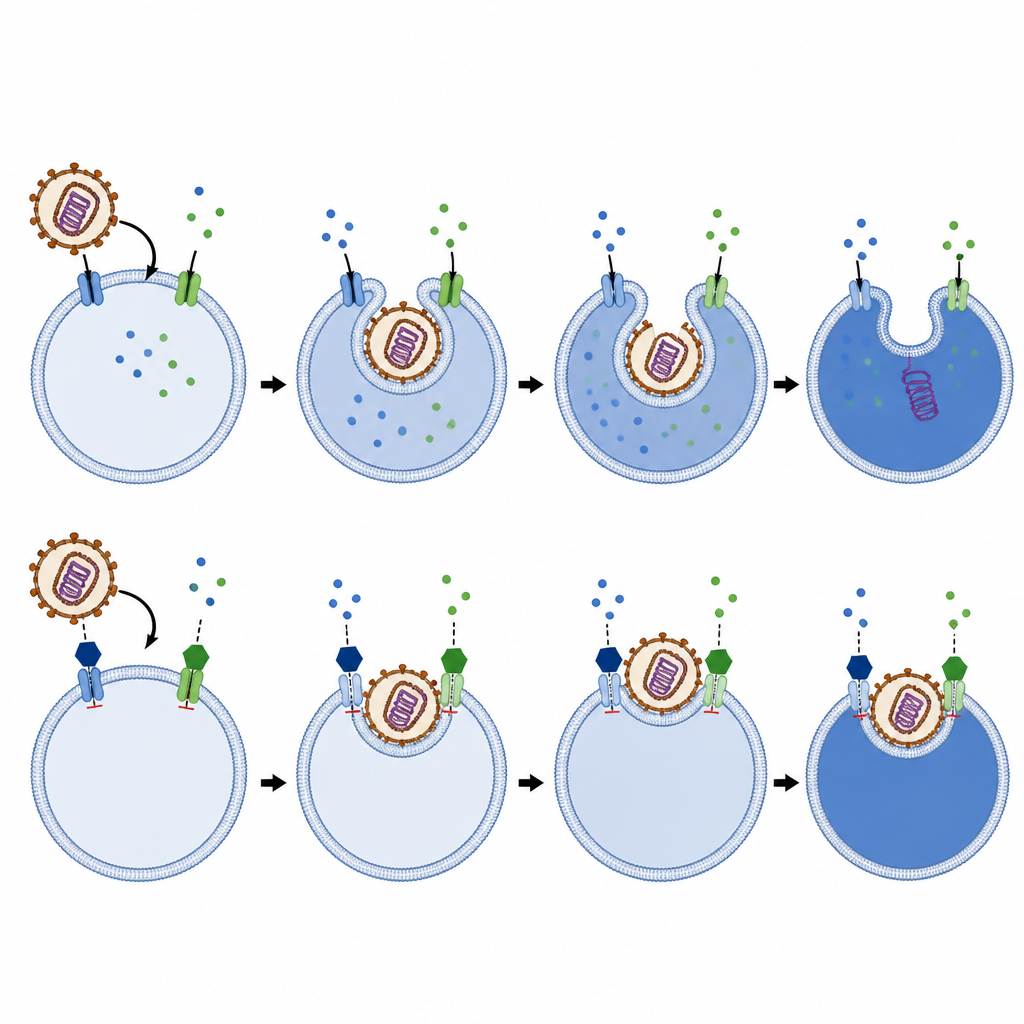
How shifting ions reshapes the entry window
To understand what potassium itself does to the virus, the scientists exposed Hazara virus particles to carefully controlled mixtures that varied in acidity and potassium concentration before adding them to cells. Without extra potassium, even small drops in pH quickly damaged the virus and sharply reduced its ability to infect. When potassium was present at levels similar to those thought to exist in endosomes, the virus tolerated a wider pH range and remained infectious down to more acidic conditions. This suggests that potassium helps hold the viral surface in a fusion ready state for longer, giving the virus more chances to escape from endosomes as they mature and move deeper inside the cell.
What this could mean for future treatments
Together, these findings paint a picture of Hazara and related nairoviruses as dependents on host potassium and calcium channels during their first crucial steps inside the cell. By blocking those channels with drugs that are already used in the clinic for heart or blood pressure conditions, it may be possible to reduce viral entry and spread. While more work is needed, especially with the more dangerous Crimean Congo virus and in animal models, this study points to a realistic path where existing ion channel medicines could be repurposed as part of antiviral strategies against a serious tick borne disease.
Citation: Charlton, F.W., Hover, S.E., Alyahyawi, A. et al. Identification of cellular ion channels that facilitate Hazara nairovirus infection enables selection of clinically approved compounds with anti-nairoviral properties. Sci Rep 16, 14840 (2026). https://doi.org/10.1038/s41598-026-42810-7
Keywords: Hazara virus, Crimean Congo haemorrhagic fever, ion channels, potassium channel blockers, viral entry