Clear Sky Science · en
Hydrogen storage potential of cubic InXH3 (X = Be, Mg, Ca, Sr, Ba, Ra) hydride perovskites: a comprehensive first principles investigation
Why Storing Hydrogen Matters
As the world searches for cleaner alternatives to coal, oil, and gas, hydrogen stands out as a fuel that produces only water when used. But keeping hydrogen safely and compactly stored remains a major hurdle, especially if we want it to power cars, trucks, and energy systems at scale. This study explores a special family of crystalline materials, called hydride perovskites, that could hold hydrogen in solid form and release it when needed, potentially helping to build a future hydrogen economy.
New Materials for Holding Hydrogen
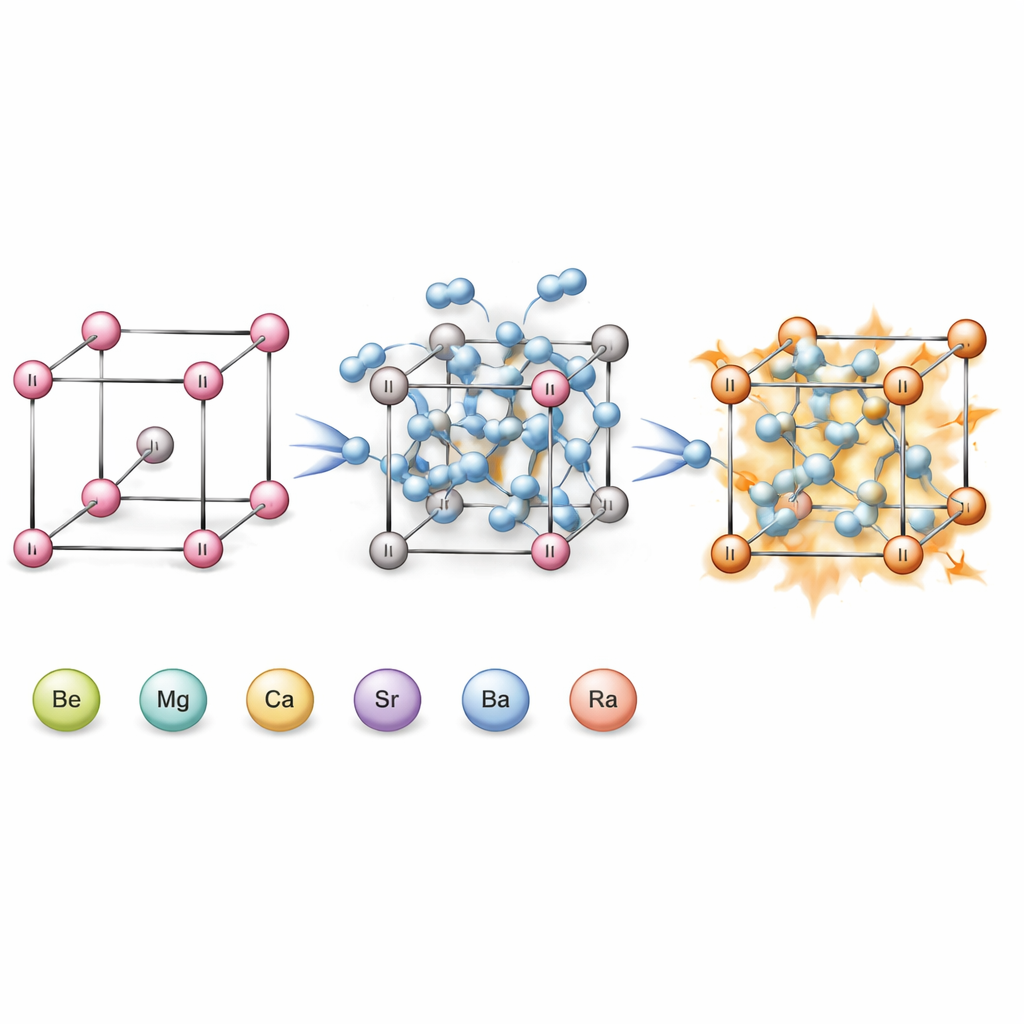
The researchers focused on a series of related compounds with the formula InXH3, where indium (In) and hydrogen (H) are combined with one of six alkaline earth metals (X = Be, Mg, Ca, Sr, Ba, Ra). Inside these materials, atoms arrange themselves in a highly ordered cube-like framework known as a perovskite structure. Using powerful computer simulations based on quantum mechanics rather than laboratory experiments, the team asked a basic question: are these crystals structurally sound and energetically willing to host hydrogen atoms in their lattice?

Testing Strength and Stability on the Computer
First, the team checked whether each compound could exist in a stable cubic form. They calculated geometric measures and found that all six materials fall well within the range typical for robust perovskites, meaning their atomic building blocks fit together comfortably. They then examined mechanical properties such as stiffness and resistance to shape change. All compounds passed standard stability checks, but their rigidity varied: compositions with lighter metals like magnesium were stiffer, while those with heavier metals like radium were softer. This tunable stiffness matters because a crystal that can flex slightly may allow hydrogen to move and be released more easily, while still holding it securely when needed.
How Electrons Shape Hydrogen Behavior
The researchers next turned to the electronic behavior of these materials, which strongly influences how tightly hydrogen is bound. Two of the compounds, based on beryllium and magnesium, behaved like metals, with electrons free to move throughout the crystal. The others showed small but direct energy gaps, placing them between metals and good insulators. By using a more accurate, but more demanding, computational method, the team refined these energy gaps and confirmed that several members of the family act as narrow-gap semiconductors. In simple terms, this mix of metallic and semiconducting behavior suggests a range of bonding strengths between hydrogen and the surrounding atoms, offering knobs to tune how easily hydrogen can be absorbed and released.
Light, Hydrogen, and Practical Limits
Beyond structure and electrons, the study also probed how these crystals respond to light, which is important for any material that may be used near optical or electronic devices. All six compounds showed strong and stable optical responses over a wide range of energies, indicating that their frameworks remain robust under energetic radiation. Most crucially for hydrogen storage, every compound had a negative formation energy, meaning that, at least in theory, they can form spontaneously and are thermodynamically stable. The team computed how much hydrogen each material can hold by weight and per unit volume, and how hot they must become before releasing that hydrogen. The lightest member, InBeH3, came out on top, with the highest hydrogen content and a moderate release temperature, while heavier versions stored less hydrogen and required more heat to let it go.
What This Means for Future Hydrogen Systems
Although the best-performing compound, InBeH3, still falls short of the aggressive storage targets set for hydrogen-fueled vehicles, it and its relatives provide a valuable blueprint. They show that cubic hydride perovskites built from indium and alkaline earth metals can be stable, tunable hosts for hydrogen, with properties that can be adjusted by swapping one metal for another. These materials are therefore promising candidates for stationary or off-board storage, where weight limits are less strict but safety and control of hydrogen release are vital. More broadly, the work demonstrates how first-principles calculations can guide the design of next-generation solid materials for clean energy, long before they are made in the lab.
Citation: Amin, A.B., Naeem, H., Rizwan, M. et al. Hydrogen storage potential of cubic InXH3 (X = Be, Mg, Ca, Sr, Ba, Ra) hydride perovskites: a comprehensive first principles investigation. Sci Rep 16, 12319 (2026). https://doi.org/10.1038/s41598-026-42809-0
Keywords: hydrogen storage, perovskite hydrides, solid-state energy, density functional theory, clean fuels