Clear Sky Science · en
Preparation of motion sensor using AgNWs material and performance analysis in sports activities
Smart Bandages for Everyday Motion
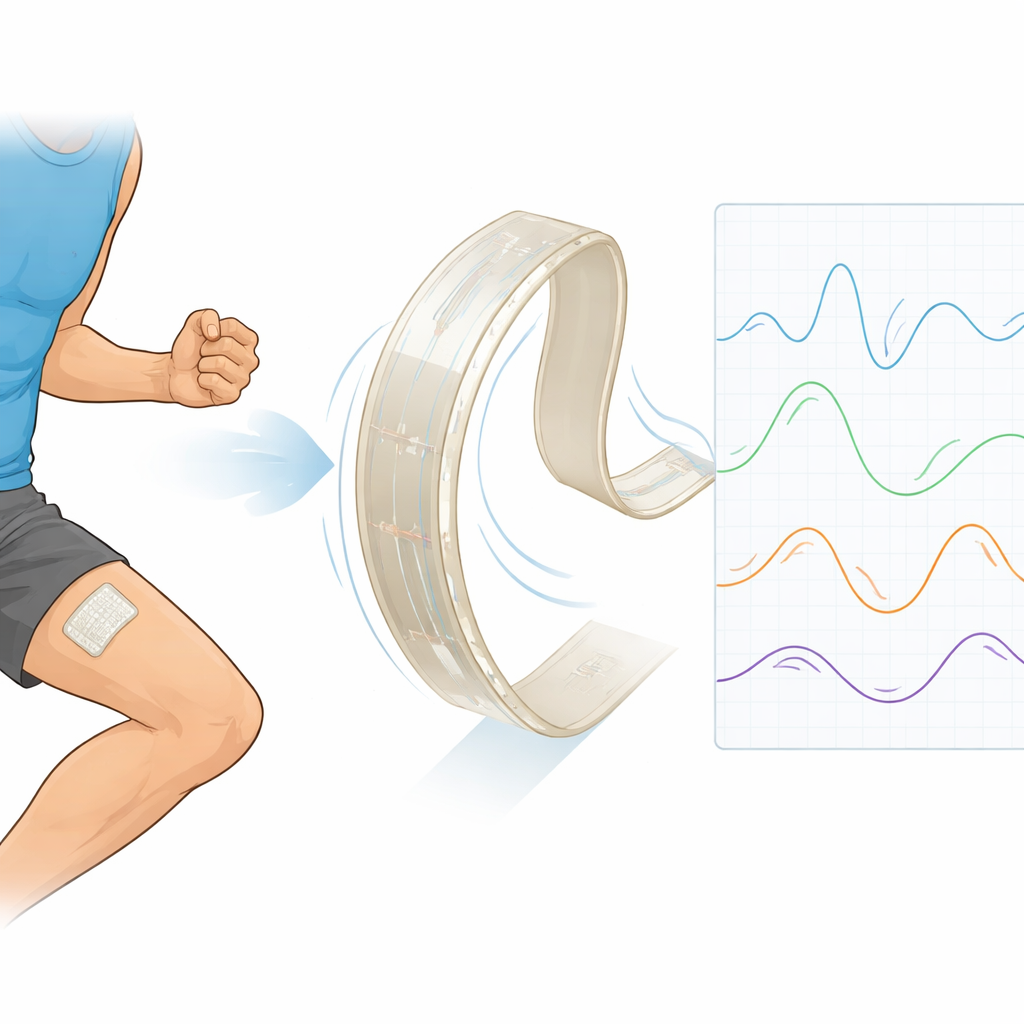
Imagine a flexible sticker on your skin that quietly tracks how your muscles fire and how your joints move while you train, rehab from injury, or simply go for a jog. This study presents such a motion sensor, built to work like a second skin during real exercise. By rethinking both the materials and the way they are combined, the researchers created a stretchy, durable "electronic bandage" that can read muscle activity with stable, high‑quality signals during sports.
Why Better Motion Sensors Matter
As training and health monitoring become more data driven, coaches and doctors want accurate information about how our bodies move in real time. Many existing flexible sensors struggle when put to the test in real‑world activity: their signals drift, they respond too slowly to quick movements, and useful information is easily buried in electrical noise. This paper targets those weak spots. The authors focused on a material called polydimethylsiloxane (PDMS), a soft, rubbery silicone often used in medical devices, and combined it with ultra‑thin silver nanowires that act like tiny electrical paths. The goal was a sensor that stretches with the body yet keeps its readings sharp and reliable, especially during dynamic sports motions.
Building a Stretchy Electrical Net
At the heart of the design is a three‑dimensional network of silver nanowires locked inside the flexible PDMS. Getting these nanowires to spread out evenly and stick firmly in the soft material is difficult; if they clump together or slide around, the electrical signal becomes unstable. The team solved this by first mixing the nanowires into dimethyl silicone oil and using ultrasound to break up clumps. This pre‑mixed suspension is then blended into uncured PDMS, poured into a mold, and gently dried and heated so the silicone cross‑links into an elastic solid. During this process, the silver nanowires form an interconnected web inside the cured PDMS, creating many overlapping points through which electricity can flow. When the strip is stretched, this web deforms, changing how easily current can pass, which allows the device to sense strain.
From Lab Recipe to Wearable Device
To turn this sensitive strip into a practical motion sensor, the authors combined several manufacturing steps. They used spin coating to create a thin, uniform conductive film and screen printing to add silver‑based electrodes in patterns designed with computer‑aided design software. The same design tools were used to shape the width and curvature of the sensor circuits so they would hug the skin comfortably and pick up clean signals. The completed devices were tested with a tensile machine that repeatedly stretched them while instruments measured changes in resistance. The sensors were also attached to the skin over key muscles, and a professional bioelectric recording system captured muscle electrical activity during rest and exercise. Signal processing methods were then applied to separate meaningful muscle signals from background noise and to compute the signal‑to‑noise ratio.
Putting the Sensor Through Sports Tests
The new PDMS‑based sensor was compared with versions made using two other common flexible substrates: cellulose nanofiber (CNF) and polyethylene terephthalate (PET). Across 3,000 stretching cycles, the PDMS sensors showed a resistance fluctuation of less than 5 percent, far smaller than for CNF and PET, which exhibited larger drifts and signs of fatigue. In stretching tests up to 60 percent strain, the PDMS sensors responded roughly twice as fast as CNF‑based ones and clearly faster than PET‑based devices. When the researchers mimicked typical human motion frequencies between 0.5 and 2 hertz, the PDMS sensors remained stable and produced strong signals in the 0.5–1.5 hertz range, which matches most natural limb movements. During basketball drills with volunteers wearing the sensors on their arms and legs, the devices consistently produced muscle signals with an average signal‑to‑noise ratio around 25 decibels, meaning the useful information far outweighed the background electrical chatter.

What This Means for Training and Health
In simple terms, the study shows that carefully arranging tiny silver wires inside a soft silicone band can create a motion sensor that stretches with the body yet keeps its readings remarkably steady. Compared with similar devices made on stiffer or more fragile materials, the PDMS‑based sensor offers better durability, faster response, and cleaner signals during realistic sports activity. While questions remain about long‑term comfort, temperature effects, and use in more extreme movements, this work points toward future wearable patches that could track muscle effort and joint motion with laboratory‑grade precision on the playing field, in the clinic, or even at home.
Citation: Wang, H. Preparation of motion sensor using AgNWs material and performance analysis in sports activities. Sci Rep 16, 13045 (2026). https://doi.org/10.1038/s41598-026-42806-3
Keywords: wearable motion sensor, silver nanowires, flexible electronics, sports performance monitoring, electromyography