Clear Sky Science · en
A unified Haar wavelet collocation framework for fractional volterra integro-differential equations with application to tumor-immune dynamics modeling
Why equations can help fight cancer
Modern medicine increasingly relies on computers and mathematics to understand how diseases grow and how treatments work. This article introduces a new way to solve a difficult family of equations that describe systems with “memory,” such as how tumors interact over time with the immune system and cancer drugs. By making these equations easier and faster to solve, the authors open the door to more realistic computer models that could ultimately help design better cancer therapies.
Capturing systems that remember their past
Many real-world processes do not react only to what is happening right now; they also depend on what has happened over hours, days, or years. Traditional equations with ordinary derivatives often miss this history. The paper focuses on a richer class of models called fractional Volterra integro-differential equations. These equations combine three ingredients: rates of change with memory, ordinary rates of change, and integrals that collect the influence of the entire past up to the present. Such models appear in problems ranging from heat flow in materials that “remember” previous temperatures to population dynamics with delayed feedback. In biology, they are especially relevant for processes like tumor growth and immune response, where past exposure and lingering effects matter.
Using simple building blocks to tame complex behavior
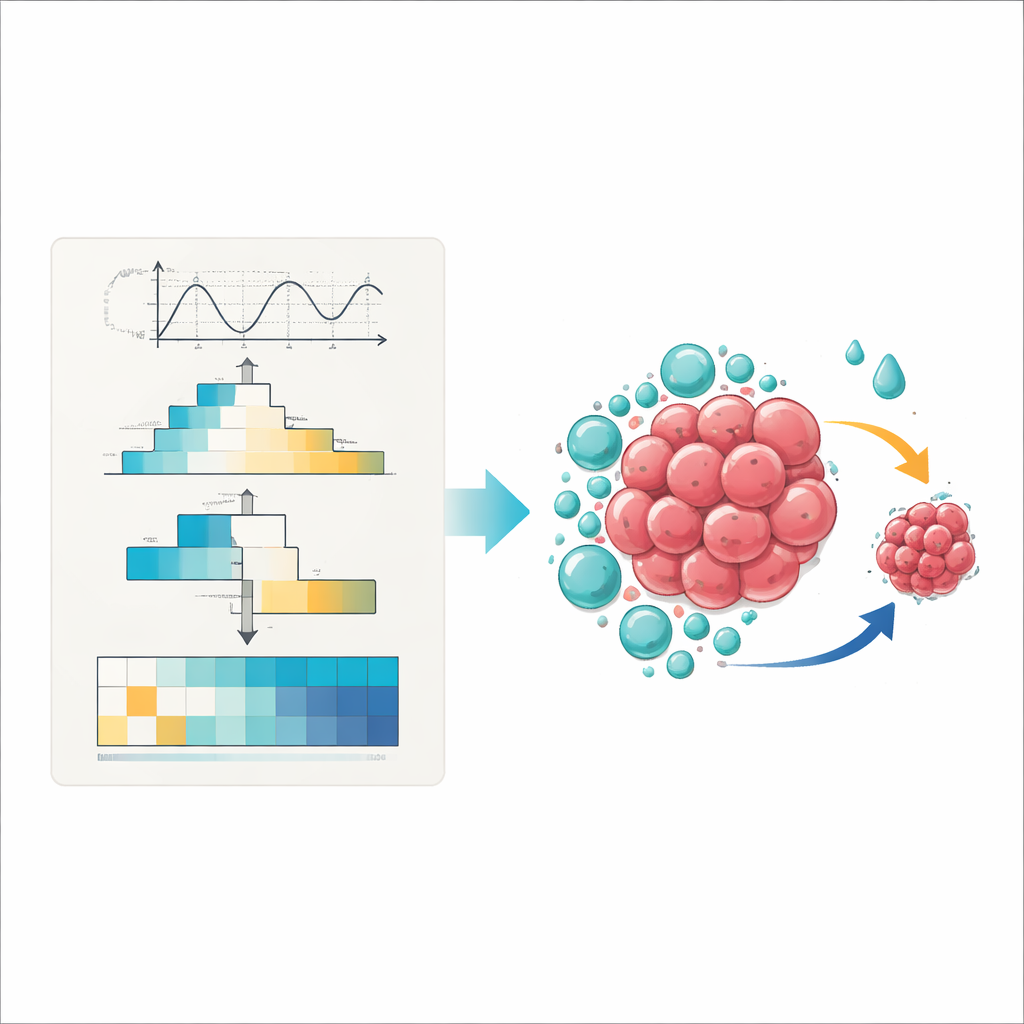
To handle these demanding equations, the authors build on a tool from signal processing known as Haar wavelets. A Haar wavelet is a very simple block-like function that is either “on” or “off” over short intervals in time. By stacking many of these blocks at different scales, almost any smooth curve can be approximated. The key idea of the new framework is to represent the highest derivative in the equation as a sum of these wavelet blocks, then recover all lower derivatives and the solution itself by integrating step by step. Instead of wrestling directly with a difficult continuous equation, the method converts the problem into a standard system of algebraic equations that computers can solve efficiently.
From memory and history to matrices and numbers
The heart of the technique lies in so-called operational matrices. These matrices describe how the Haar building blocks behave when they are integrated, either in the usual sense or in the fractional “memory” sense. Once these matrices are constructed, the fractional derivative, the ordinary derivatives and the history-dependent integral can all be expressed using the same wavelet basis. The authors then enforce the original equation at a set of carefully chosen points, a strategy known as collocation. This produces a linear system whose unknowns are the wavelet coefficients. Solving this system yields an approximate solution for the entire time interval. A detailed mathematical analysis shows that, as the number of wavelet blocks increases, the error in the solution decreases roughly like the square of the resolution—evidence of reliable and predictable accuracy.
Putting the method to the test
To check that their approach works in practice, the authors apply it to several test problems where exact solutions are known. In each case, they find that their wavelet-based method tracks the true answer extremely closely, with errors that shrink rapidly as the resolution is refined. They also compare performance with other popular numerical techniques that rely on Chebyshev polynomials, Bernoulli polynomials, or spectral methods. For the same level of refinement, the Haar wavelet approach achieves smaller errors in less computing time, thanks largely to its sparse and easy-to-build matrices. This combination of simplicity, speed, and accuracy is especially important for large simulations or parameter sweeps.
Modeling the slow dance between tumors and the immune system
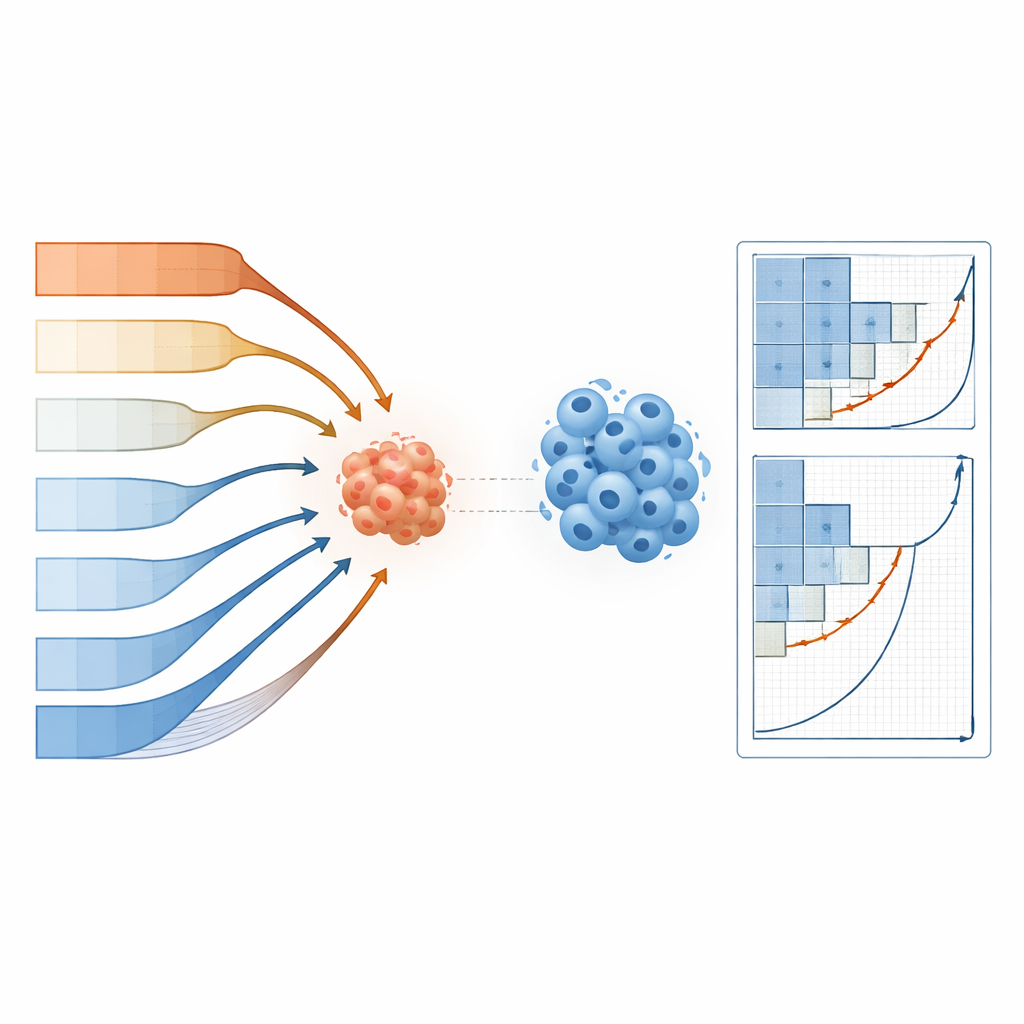
Beyond test cases, the paper’s most striking application is a model of tumor–immune–drug interactions. Here, the tumor’s growth is governed by a fractional derivative, representing the way cancer cells remember past conditions in their microenvironment. The immune response includes a history term that spreads the influence of earlier tumor levels over time, reflecting slow recruitment and activation of immune cells. A drug variable describes how an immunotherapy agent enters and leaves the body, boosts immune activity and directly harms tumor cells. Simulations based on realistic parameter values show an initial phase of tumor expansion, followed by treatment-driven regression and eventual stabilization at a much lower tumor burden. They also reveal how the strength of memory in the system, encoded by the fractional order, can strongly affect treatment success.
What this means for future cancer modeling
In accessible terms, the authors have created a numerical “engine” that turns highly sophisticated equations with memory and delay into practical tools for scientists and clinicians. Their results suggest that this engine can accurately track how tumors grow, how the immune system responds over time, and how intermittent drug dosing shapes the outcome—all without overwhelming computational cost. While the work is still mathematical and exploratory, it provides a robust foundation for future studies that could test different treatment schedules on a computer before trying them in the clinic, helping to tailor therapies to the complex, history-dependent nature of real tumors.
Citation: Hamood, M.M., Sharif, A.A. & Ghadle, K.P. A unified Haar wavelet collocation framework for fractional volterra integro-differential equations with application to tumor-immune dynamics modeling. Sci Rep 16, 12552 (2026). https://doi.org/10.1038/s41598-026-42803-6
Keywords: fractional calculus, Haar wavelets, tumor-immune modeling, numerical methods, immunotherapy