Clear Sky Science · en
DUSTrack: Semi-automated point tracking in ultrasound videos
Why following motion inside the body matters
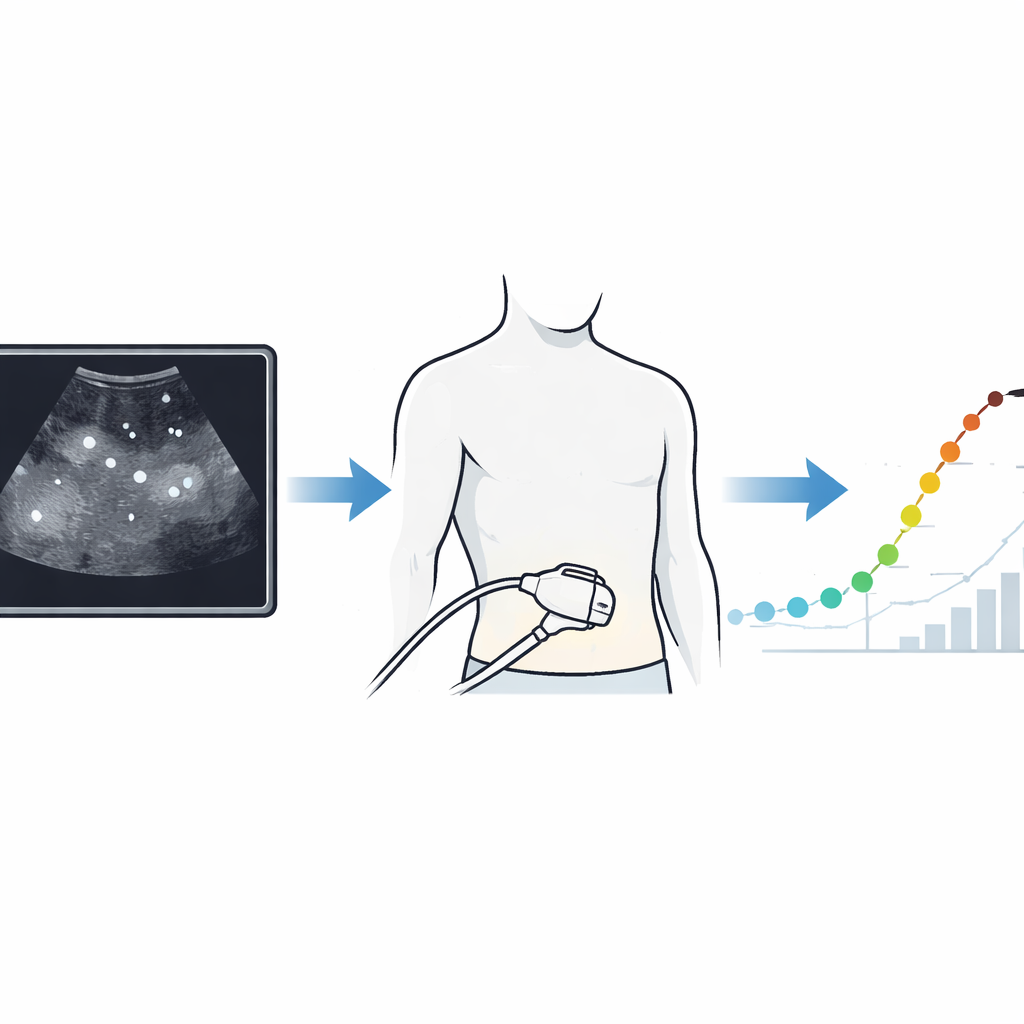
Modern ultrasound machines can show our beating hearts and working muscles in real time, without radiation or surgery. Yet turning these grainy, fast-changing images into precise measurements of how tissues move has been surprisingly difficult. This paper introduces DUSTrack, an open-source software toolkit that helps researchers and clinicians follow tiny points inside ultrasound videos more accurately and with less manual effort, opening the door to richer insights in cardiology, rehabilitation, and sports science.
Watching tissues move beneath the skin
Many medical and sports questions boil down to a simple idea: how do specific parts of the body move over time? Tracking the motion of the heart wall can help diagnose disease or guide treatment. Following muscle fibers can reveal how athletes generate force, or how patients recover after injury. Ultrasound is ideal for this because it is safe, portable, and can capture both slow breathing and rapid running at hundreds of frames per second. The challenge is that ultrasound images are noisy and lack crisp edges, so even experts struggle to mark the exact same point across hundreds or thousands of frames, and existing computer programs either slowly drift away from the true location or jump around from frame to frame.
Blending human judgment and machine learning
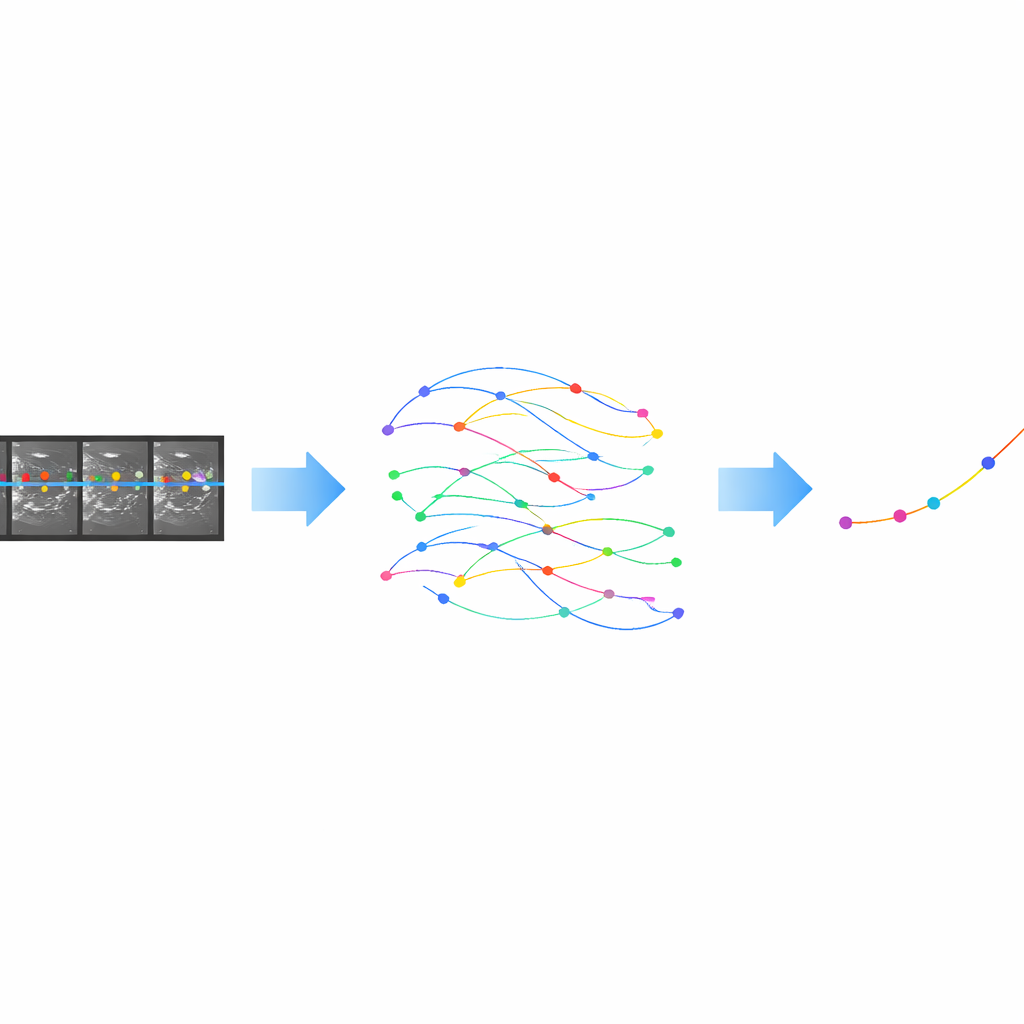
DUSTrack tackles these problems by turning point tracking into a collaboration between humans, deep learning, and a classic motion-estimation method called optical flow. The process starts with a graphical interface that lets a user step through a short stretch of video and indicate where key points—such as a spot on the heart wall or a muscle boundary—are located. Instead of asking the user to label widely separated frames, DUSTrack follows the natural habit of clinicians: they watch consecutive frames and adjust points as they move. The software fills in many in-between frames automatically using optical flow, giving the user a chance to quickly review and correct these estimates. These curated examples then train a deep neural network so it can recognize the same points across the rest of the video.
Making motion smooth without losing important details
Although the trained network is good at finding the correct location in each individual frame, its predictions can still jitter slightly from one frame to the next. Simple smoothing filters can reduce this noise, but they also risk erasing real, fast movements that carry important physiological information. DUSTrack introduces a smarter cleanup step that again uses optical flow, this time in short overlapping windows. Around each moment in time, the software builds many small motion segments anchored to the neural network’s estimates, then averages them to produce a single, smooth path. This approach preserves quick, genuine motions—such as a sudden muscle contraction—while suppressing the random wiggles that arise from model imperfections.
From beating hearts to working muscles
To show how broadly the method can be used, the authors apply DUSTrack to three very different tasks. In heart ultrasound videos, they track a handful of points on the left ventricle and turn those into continuous measurements of wall thickness and chamber size across several heartbeats, rather than just at two time points. In upper-arm scans during a reaching movement, they follow points inside two muscles to quantify how their shapes change in different directions, revealing distinct deformation patterns in the triceps and brachialis. And in the calf muscle, they track points along internal structures called fascicles and connective sheets to recover established measures of muscle architecture. In this last case, DUSTrack performs about as well as a specialized, state-of-the-art fascicle-tracking program, suggesting that a general-purpose method can match tailored tools.
What this means for future ultrasound analysis
To a non-expert, DUSTrack can be thought of as a precise “motion highlighter” for ultrasound videos: it helps people and algorithms follow tiny internal landmarks closely over time, with far less guesswork and less unwanted wobble. By combining an intuitive interface, a trainable neural network, and a motion-aware smoothing step, the toolkit achieves accuracy near the limits of what human experts can reliably see in these images. Because it is open source and designed in modular pieces, DUSTrack can both improve today’s measurements and generate the large, reliable datasets needed to train tomorrow’s fully automated ultrasound systems.
Citation: Namburi, P., Pallarès-López, R., Rosendorf, J. et al. DUSTrack: Semi-automated point tracking in ultrasound videos. Sci Rep 16, 13340 (2026). https://doi.org/10.1038/s41598-026-42795-3
Keywords: ultrasound tracking, tissue motion, deep learning, biomechanics, echocardiography