Clear Sky Science · en
Federated edge-AI for reliable and privacy-preserving pipeline leak detection in drone swarms using neutrosophic sugeno-weber norms
Watching Hidden Threats Beneath Our Feet
Natural gas pipelines quietly crisscross continents, carrying fuel that powers homes, factories, and power plants. Yet a tiny crack in one of these buried lines can release explosive gas, spark wildfires, and pour greenhouse gases into the atmosphere long before anyone notices. This paper explores how swarms of smart drones, each acting as a flying sensor station, can team up to spot leaks quickly and privately. It also introduces a new way for these machines to make sense of messy, uncertain data so that operators can trust the warnings they receive.
Why Smarter Leak Hunting Matters
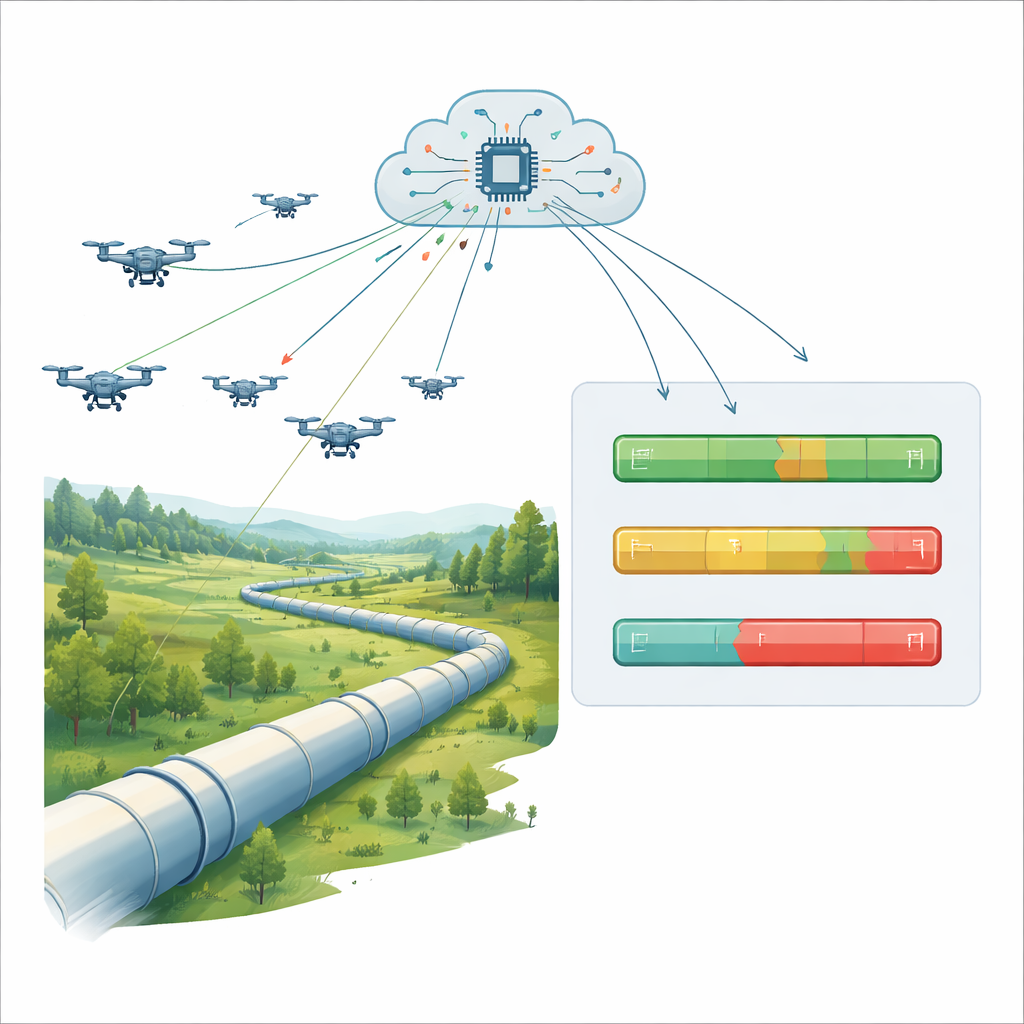
Finding pipeline leaks is a classic needle‑in‑a‑haystack problem. Pipelines run through remote deserts, forests, farmland, and cities. Weather, terrain, and aging equipment can all distort readings from cameras, gas sniffers, microphones, and pressure gauges. Delays in detection do not just cost money; they can endanger lives and devastate ecosystems. Traditional monitoring relies on fixed sensors and central computers that must collect all raw data, a setup that can be slow, vulnerable to cyberattacks, and intrusive for landowners. The authors argue that a new generation of mobile, cooperative drones, each carrying its own computing power, can inspect vast networks faster while keeping raw data close to the source.
Drones That Think Together at the Edge
In the proposed vision, each drone flies along the pipeline and carries several kinds of sensors—for gas concentration, temperature, sound, vibration, and location. Instead of streaming every measurement back to a distant server, the drone processes data on board and shares only compact summaries with the rest of the swarm. This approach, known as federated edge AI, allows many drones to learn from each other without exposing all of their raw readings. It reduces communication delays, protects sensitive industrial information, and can scale to very large fleets. Working as a group, the drones can cover huge distances, adapt their flight paths around obstacles, and revisit suspicious spots more often.
Making Sense of Doubt and Disagreement
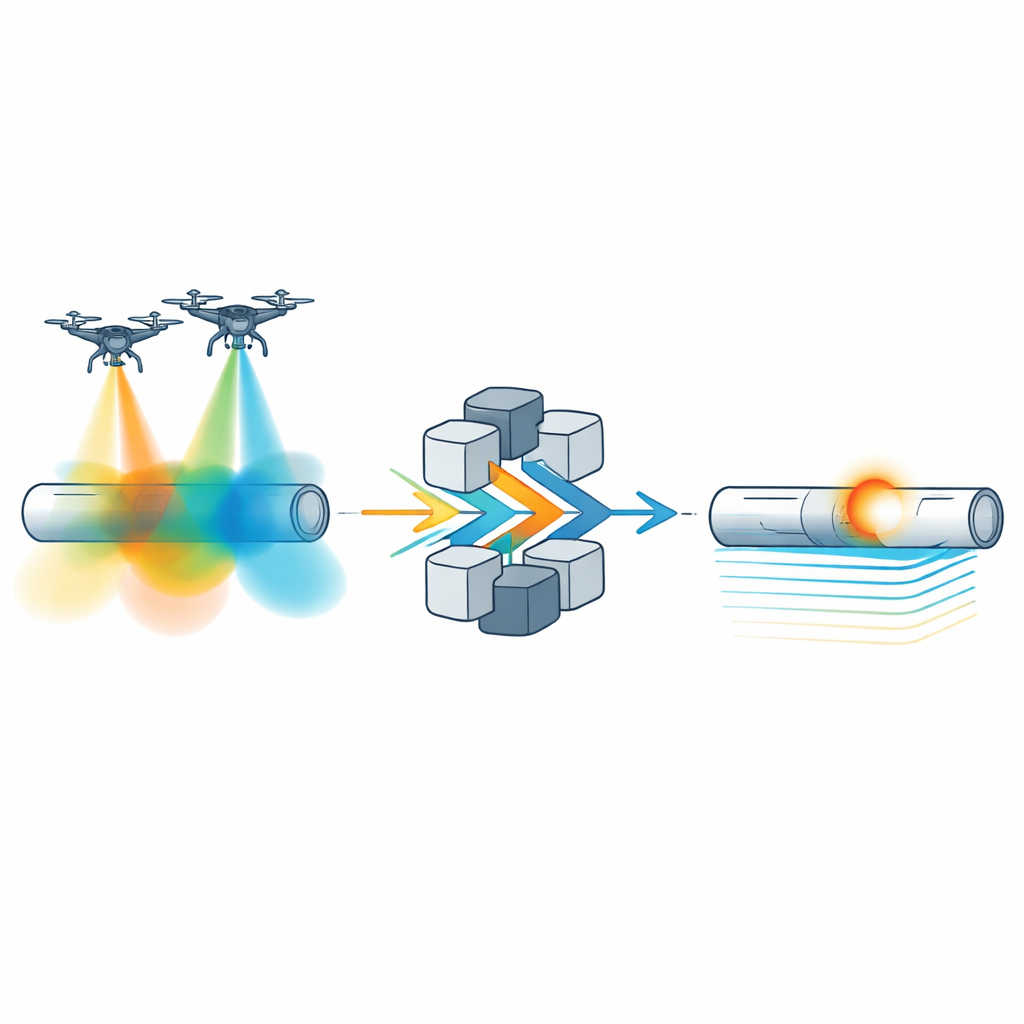
Real-world sensor data are rarely clean. One drone may detect a faint gas plume; another might be confused by crosswinds or loud machinery; a third may fly through rain that obscures its camera. Classic decision tools tend to treat information as either reliable or not, and they struggle when evidence is conflicting or incomplete. The authors build on a mathematical idea that explicitly separates three ingredients in every piece of information: support for a leak, support against a leak, and genuine uncertainty. They combine this with a flexible family of combining rules that can model subtle interactions between clues—for example, letting strong agreement between different sensors amplify confidence, while letting disagreement flag areas that need a closer look.
From Competing Technologies to Clear Choices
To test their framework, the researchers imagine a realistic planning problem: energy operators must choose among several advanced monitoring strategies. Options include quantum‑enhanced learning for drone swarms, self‑healing repair drones that can patch leaks, digital twin models linked to drones, and hybrid air‑and‑underwater swarms for offshore lines. Each approach must be judged on several fronts, such as privacy‑preserving learning, the ability of the swarm to reorganize itself, the sharpness of leak localization, and resilience against cyberattacks. Expert opinions about these criteria are inherently fuzzy and sometimes contradictory. Using their new method, the authors turn these mixed judgments into numerical rankings and show that quantum‑assisted federated swarms emerge as the most promising option under uncertain conditions.
Stronger Decisions in a Messy World
Ultimately, the paper claims that its uncertainty‑aware decision engine lets autonomous drone swarms flag dangerous leaks more reliably than older techniques. By preserving not only what the sensors seem to say, but also how unsure they are and how strongly they disagree, the method reduces the chances of both missed leaks and needless alarms. The authors also show that their rankings stay stable even when the level of uncertainty grows, and that they outperform a widely used benchmark method for multi‑criteria decisions. For non-specialists, the key message is that a more honest treatment of doubt—built directly into the math that guides our machines—can make future energy systems safer, smarter, and more resilient.
Citation: Zulqarnain, R.M., Hameed, M.S., Saeedi, G. et al. Federated edge-AI for reliable and privacy-preserving pipeline leak detection in drone swarms using neutrosophic sugeno-weber norms. Sci Rep 16, 13728 (2026). https://doi.org/10.1038/s41598-026-42794-4
Keywords: pipeline leak detection, drone swarms, federated edge AI, uncertainty in decision making, critical energy infrastructure