Clear Sky Science · en
Adsorption of Pb2+and malachite green from water onto a newly developed nanocomposite of bentonite@perovskite Co-Ni oxide@bimetallic Mg/Cu MOFs and their adsorption and kinetic studies
Why Cleaning Up Water Matters
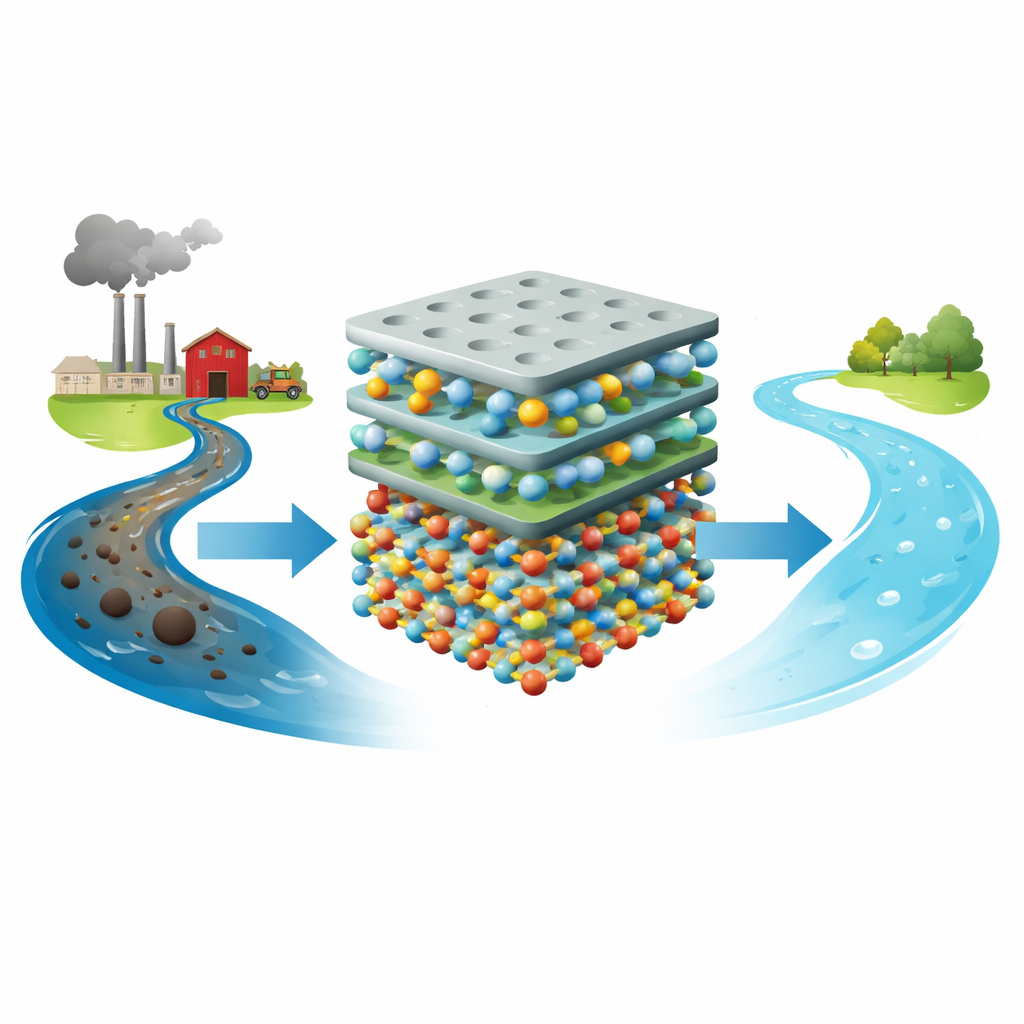
Many communities around the world struggle with water contaminated by toxic metals and industrial dyes. Lead can damage the brain and kidneys, while bright-colored dyes such as malachite green are linked to cancer and genetic problems. Conventional treatment plants often struggle to remove these pollutants quickly and cheaply. This study presents a new, low-cost material that can pull both lead and malachite green out of water very efficiently, offering a potentially practical way to make drinking water and wastewater safer.
A New Cleaning Sponge for Dirty Water
The researchers created a tiny, highly porous "sponge" by combining three ingredients: a natural clay called bentonite, a special metal oxide made from nickel and cobalt, and a modern class of porous crystals known as metal–organic frameworks that include magnesium and copper. Each ingredient brings a different strength. Bentonite is abundant, cheap, and already good at attracting charged contaminants. The nickel–cobalt oxide adds chemically active metal sites, and the metal–organic framework contributes a maze of pores and organic structures that can interact with dye molecules. Fusing all three into a single solid produces a nanocomposite designed to catch both heavy metals and organic dyes at the same time.
Looking Inside the New Material
To confirm that this hybrid sponge formed as intended, the team used a suite of tools that probe structure and composition. Infrared measurements revealed how the chemical groups on clay, metal oxide, and framework link together, while X-ray diffraction showed that the crystalline structures of each component survive and interlock in the final product. Surface area tests indicated a large porous network, with many channels for water and pollutants to move through. Electron microscope images showed a complex, flower-like texture made of layered sheets and particles, giving a rough, high-area surface. Together, these observations support the idea that the three building blocks merge into a stable, highly accessible network instead of remaining as separate powders.
Putting the Sponge to the Test
The scientists then tested how well the material removes lead ions and malachite green dye from water. They varied pH, contact time, the amount of adsorbent used, and how much pollutant was present. Under the best conditions, the material captured up to about 106 milligrams of lead per gram of solid at neutral pH, and about 15 milligrams of dye per gram at slightly acidic pH. Impressively, lead removal was extremely fast when the process was assisted by microwave energy: most of the lead was taken up within only a few seconds. Dye removal, carried out with simple shaking rather than microwaves, reached its maximum within about 20 minutes. The team also explored how competing ions such as sodium, calcium, and magnesium influence performance and found that, although they do reduce removal somewhat, lead and dye are still strongly captured.
How the Trapping Process Works
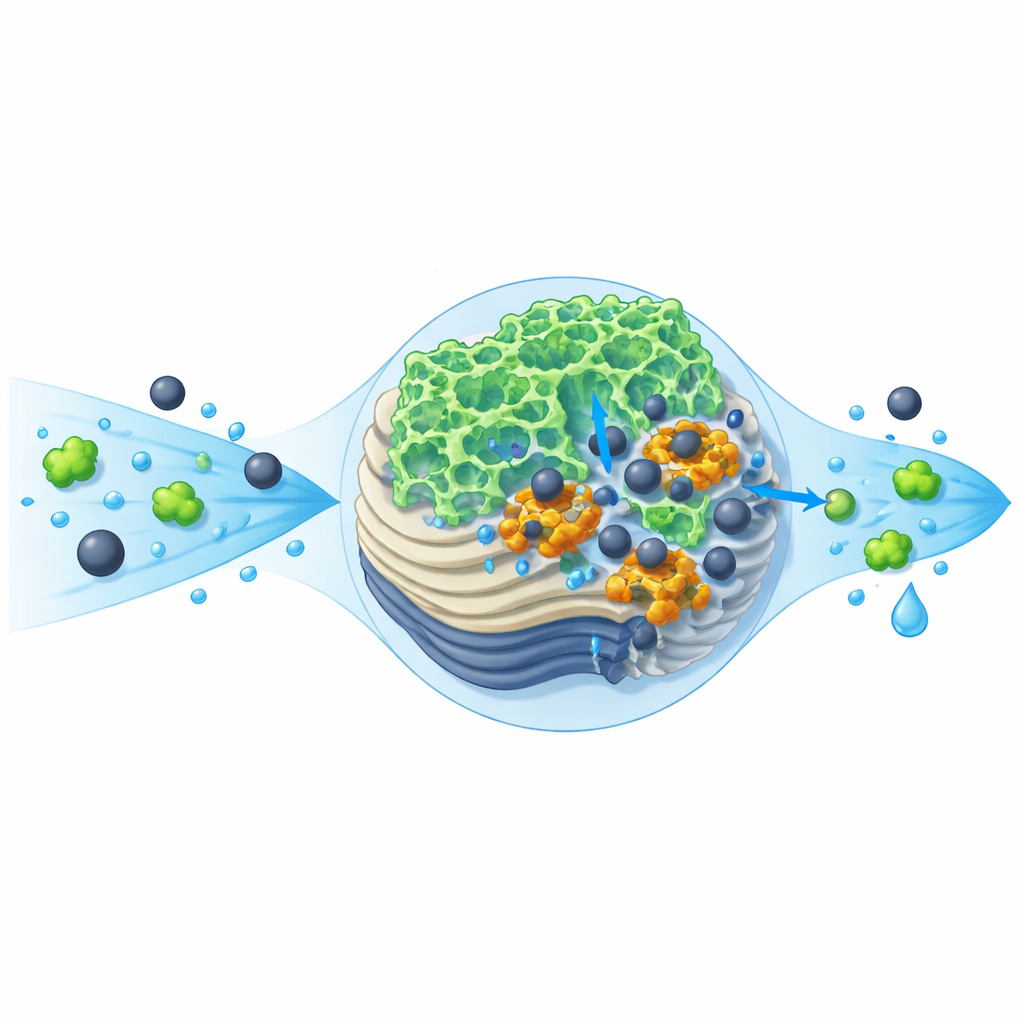
By analyzing how uptake changes over time and with concentration, the authors examined the underlying removal mechanism. Their results indicate that a mix of forces is at play. At suitable pH, the surface of the composite is slightly negatively charged, which draws in the positively charged lead ions and dye molecules by electrostatic attraction. Chemical bonding between lead and the metal–oxygen groups in the clay and nickel–cobalt oxide appears to strengthen this binding, while the organic framework provides additional sites that can interact with the dye’s ring-shaped structure. The porous architecture helps contaminants diffuse deep into the material, where they can be trapped on internal surfaces. Tests with different mathematical models of adsorption support this picture of combined physical and chemical capture on a heterogeneous surface.
From Laboratory to Real Water
To explore real-world use, the team packed the composite into a small column and passed both tap water and industrial wastewater spiked with lead or dye through it. After several runs, more than 85–95 percent of both pollutants could still be removed, even after five reuse cycles. Measurements showed that only trace amounts of nickel and cobalt leach from the solid, well below health guideline limits, suggesting the material is stable and unlikely to introduce new contaminants. The estimated cost of raw materials is modest, since the recipe relies on common salts, clay, and an inexpensive organic acid, making it attractive for scale-up.
What This Means for Safer Water
In simple terms, this study demonstrates a compact, reusable “super sponge” that can rapidly snatch both a dangerous metal and a toxic dye from water. By smartly combining a natural clay with modern porous crystals and metal oxides, the researchers achieved strong, fast, and relatively low-cost cleanup performance. While further testing in large-scale systems is still needed, the work points toward new generations of tailored filter materials that could help factories, treatment plants, and even small communities deal more effectively with stubborn water pollutants.
Citation: Adel, S.E., El Sayed, I.E.T., Allam, E.A. et al. Adsorption of Pb2+and malachite green from water onto a newly developed nanocomposite of bentonite@perovskite Co-Ni oxide@bimetallic Mg/Cu MOFs and their adsorption and kinetic studies. Sci Rep 16, 13520 (2026). https://doi.org/10.1038/s41598-026-42785-5
Keywords: water purification, lead removal, malachite green, nanocomposite adsorbent, wastewater treatment