Clear Sky Science · en
Study on freeze–thaw cyclic durability of reclaimed ceramic concrete in western high altitude region
Turning Tile Trash into Tougher Roads
Across the globe, mountains of broken ceramic tiles from construction and renovation sites end up in landfills. At the same time, roads, bridges, and buildings in cold, high‑altitude regions are battered by repeated cycles of freezing and thawing, which slowly tear conventional concrete apart. This study explores a two‑for‑one solution: grinding up waste ceramic tiles and blending them into concrete to both recycle a stubborn waste stream and build structures that better survive harsh winter climates.
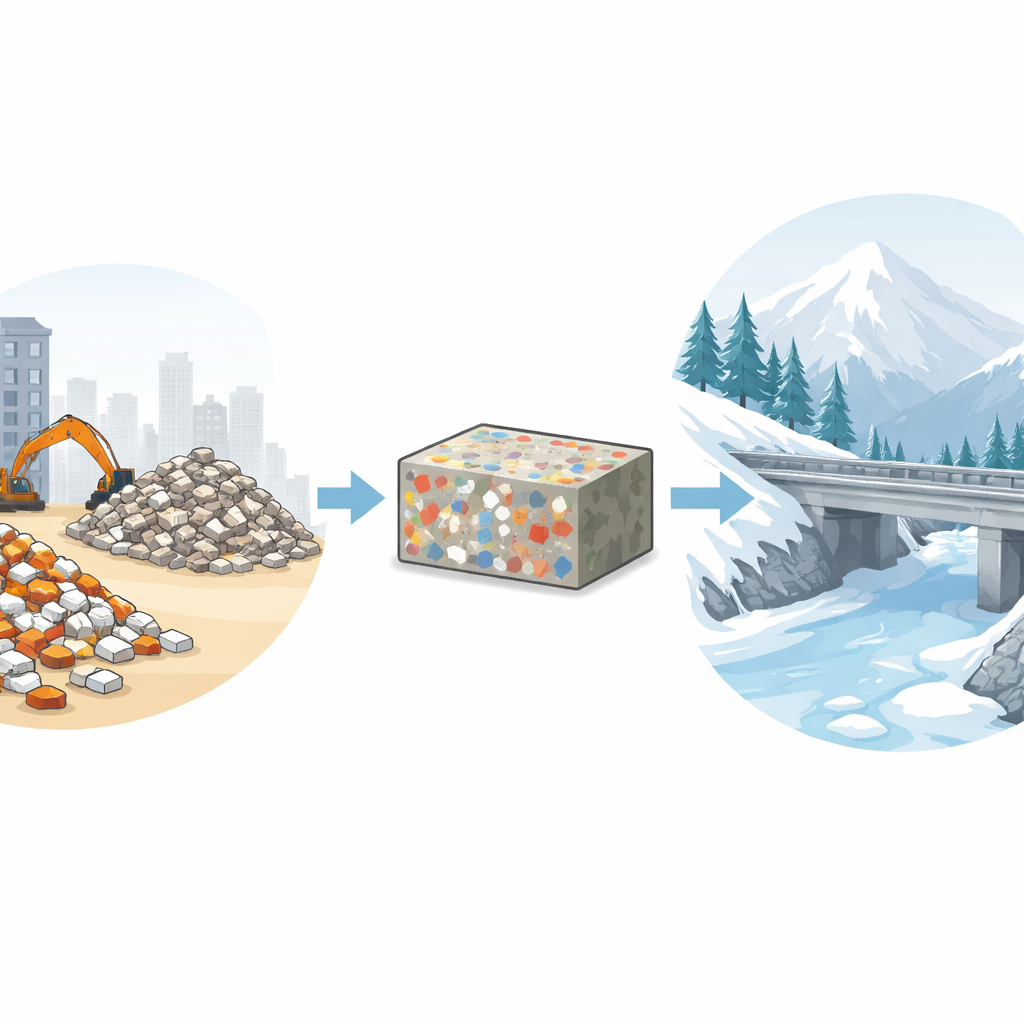
Why Freezing and Thawing Breaks Concrete
Concrete looks solid, but on the inside it is laced with tiny pores and hairline gaps. When water seeps in and later freezes, it expands like ice in a clogged pipe. With every freeze–thaw cycle, this expansion and contraction pries open microcracks, loosens the glue‑like cement, and knocks off grains from the surface. Over years, this slow internal weathering can turn a strong block into a crumbly, leaking material. For high‑altitude regions, where temperatures bounce around the freezing point for long stretches of the year, understanding and slowing this damage is essential for safe, long‑lasting infrastructure.
From Broken Tiles to New Concrete
The researchers tested whether crushed ceramic tiles could replace part of the sand‑sized particles normally used in concrete. They cast six sets of concrete blocks, gradually increasing the share of ceramic particles from 0% (ordinary recycled concrete) up to 100%, where all of the fine aggregate came from waste tiles. These blocks were fully soaked in water, then repeatedly frozen to about −18 °C and thawed to just above freezing, with each cycle lasting four hours. Every 30 cycles, the team weighed the blocks to see how much material had fallen off and measured how easily sound waves passed through them, a sensitive indicator of internal stiffness and cracking.
Finding the Sweet Spot at 20 Percent
A clear pattern emerged. All blocks became less stiff as the cycles piled up, showing that internal damage was accumulating, but the rate of decline depended strongly on the amount of ceramic. Concrete with 20% ceramic particles proved the most resilient: it withstood roughly 398 freeze–thaw cycles before its performance fell below accepted standards. Microscopic images showed that early damage was mostly confined to a thin surface zone, while the interior stayed dense and well bonded. The ceramic grains, which absorb less water and have fewer open pores than typical recycled sand, helped reduce how much water entered the concrete and how strongly it expanded on freezing.
Beyond that 20% replacement, however, durability worsened sharply. At high ceramic contents, the glossy tile surfaces bonded poorly with the surrounding cement, leaving extra voids and weak interfaces. These gaps acted like tiny reservoirs where water could freeze, expand, and link up into networks of cracks. At 80% and especially 100% ceramic content, blocks suffered rapid surface peeling and deep cracking and could not survive the 300‑cycle test window without serious damage. Careful measurements of the thin boundary region around each grain showed it became thicker and more porous as ceramic content increased, undermining the concrete’s overall strength.
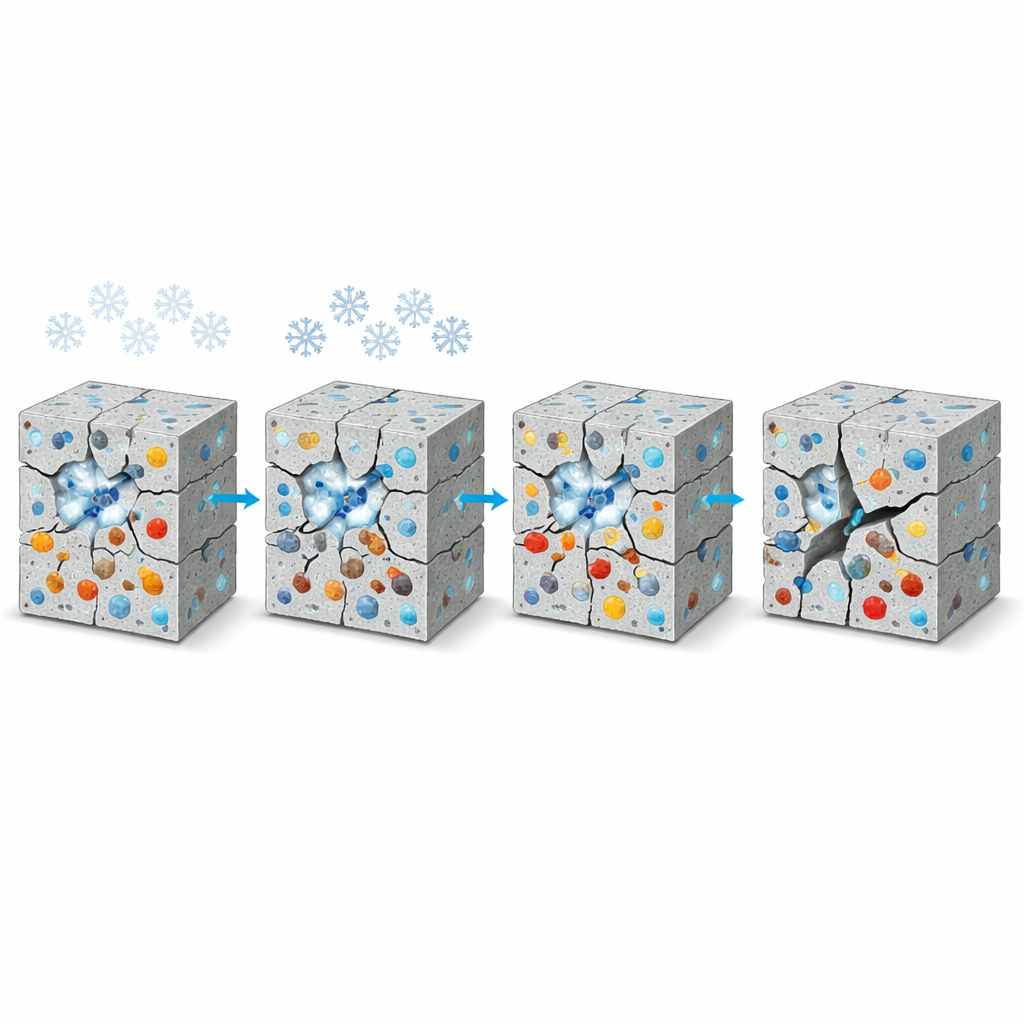
Predicting How Long the Concrete Will Last
Knowing that 20% ceramic content works best is only part of the story; engineers also need to estimate how long such concrete will perform safely in the real world. To tackle this, the authors treated the gradual loss of stiffness and mass as a kind of slow‑moving random process. Using a mathematical tool originally developed for tracking wandering particles, they built a reliability curve that shows how the chance of the concrete still meeting performance targets drops as the number of freeze–thaw cycles grows. For the best‑performing mix, the analysis suggests it can tolerate about 383 cycles before its reliability falls below a conservative safety threshold, and around 398 cycles before it is effectively spent.
What This Means for Cold‑Region Construction
In practical terms, the study shows that a modest dose of crushed ceramic tiles—about one‑fifth of the fine aggregate in the mix—can turn a waste product into a valuable ingredient for durable concrete in cold, high‑altitude areas. At this level, the tiles help limit water uptake and internal ice damage; beyond it, they introduce too many weak spots and actually hasten failure. By combining lab tests with life‑prediction modeling, the work offers both a recipe and a forecasting tool for designers who want to build roads and structures that last longer while cutting construction waste. Future research will look at how this optimized concrete stands up to other long‑term threats, such as penetrating salts and carbon dioxide, further clarifying its role in sustainable infrastructure.
Citation: Kuan, P., Heyuqiu, L. & Yaping, L. Study on freeze–thaw cyclic durability of reclaimed ceramic concrete in western high altitude region. Sci Rep 16, 12952 (2026). https://doi.org/10.1038/s41598-026-42770-y
Keywords: recycled concrete, ceramic tile waste, freeze–thaw durability, cold-region infrastructure, material service life