Clear Sky Science · en
A pipeline leakage detection method for boiler energy operation system using enhanced SVM-based acoustic emission technology
Why hidden leaks in power plants matter
Inside large power plants, networks of metal pipes move scalding steam and hot gases that keep the lights on. If one of these pipes starts to leak—even through a pin-sized hole—it can waste energy, damage equipment, and in extreme cases trigger dangerous explosions. Yet the very noise and heat of an operating boiler make such leaks hard to spot early. This study explores a smarter way to “listen” for trouble inside these pipes using sound waves and machine learning, with the goal of catching small leaks quickly and reliably, even in very noisy industrial environments.
Listening to pipes instead of watching gauges
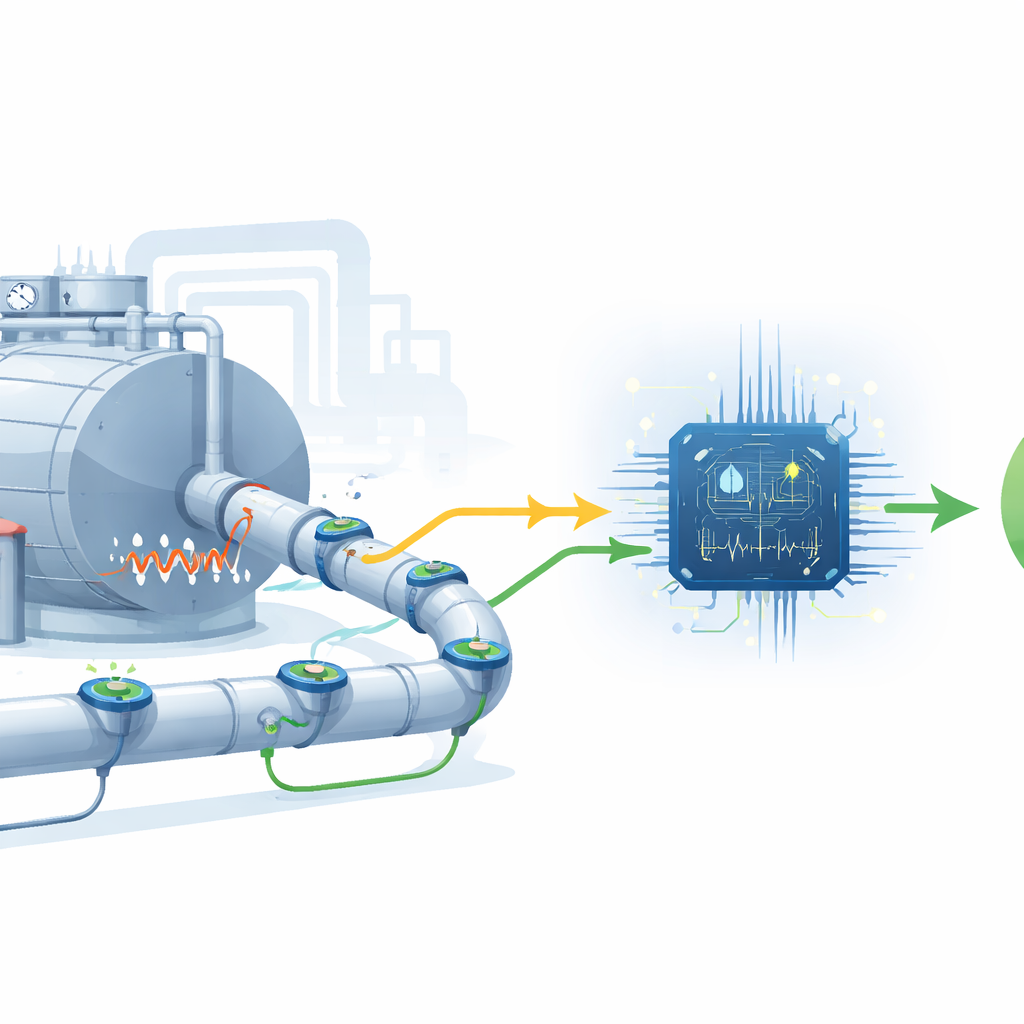
Traditional leak detection methods focus on pressure or flow: operators watch for drops in pressure or mismatches between how much fluid goes in and comes out. These methods work reasonably well for big, sudden failures, but they are slow to react and often miss small or slowly growing leaks. The approach in this paper relies instead on acoustic emission—tiny stress waves that ripple through the metal when a crack forms or steam escapes. Sensitive piezoelectric sensors glued to the pipe wall pick up these waves, which are then filtered and turned into digital signals. Because these sound signatures come directly from the leak itself, they can reveal problems earlier and work in harsh conditions where other sensors struggle.
Turning raw noise into meaningful patterns
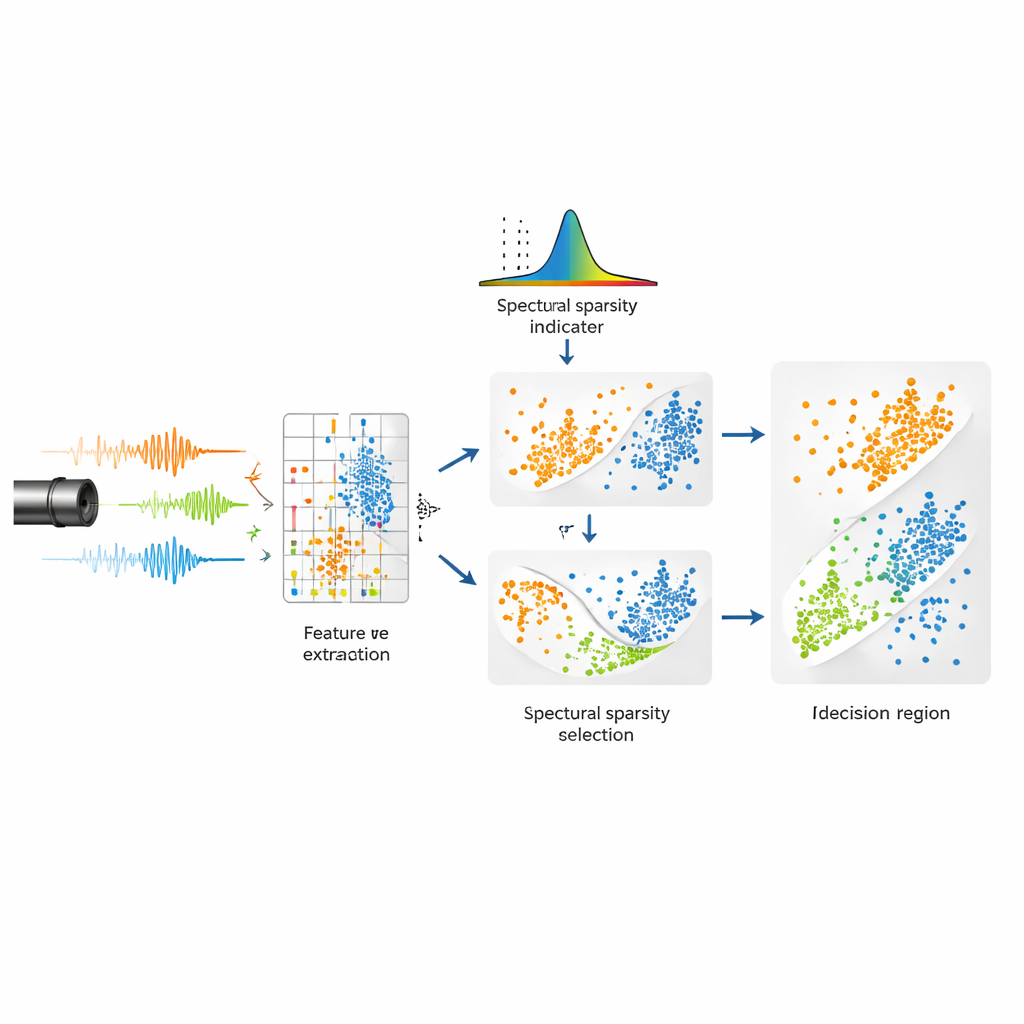
Simply capturing sound is not enough: an operating boiler is full of background noise from pumps, fans, and flowing gas. The researchers tackle this by compressing each burst of acoustic data into an eight-number “fingerprint” that describes how the signal behaves over time and across frequencies. Some numbers capture how strong and how long the burst lasts; others measure how quickly it rises, how often it rings, and how its energy is spread over low or high pitches. These fingerprints differ in characteristic ways for three leak types they studied—small spots, growing fractures, and violent tube explosions—so that a computer can learn to tell them apart.
A smarter decision engine for noisy factories
At the heart of the system is an enhanced version of a support vector machine, a widely used classification algorithm. Standard versions of this algorithm stumble when data are noisy and when different leak types produce signals that are not cleanly separated. The authors introduce two key upgrades. First, they automatically choose between a simple and a more flexible decision rule based on how concentrated or spread out a signal’s frequency content is: sparse, sharply peaked spectra are handled with a simple rule, while complex, broadband spectra use a curved one. Second, they give extra importance during training to those sample signals that fall close to the decision boundary—precisely where noise is most likely to cause mistakes—so that the algorithm learns to draw more reliable dividing lines.
Putting the method to the test
The team built a laboratory-scale boiler pipeline system to generate controlled leaks of three types and record their acoustic signatures. Under quiet conditions similar to a well-insulated lab, the enhanced classifier correctly identified all test samples of spot, fracture, and explosion leaks—achieving 100 percent accuracy. The real challenge came when the researchers added strong artificial noise to mimic the harsh 70 dB background typical of real boiler rooms. Even then, their method correctly classified more than 85 percent of leaks across all three types and outperformed a carefully tuned conventional support vector machine by about 12 to 15 percentage points. It also beat other common tools such as decision trees, random forests, boosted models, k-nearest neighbors, and a compact deep-learning network trained on the same small dataset.
What this means for safer, cleaner energy
For non-specialists, the takeaway is that this work makes it much more practical to monitor critical boiler pipelines using sound, without needing vast amounts of training data or perfectly quiet conditions. By combining a compact acoustic fingerprint with an adaptive, noise-aware classifier, the method can flag the likely type of leak early and reliably. In power plants, that could translate into fewer catastrophic failures, less wasted fuel, and more efficient maintenance routines—where crews are guided by intelligent listening systems that point them to trouble long before it becomes visible.
Citation: Yuan, T., Zhang, X., Zhang, Q. et al. A pipeline leakage detection method for boiler energy operation system using enhanced SVM-based acoustic emission technology. Sci Rep 16, 12520 (2026). https://doi.org/10.1038/s41598-026-42769-5
Keywords: pipeline leak detection, acoustic emission, boiler safety, machine learning, support vector machine