Clear Sky Science · en
Terahertz emission from a spintronic stack nanodecorated with plasmonic nanoparticles
Why tiny gold shells could power future scanners
Behind airport body scanners, chip inspection tools, and next‑generation wireless links lies a band of light our eyes cannot see: terahertz waves. Engineers want compact, efficient terahertz sources to make these technologies cheaper and more widespread. This paper shows that sprinkling a thin magnetic metal stack with a sparse layer of special gold‑coated glass nanoparticles can noticeably boost its terahertz output, offering a simple route toward brighter, more practical terahertz emitters.

What makes terahertz waves so useful
Terahertz radiation sits between microwaves and infrared light. It can pass through clothing, plastics and many other materials, and it can reveal fingerprints of chemicals and structures, which makes it attractive for security screening, medical imaging, quality control and ultrafast electronics research. Many existing terahertz sources are bulky crystals or specialized semiconductor devices: they can be powerful or broadband, but they are often hard to scale to large areas, tricky to integrate on chips, or limited in the range of frequencies they cover.
A new kind of ultrathin light‑to‑terahertz converter
In the last decade, “spintronic” terahertz emitters have emerged as a promising alternative. They are built from nanometer‑thin metal sandwiches: a magnetic layer squeezed between two non‑magnetic metals. When hit by an ultrafast laser pulse, electrons with a preferred spin direction rush out of the magnet into the neighboring layers. Thanks to a quantum effect that ties an electron’s spin to its motion, this spin flow is converted into a brief sideways charge surge, which in turn radiates a burst of terahertz waves. Because everything happens in layers only a few atoms thick, these devices can be fabricated over large areas and emit very broad‑bandwidth terahertz pulses without the usual crystal tuning constraints.
The bottleneck: getting light into an ultrathin stack
The catch is that such thin metal stacks do not absorb much of the incoming laser light. To get strong terahertz pulses, the optical energy has to be efficiently dumped into this nanometric region. Traditionally, researchers try to optimize the thickness and composition of each metal layer with atomic‑scale precision, but this still leaves most of the light passing through or being reflected. The authors explore a different idea: use tiny optical antennas on the surface to concentrate the laser energy exactly where it is needed, without redesigning the stack itself.
How gold‑shell nanoparticles turbocharge the stack
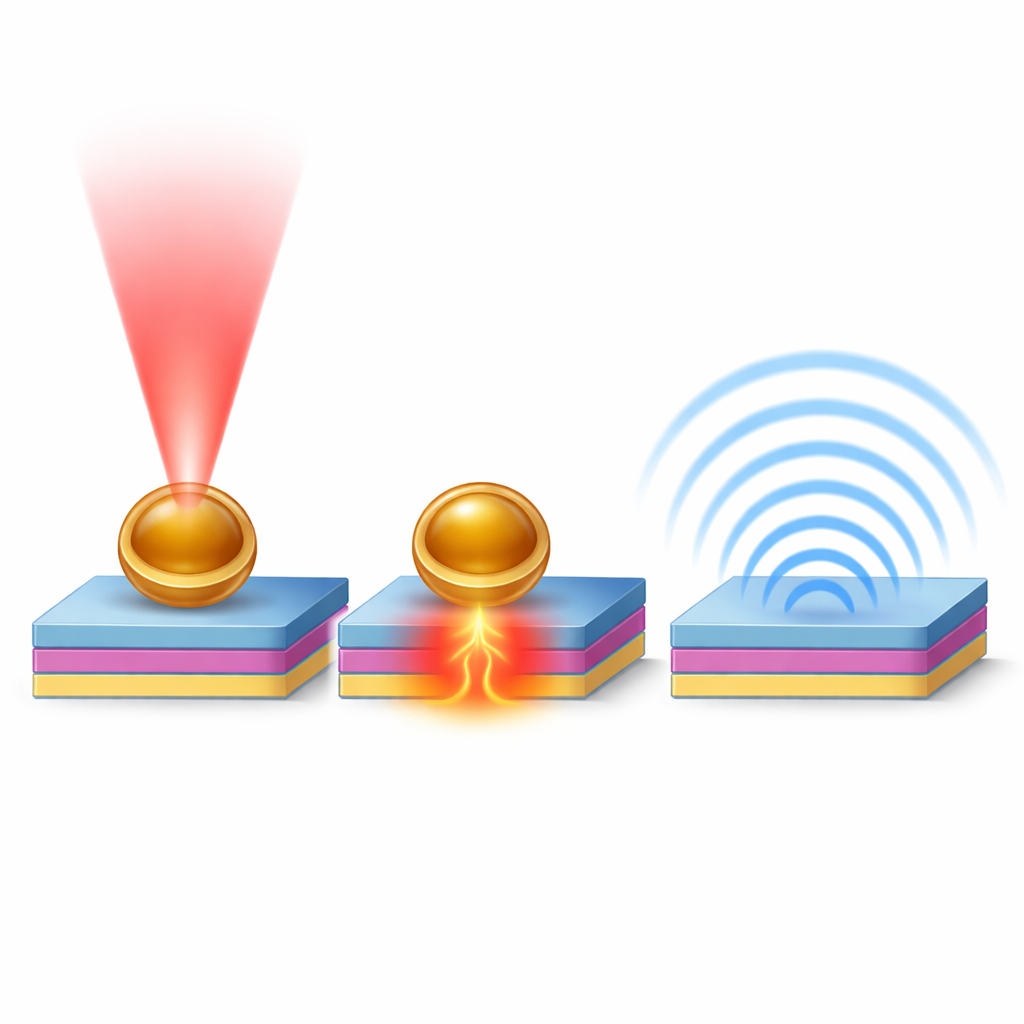
The team deposits a sparse monolayer—only about 6% of the surface—of core–shell nanoparticles directly on top of a tungsten/iron/platinum trilayer grown on glass. Each particle consists of a glass (silica) sphere wrapped in a thin gold shell and is about 150 nanometers across. At the laser wavelength used (around 800 nanometers), the gold shell supports a strong plasmon resonance: electrons in the metal collectively slosh in sync with the light, creating intense, localized “hot spots” of electromagnetic field around each particle. Simulations and electron microscopy show that, even when particles form small clusters and are randomly oriented, they consistently funnel extra energy into the nearby metal layers, especially when the laser beam strikes at an oblique angle.
What the measurements reveal
By rotating the decorated sample in a magnetic field and recording the emitted terahertz pulses, the researchers compare performance with and without nanoparticles. For a given laser fluence, the terahertz peak field from the nanoparticle‑coated device is enhanced by about 10% at normal incidence and up to about 60% when the beam grazes the surface at 75 degrees. Because only a small fraction of the area is actually covered, the local improvement directly under and around each nanoparticle is inferred to be much larger—several‑fold to more than ten‑fold in field. The enhancement is strongest at high angles and for a particular polarization of the incoming light, consistent with numerical models that predict increased absorption in the trilayer under these conditions. Importantly, this improvement persists even as the laser intensity approaches regimes where heating and saturation begin to reduce overall efficiency.
Why this simple “nano‑decoration” matters
For non‑specialists, the key message is that you can significantly boost the terahertz output of an already optimized ultrathin emitter simply by decorating its surface with a dilute layer of resonant gold‑shell nanoparticles applied via an easy drop‑casting step. These particles act as ultrafast funnels, concentrating laser energy into the active magnetic region without the need for complex patterning or precise alignment. The result is a compact, scalable platform where local light‑to‑terahertz conversion is far more efficient than in the bare metal stack. This strategy opens a practical pathway to brighter, more versatile terahertz sources for spectroscopy, imaging, and ultrafast technology.
Citation: Cecconi, V., Thomas, A.D., Wang, J.T. et al. Terahertz emission from a spintronic stack nanodecorated with plasmonic nanoparticles. Sci Rep 16, 13311 (2026). https://doi.org/10.1038/s41598-026-42758-8
Keywords: terahertz emitters, spintronics, plasmonic nanoparticles, core–shell nanostructures, ultrafast optics