Clear Sky Science · en
Torque regulation is affected by joint angle during isometric contraction in young male adults
Why leg angle matters for strength control
Everyday actions like standing up from a chair, climbing stairs or kicking a ball depend on how precisely our leg muscles can produce and adjust force at the knee. This study asked a simple but important question: does the bend of the knee change how steadily and adaptably we can push against a fixed load, even when overall strength is held constant? The answer helps explain why some positions feel strong and controlled while others feel shaky, and it may guide training and rehabilitation choices.
How the study tested knee force control
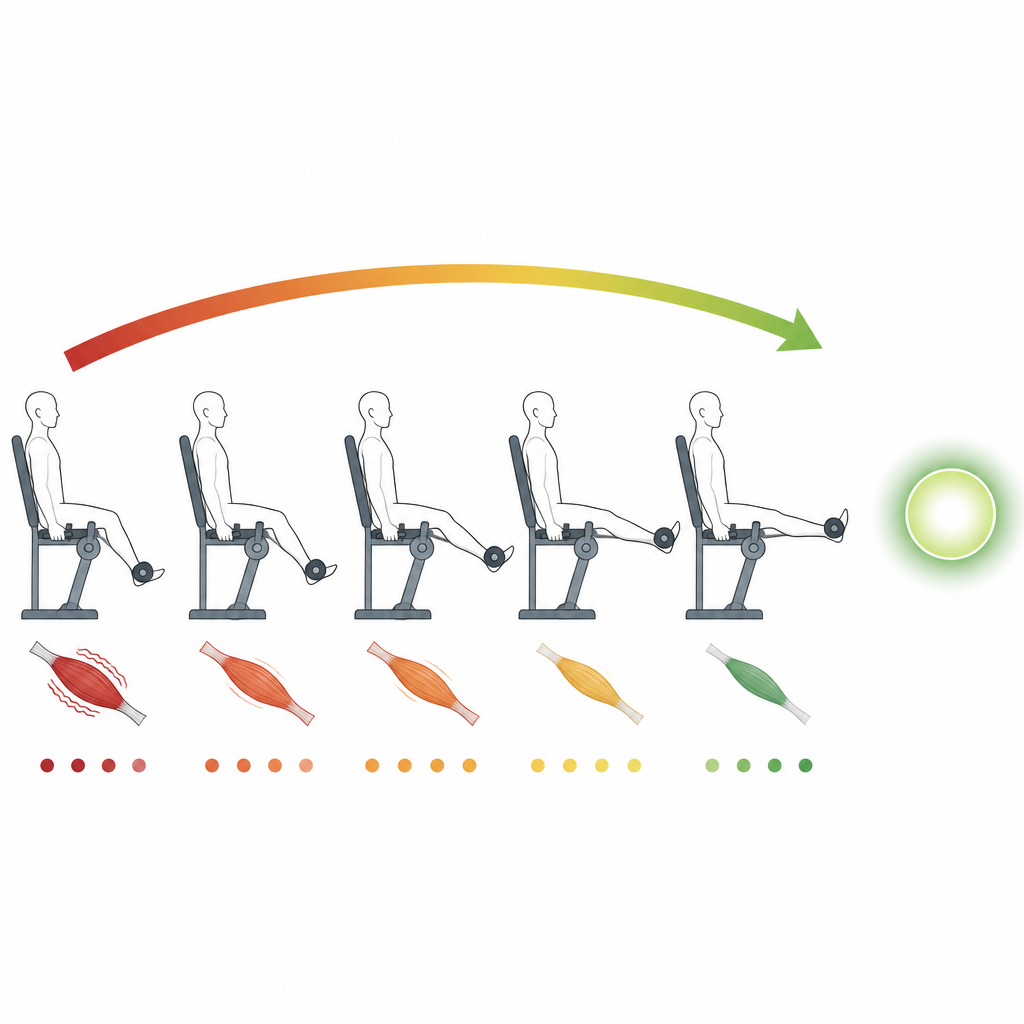
Researchers worked with twenty five healthy young men who came to the lab for two sessions. In the first session, they used a machine to find each person’s strongest knee angle, called the optimal angle, and measured their peak strength there and at other angles. They also ran a demanding test to estimate a personal reference level of effort. In the second session, each volunteer performed steady pushing tasks with the knee at five different angles, from more bent to more straight, while seated in the dynamometer. At each angle they held a submaximal force level for thirty seconds, matching a target line on a screen. The team recorded the torque at the knee and electrical signals from the main thigh muscles on both the front and back of the leg.
Looking beyond simple wobble in the force
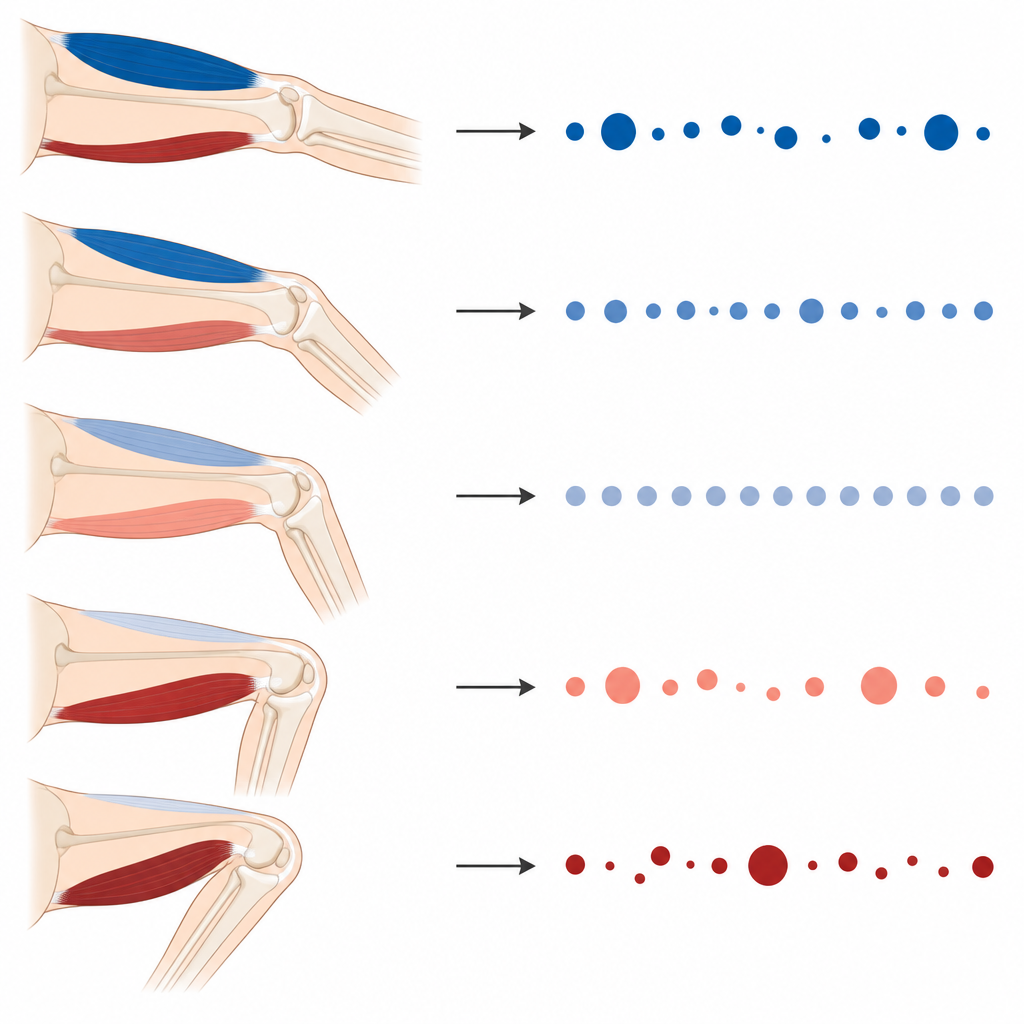
Rather than only asking how much the force wobbled, the researchers also examined how that wobble was organized over time. Traditional measures such as the coefficient of variation capture the size of fluctuations around the target. By contrast, a measure called sample entropy describes how predictable or complex the pattern of fluctuations is; more complex patterns suggest a system that can flexibly adjust its output. From the same force traces, they computed both the magnitude of variability and this complexity measure. They also calculated a co contraction index from the muscle recordings, which reflects how much the front and back thigh muscles were switched on at the same time to stiffen and stabilize the knee.
What happens when the knee is too bent or too straight
The results showed that the angle of the knee clearly shaped how force was regulated. As expected, maximal strength followed a familiar curve, peaking around the optimal angle and dropping when the knee was either more bent or more straight. Force complexity was highest at that optimal angle and was significantly lower when the knee extensors were placed in a shortened position with the knee more flexed. In that bent posture, the pattern of force became more regular and less adaptable. Interestingly, when the muscles were lengthened with the knee more extended, complexity did not fall, suggesting that other features of the muscle and tendons helped preserve a flexible control pattern even though the position differed from the optimum.
Force steadiness and muscle co tightening
When the team looked at the size of the force fluctuations, they found a different picture. The force became less steady, with larger swings around the target, at both the more bent and more extended positions, forming a U shaped trend across angles. Co contraction between the thigh muscles also tended to be lowest near the optimal angle and higher in the more extreme positions. In other words, when the joint moved away from its strongest posture, the nervous system responded by tightening both the front and back muscles around the knee, likely to protect the joint and keep it stable. This extra stiffness, however, went hand in hand with shakier and less finely tuned force output.
What these findings mean for everyday movement
Put simply, the study suggests that our ability to finely control force at the knee is best when the joint sits near its strongest angle and declines when the leg is either too bent or too straight. The researchers also show that how the force varies over time carries information that simple measures of steadiness miss. This richer view of force control, using both the size and the pattern of fluctuations, could help identify early changes in how the neuromuscular system adapts to demands, and may one day guide exercise programs or rehabilitation plans that aim to preserve not just strength, but also the subtle adaptability that makes movement smooth and secure.
Citation: Oliveira, J.H., Gomes, J.S., Bauer, P. et al. Torque regulation is affected by joint angle during isometric contraction in young male adults. Sci Rep 16, 15429 (2026). https://doi.org/10.1038/s41598-026-42754-y
Keywords: knee joint angle, force control, muscle co-contraction, torque variability, neuromuscular adaptability