Clear Sky Science · en
Physical simulation test of true triaxial rock mechanics for waterflood dilation in offshore oilfields
Why this matters for offshore oil and gas
Much of the world’s easy-to-produce offshore oil has already been tapped. What remains often sits in stubborn rock that barely lets fluids move. This paper explores a promising way to gently "stretch" such tight rock around injection wells using controlled water injection, so that oil can flow more easily without the massive surface equipment that classic hydraulic fracturing needs. For readers interested in how clever physics and lab experiments can unlock hard-to-reach resources with a lighter footprint, this study offers a detailed look.
The challenge of tight offshore rock
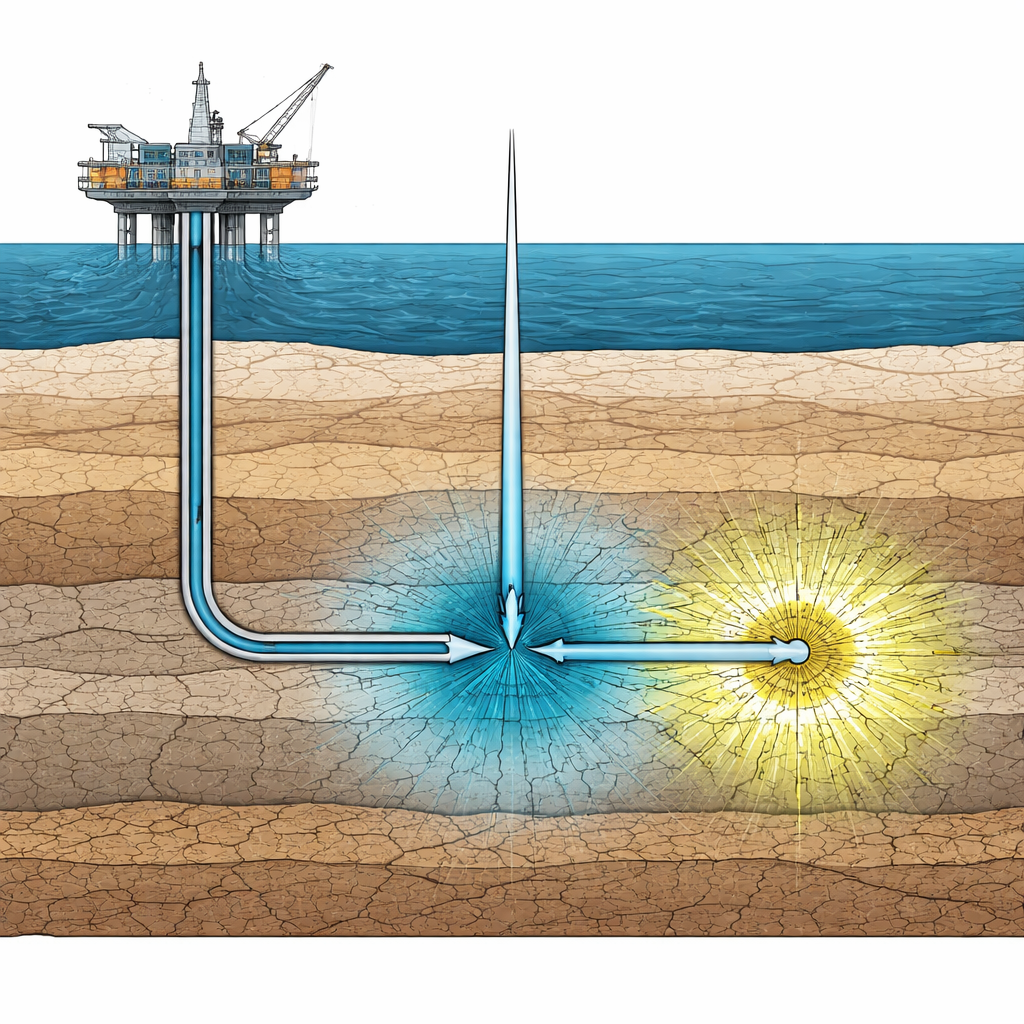
Offshore fields in China’s western South China Sea still hold large volumes of oil, but much of it sits in low-permeability sandstone. These rocks have tiny, poorly connected pores, many internal layers, and damage near existing wells, all of which make it hard for injected water to sweep oil toward production wells. Conventional hydraulic fracturing could improve flow, but it requires large, high-pressure pumping units and space that offshore platforms often lack. The authors therefore examine "waterflood dilation"—a subtler approach where carefully controlled water injection encourages many tiny cracks and pore openings instead of a few big fractures.
Probing how the rock behaves under stress
To design such a process, the team first needed to understand how the reservoir rock responds to stress deep underground. They tested core samples from the target field to measure how strong and stiff the sandstone is and how much it bulges sideways under compression. The rock turned out to be moderately strong but relatively brittle, with limited side expansion. This combination means it can store stress and then fail suddenly, favouring the formation of small cracks when pressured by injected water. They also used an acoustic method that listens for tiny sound bursts inside the rock as it is reloaded. These sounds reveal the in‑place stress levels at reservoir depth, including the vertical weight of overlying rock and the two main horizontal stresses. Matching these in the lab was essential to simulate realistic downhole conditions.
Recreating the reservoir in a cube of rock
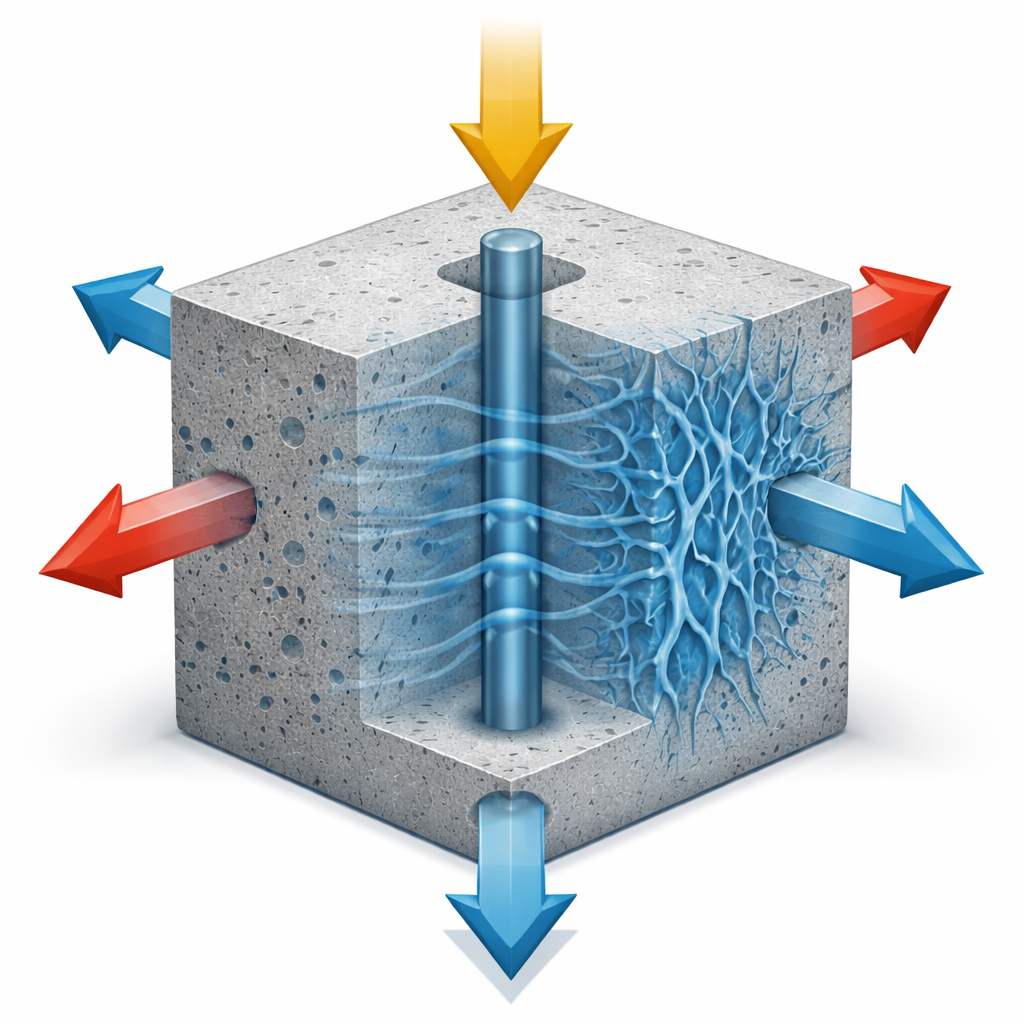
The heart of the work is a series of "true triaxial" experiments. Instead of the usual cylindrical cores squeezed the same way from both sides, the researchers used 10‑centimetre rock cubes that can be stressed independently in three directions, mimicking the real difference between vertical and horizontal forces in the subsurface. Each cube contained a small central borehole connected to a pump. The team applied stresses corresponding to the measured field values and then ran eight different injection programmes. These varied in whether the rock was pre‑pressurised in its pores, whether the injected liquid was hot or cold, whether flow was steady or oscillating, and whether the fluid was plain water or a thicker polymer solution. By keeping the maximum pressure just below the rock’s breaking point, they aimed to encourage distributed dilation rather than a single through‑going fracture.
How different injection styles change the rock inside
During each test, the scientists tracked injection rate, pressure, and total injected volume, and visually inspected whether fluids leaked from cube faces, a sign that cracks had connected to the surface. They also added a coloured tracer to show where water had travelled. Afterward, the cubes were scanned with medical-style CT imaging and converted into 3D digital models. Using image analysis, they calculated how the fraction of the rock’s volume occupied by pores changed under each scenario. Even though the overall porosity increases were modest—on the order of a few hundredths of a percent—they were measurable and consistently larger when pore pressure was ramped up in steps, when colder water was used, or when the pump alternated between low and high flow. A more viscous polymer, while harder to push through the rock, appeared to help support and stabilize very fine fractures near the borehole.
What this means for real offshore wells
Putting their results together, the authors conclude that waterflood dilation can subtly but usefully open up tight offshore sandstone around injection wells when in‑situ stresses are favourable, especially where horizontal stresses differ significantly. The most effective recipes involve pre‑pressurising pores in a stepped fashion, using lower injection rates, adding some flow oscillation, and in some cases choosing cooler or slightly thicker fluids. Rather than relying on violent fracture treatments, operators can use these insights to design gentler, more compact water‑injection programmes that create dense networks of micro‑cracks, improve local permeability, and potentially extend the productive life of offshore reservoirs.
Citation: Li, D., Chen, H., Liang, X. et al. Physical simulation test of true triaxial rock mechanics for waterflood dilation in offshore oilfields. Sci Rep 16, 13736 (2026). https://doi.org/10.1038/s41598-026-42750-2
Keywords: waterflood dilation, offshore sandstone, triaxial rock mechanics, microfracture networks, enhanced oil recovery