Clear Sky Science · en
Electrochemical studies on Cocos nucifera (coconut hair oil) derived carbon soot as an electrode material for EDLC application using non-aqueous NaPF6 electrolyte
Turning Everyday Coconut Oil into Smart Power Storage
Imagine that the same coconut oil often used for hair care could help power future electronics and support cleaner energy systems. This study explores how ordinary coconut hair oil can be burned to produce a fine black powder, called soot, that is then transformed into a promising material for supercapacitors—devices that charge and discharge much faster than typical batteries. By carefully treating this soot, the researchers show it can store significant amounts of electrical energy while being low-cost, scalable, and environmentally friendly.
Why Fast Energy Storage Matters
Our growing demand for clean energy requires devices that can quickly capture, release, and balance electrical power. Supercapacitors fill a special niche between conventional batteries and simple capacitors: they can deliver very high power over short times and survive many thousands of charge–discharge cycles. However, to make them practical and affordable on a large scale, we need electrode materials that are cheap, abundant, and easy to process. Waste-derived carbons made from oils and biomass have attracted attention because they can turn everyday or discarded materials into advanced components for energy storage.
From Flame to Functional Carbon
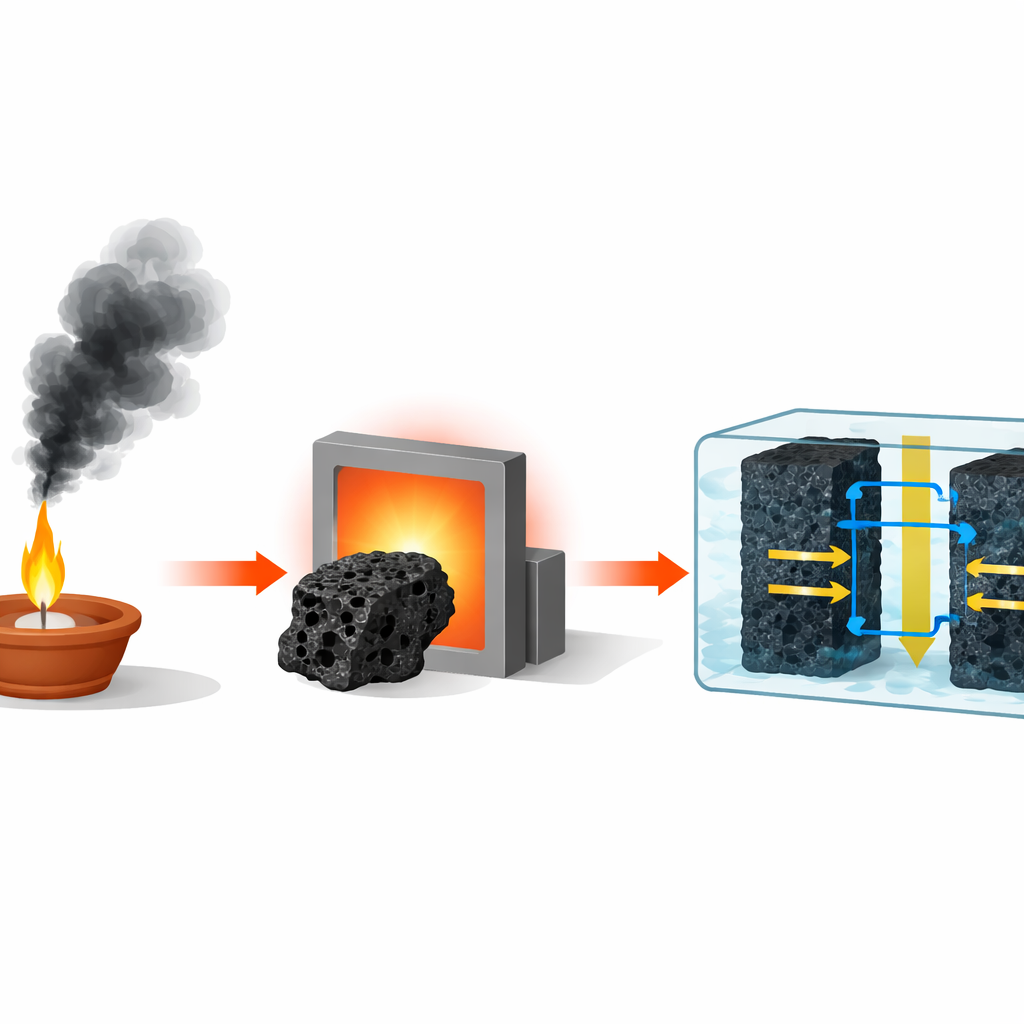
The researchers began by burning coconut hair oil in a small open flame using a cotton wick and a clay lamp. A metal plate held over the flame collected the rising soot, which naturally formed tiny layered, spherical carbon particles. This simple “flame synthesis” method requires no special gases or complex equipment. Once collected, the raw soot was mixed with chemical agents—zinc chloride (ZnCl₂) or potassium hydroxide (KOH)—and heated to 900 °C in a controlled environment. This activation step etched and reorganized the carbon, opening up a maze of pores and refining its internal structure. X-ray diffraction, electron microscopy, gas adsorption, and surface chemistry tests confirmed that activation subtly altered the crystallite arrangement, shrank agglomerate size, and greatly increased the accessible surface area.
Building a Better Sponge for Ions
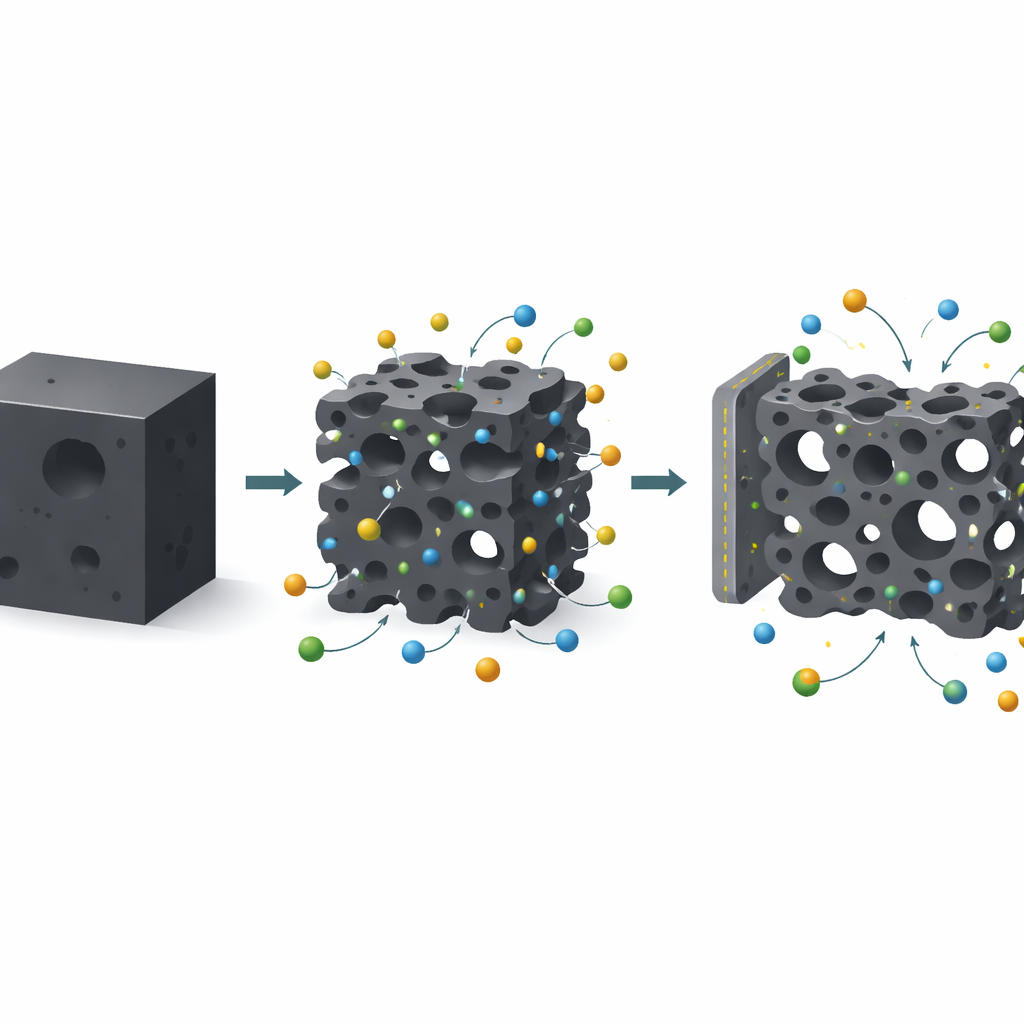
The key to a good supercapacitor electrode is to provide a huge internal surface that ions in the liquid electrolyte can quickly reach. The coconut soot treated with KOH developed a highly porous, sponge-like network, with both tiny and medium-sized pores that allow ions to move in and out efficiently. Its surface area rose to more than eight times that of the untreated soot, and the pore system became more interconnected and open than in the sample treated with zinc chloride. Chemical analysis showed that activation also tuned the balance between different forms of carbon and oxygen-containing groups, which helped maintain electrical conductivity and improved interaction with the electrolyte.
Testing the Coconut-Based Supercapacitor
To see how well the new materials worked in practice, the team fabricated symmetric electric double-layer capacitors, where both electrodes were made from the same coconut-derived carbon mixed with a small amount of conductive additive and binder. The devices used a non-aqueous sodium salt electrolyte, allowing operation over a 0–1 volt window. Charge–discharge curves had the nearly triangular form expected for ideal capacitors, and cyclic voltammetry showed near-rectangular shapes even at higher scan rates, indicating rapid and reversible ion motion. Impedance measurements revealed relatively low internal resistance, especially for the KOH-activated sample, meaning ions could easily access the internal pore network.
How Much Energy This Coconut Carbon Can Hold
Among all the tested materials, the KOH-activated coconut soot stood out. It delivered a specific capacitance of about 176 farads per gram at low current, along with an energy density of roughly 6.1 watt-hours per kilogram and a peak power density around 395 watts per kilogram. While this energy is lower than that of many batteries, the power delivery and cycling stability—retaining about three-quarters of its capacitance after more than 2,000 rapid cycles—make it attractive for applications that need quick bursts of energy, such as power smoothing in renewable systems, regenerative braking, or backup for sensitive electronics.
From Kitchen Oil to Green Technology
In simple terms, this work shows that a household product like coconut hair oil can be turned into a finely tuned carbon material suitable for high-performance supercapacitors. The process relies on an uncomplicated flame step followed by chemical activation, and could even use expired or non-edible oil, helping to reduce waste. By combining low-cost ingredients with robust energy-storage behavior, coconut-oil-derived carbon soot offers a pathway toward greener, more sustainable components for future energy devices.
Citation: Tyagi, A., Kumari, R., Gupta, R. et al. Electrochemical studies on Cocos nucifera (coconut hair oil) derived carbon soot as an electrode material for EDLC application using non-aqueous NaPF6 electrolyte. Sci Rep 16, 12139 (2026). https://doi.org/10.1038/s41598-026-42749-9
Keywords: coconut oil carbon, supercapacitor electrodes, activated carbon soot, sustainable energy storage, electric double-layer capacitor