Clear Sky Science · en
Hydrogen production from NaBH₄ hydrolysis over chemically reduced TiO₂-based Ru nanocomposites and their antimicrobial performance
Clean fuel and safer water
Imagine a material that can both produce clean hydrogen fuel on demand and help keep water free from harmful microbes. This study explores exactly such a dual-purpose substance: tiny particles made of a common white mineral, titanium dioxide, decorated with specks of the metal ruthenium. Together, they turn a chemical called sodium borohydride into hydrogen gas under gentle conditions and also strongly hinder the growth of disease-causing bacteria. 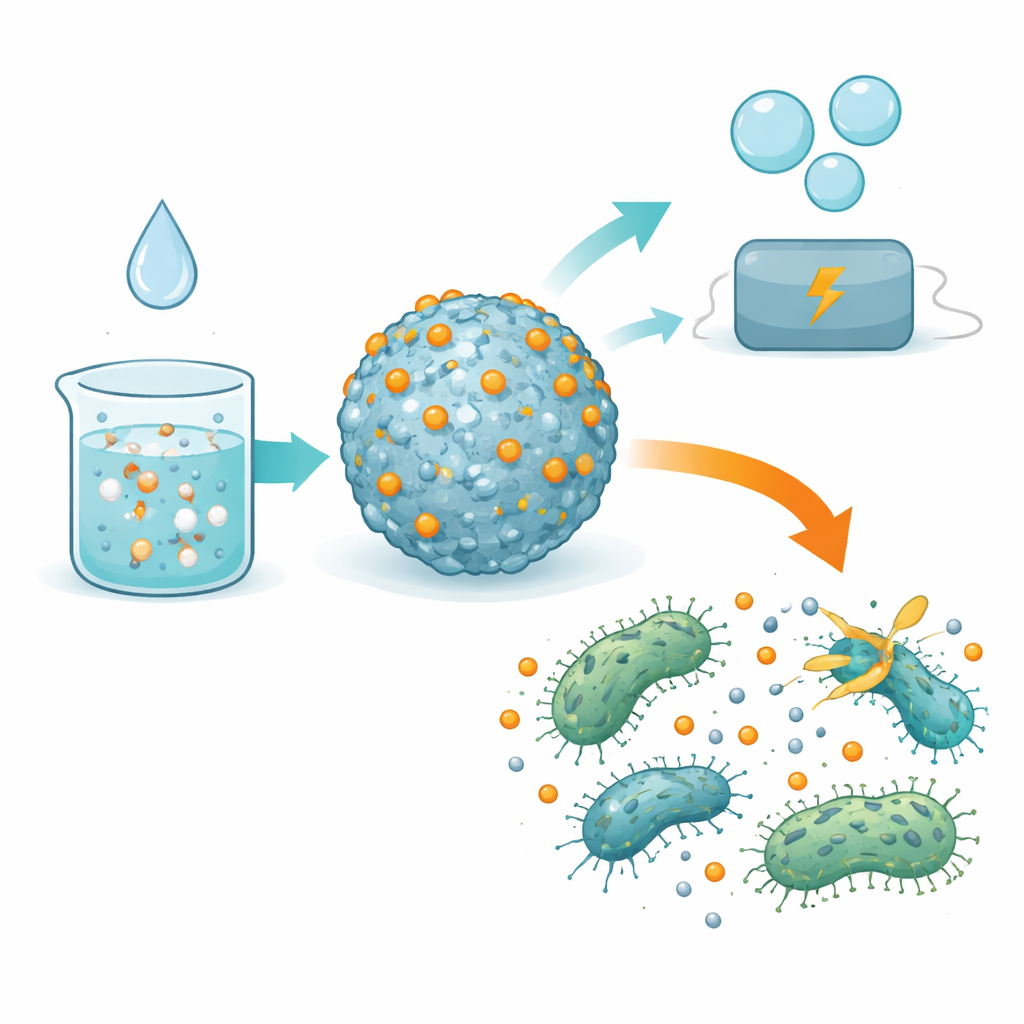
A chemical battery for hydrogen
Hydrogen is often described as a future-friendly fuel because it releases energy without producing carbon dioxide at the point of use. One challenge is how to store and release hydrogen safely and efficiently. Sodium borohydride acts like a compact chemical battery for hydrogen: when it meets water, it can release four molecules of hydrogen gas for every molecule of fuel. Left alone, however, this reaction is too slow to be useful. Catalysts—materials that speed up reactions without being consumed—are needed to make hydrogen flow fast enough for practical systems, such as portable power sources or backup supplies.
Building tiny helpers from familiar materials
The researchers created their catalyst by spreading a very small amount of ruthenium, only 0.5 percent by weight, onto ultrafine titanium dioxide powder using a simple soaking and chemical-reduction process. A suite of imaging and spectroscopy tools confirmed what the team aimed for: titanium dioxide crystals in the rutile form, carrying evenly distributed, metallic ruthenium nanoparticles about 11 nanometers across—thousands of times smaller than the width of a human hair. The rough, high-surface-area support and the intimate contact between metal and oxide help keep the metal particles from clumping, exposing many active spots where the reaction can occur.
Fast hydrogen from a calm solution
When these nanocomposites were added to water containing sodium borohydride, hydrogen bubbles formed rapidly even without extra base, which is often required in similar systems. By changing how much fuel, how much catalyst, and the temperature, the team could map how the reaction responds. They found that the hydrogen generation rate rises nearly in direct proportion to both the amount of sodium borohydride and the amount of catalyst present, behavior chemists describe as close to first order in each. At moderate temperatures between roughly room temperature and 40 degrees Celsius, the catalyst produced hundreds of milliliters of hydrogen per minute per gram of material, with each ruthenium atom turning fuel into hydrogen hundreds of times per hour.
Peering into the reaction pathway
Temperature-dependent measurements allowed the authors to estimate the energy barrier the reaction must overcome and the degree of order in the fleeting transition state where bonds are broken and formed. They obtained a relatively low activation energy, meaning the catalyst helps the reaction proceed readily at mild temperatures, and a strongly negative entropy change, implying that fuel and water molecules arrange themselves in a highly organized cluster on the ruthenium–titanium dioxide interface before releasing hydrogen. This picture matches theoretical models where both the fuel and water stick to the surface and react together in a well choreographed sequence. Although some loss of performance occurred after several reuse cycles—likely due to changes in the metal particles—the catalyst remained active, and its hydrogen production metrics compare favorably with many other ruthenium-based systems that use more metal or harsher conditions. 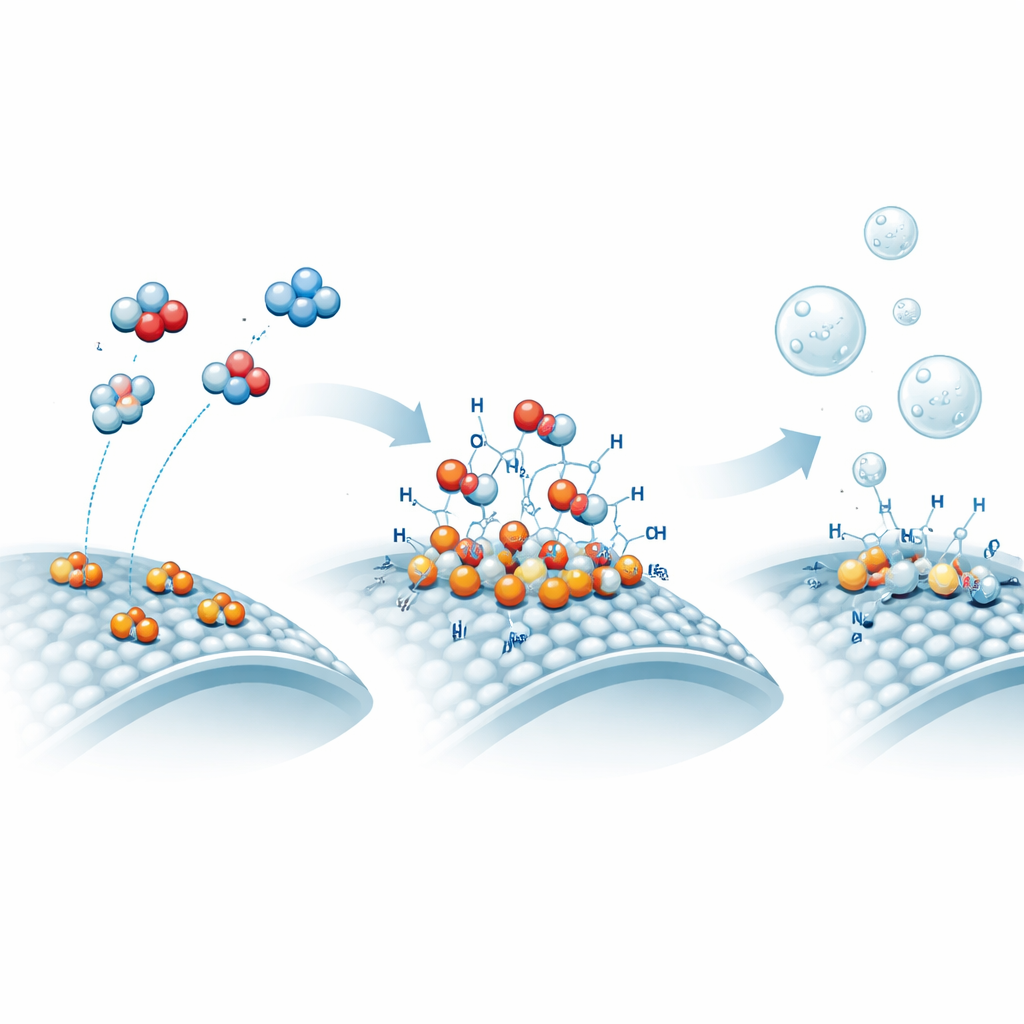
Stopping germs while making fuel
Beyond fuel production, the same nanocomposite was tested against four common bacteria, including both rod-shaped and spherical species. Even in the dark, where titanium dioxide alone is usually only weakly active, the combined material strongly inhibited bacterial growth, especially at higher doses. At the top tested concentration, growth reductions were above 90 percent for all strains and nearly complete for several of them. Compared with previously reported titanium dioxide hybrids, these results place the ruthenium–titanium dioxide particles among the more potent antimicrobial materials, hinting that ruthenium’s known microbe-killing abilities add to those of the oxide support.
One material, two solutions
For non-specialists, the main message is that a single, relatively simple nanomaterial can help tackle two pressing needs at once: clean, on-demand hydrogen fuel and control of harmful microbes. By carefully engineering how tiny metal particles sit on a common support, the authors achieved fast hydrogen release from a compact chemical fuel under gentle conditions, while also showing strong antibacterial effects. Such dual-function materials could be especially valuable in devices that simultaneously generate energy and purify water, or in self-sterilizing systems where hygiene and power supply go hand in hand.
Citation: Halvacı, E., Mutlag, F., Elaibi, H. et al. Hydrogen production from NaBH₄ hydrolysis over chemically reduced TiO₂-based Ru nanocomposites and their antimicrobial performance. Sci Rep 16, 13569 (2026). https://doi.org/10.1038/s41598-026-42735-1
Keywords: hydrogen storage, sodium borohydride, nanocatalyst, antibacterial surfaces, ruthenium titanium dioxide