Clear Sky Science · en
Machine learning-based Bayesian optimization of tuned inerter dampers for enhanced seismic response control in high-rise base-isolated structures
Why keeping tall buildings standing matters
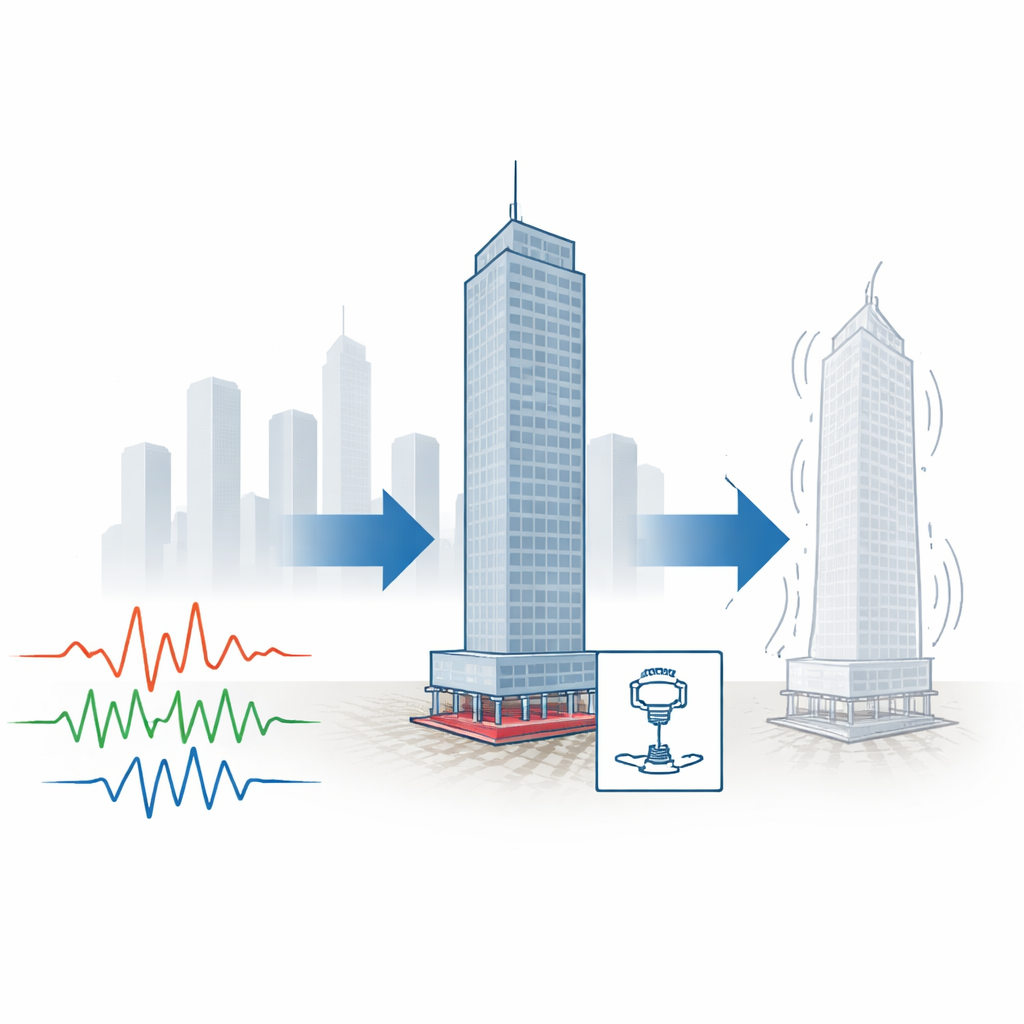
Modern cities increasingly rely on very tall buildings that must remain safe and usable even after strong earthquakes. Engineers already use special sliding bearings and dampers to let towers sway without collapsing, but these systems can struggle under certain types of powerful, long‑lasting shaking that occur near major faults. This paper explores a new combination of mechanical devices and machine‑learning–style optimization to make high‑rise, base‑isolated buildings ride out earthquakes more smoothly, with less motion and less acceleration at the top floors where people and equipment are most vulnerable.
A smarter way to calm a shaking building
The study focuses on high‑rise buildings that already sit on base‑isolation systems—flexible layers that decouple the structure from the ground. While isolation greatly reduces forces, it also makes the whole building move with a long, slow sway. Under distant earthquakes this works well, but near a fault, large pulses of ground motion can still push these tall, flexible systems to uncomfortable or even damaging displacements. To help, the authors use a device called a tuned inerter damper. Unlike a traditional tuned mass damper that relies on a heavy weight, an inerter uses clever gearing and rotating parts to create a strong inertial effect without adding much real weight to the building. Attached at the isolation layer, it resists rapid changes in motion and helps soak up seismic energy.
Letting algorithms hunt for the best settings
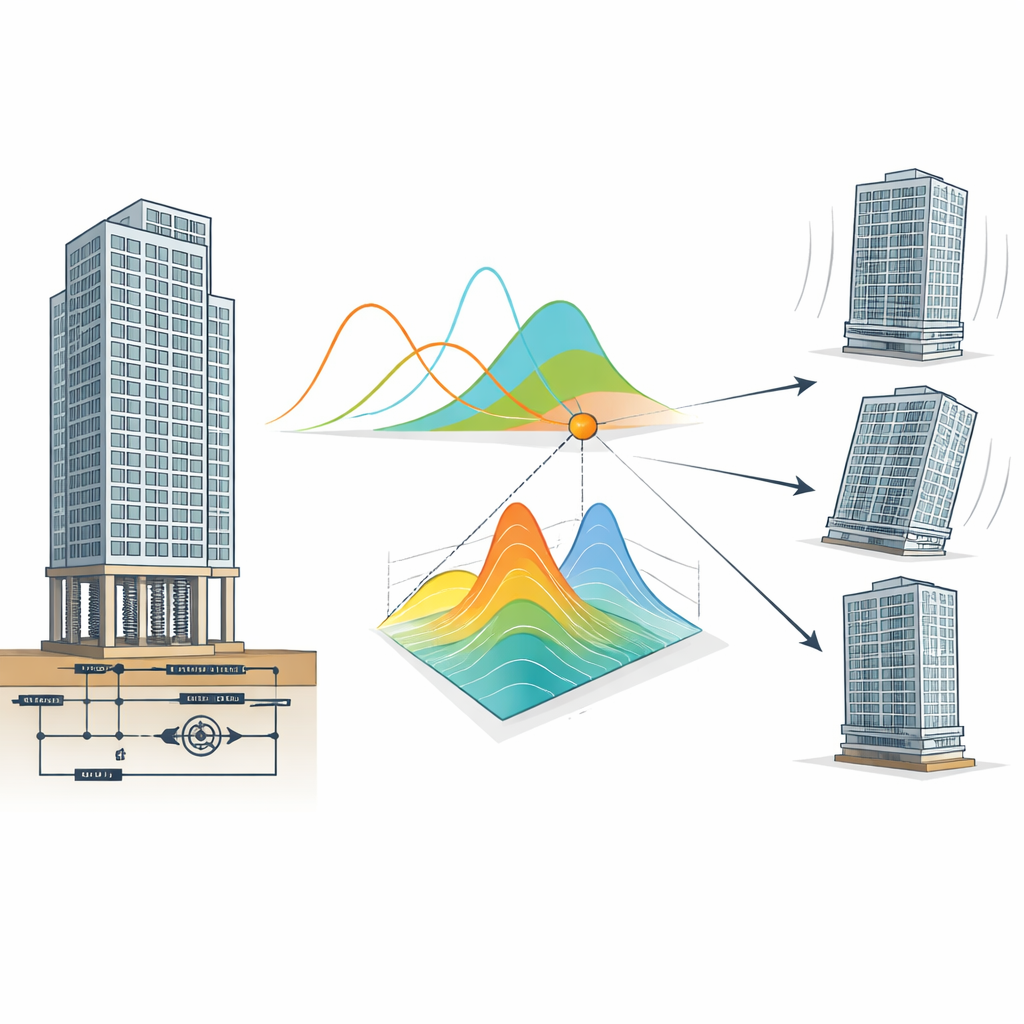
Getting the most out of this damper means choosing its “knobs” correctly: how stiff it is, how much it resists motion (damping), and how strong its apparent mass effect should be. Instead of tuning these by hand using simplified formulas, the authors turn to Bayesian optimization, a branch of machine learning designed to search for good solutions when each trial is expensive. They build a probabilistic model that links damper settings to how much the building moves under earthquake‑like shaking. The optimizer proposes new combinations of settings, focusing on those that are promising but still uncertain, and gradually converges on the configuration that gives the smallest average lateral displacement, while accounting for realistic frequency content of different earthquake types.
Testing the idea on tall virtual towers
Using detailed numerical models, the researchers apply this framework to base‑isolated buildings of 30, 40, and 50 stories. They expose these virtual towers to three families of shaking: far‑fault motions, near‑fault motions without strong pulses, and near‑fault motions with pronounced long‑period pulses, which are especially dangerous for tall flexible structures. For each case, the algorithm searches over damper frequency and damping levels for several choices of apparent mass ratio. It then evaluates how much the tuned inerter damper reduces typical (mean‑squared) displacement at the base and at upper floors, as well as peak roof accelerations, and compares the results with those from more familiar systems such as tuned mass dampers and inerter‑enhanced variants.
How much shaking can really be reduced
The optimized designs show substantial benefits. For 30‑ and 40‑story base‑isolated buildings, the tuned inerter damper typically cuts mean‑squared displacement by about 20–25% under distant and non‑pulse near‑fault earthquakes, and by roughly 10–18% under the more severe pulse‑type motions. Peak accelerations at the top stories drop by up to 22.8%, outperforming conventional tuned mass dampers and previously studied inerter‑based systems. The results also reveal clear trends: stronger apparent mass in the damper improves energy dissipation but requires careful tuning, long‑period isolated structures reap the largest rewards, and the type of ground motion strongly influences the ideal settings.
Where it works best—and where it doesn’t
The study concludes that a Bayesian‑optimized tuned inerter damper is a practical and efficient way to boost the earthquake resilience of mid‑ to high‑rise (roughly 30–40 story) base‑isolated buildings, giving engineers data‑driven guidance on how to select device parameters for different seismic environments. For very tall towers, however, higher vibration modes become more important, and a single device at the base cannot fully control all the complex motions. The authors note that their models simplify the building to emphasize the dominant sway mode and treat the inerter as an ideal linear device, so real‑world behavior will be somewhat more complicated. Even so, their work shows how combining advanced mechanical hardware with probabilistic optimization tools can meaningfully reduce shaking in tall buildings, pointing toward future designs that distribute such devices through the height of ultra‑tall structures.
Citation: Huang, S., Zhu, K. Machine learning-based Bayesian optimization of tuned inerter dampers for enhanced seismic response control in high-rise base-isolated structures. Sci Rep 16, 13216 (2026). https://doi.org/10.1038/s41598-026-42732-4
Keywords: seismic vibration control, base-isolated high-rise buildings, tuned inerter damper, Bayesian optimization, near-fault ground motions