Clear Sky Science · en
Cable online partial discharge detection and state evaluation based on deep belief network and swarm intelligence optimization algorithm
Watching the Hidden Health of Power Cables
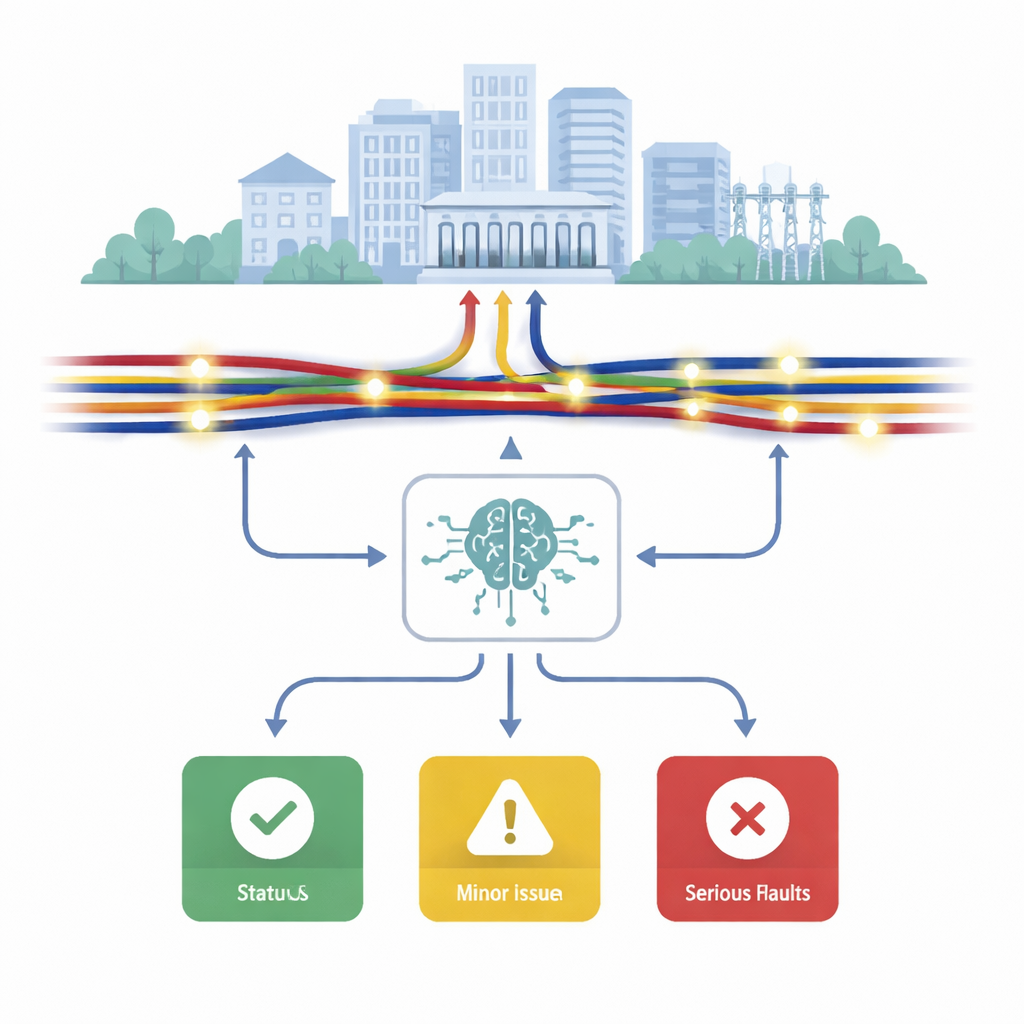
Modern cities rely on vast networks of buried power cables to keep lights on, trains running, and data centers humming. Yet deep inside the insulation of these cables, tiny electrical sparks—called partial discharges—can quietly eat away at the material for months or years before a dramatic failure shuts down part of the grid. This paper presents a new intelligent monitoring method that listens for these early warning signs in real time, even in noisy urban environments, and turns them into clear assessments of cable health.
Why Small Sparks Are a Big Problem
Underground cables are popular because they are reliable, compact, and visually unobtrusive. But their insulation can develop small defects from manufacturing flaws, moisture, or mechanical stress. When high voltage is applied, these weak points can produce tiny bursts of current instead of a clean, continuous flow. Each burst slightly damages the surrounding insulation, and over time this process can snowball into a sudden breakdown and large-scale power outage. Traditional monitoring methods use acoustic, thermal, optical, or radio sensors, but each comes with trade-offs: some are expensive to deploy over long distances, some are easily disturbed by environmental noise, and many require experts to handcraft features or adjust settings for every new cable type.
Teaching Machines to Read Noisy Signals
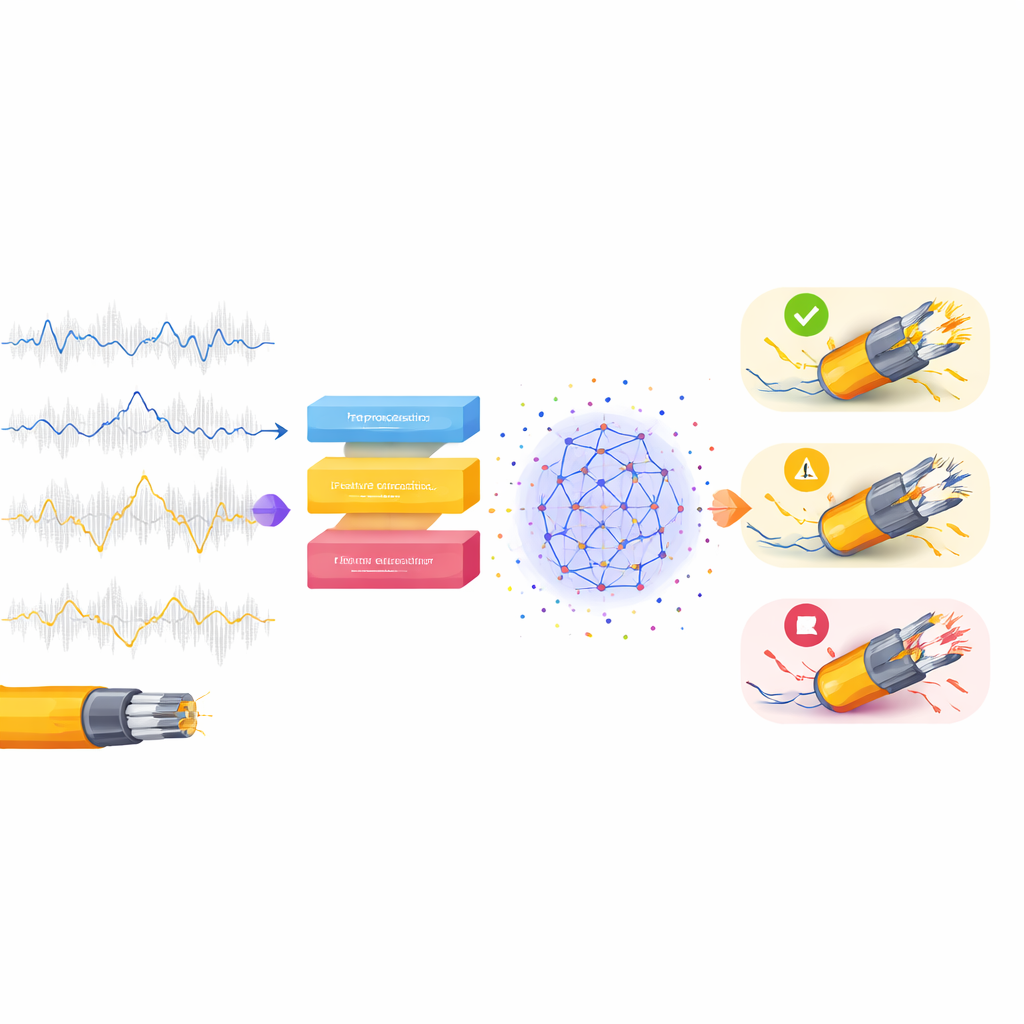
The authors tackle this challenge with a data-driven approach based on a deep belief network, a kind of layered neural network that can automatically learn patterns from raw measurements. Instead of engineers manually designing signal features, the network discovers useful representations of partial discharge signals on its own. To better handle the continuous nature of real-world measurements, the team replaces the usual binary building blocks with a version that is more natural for analog data. They then add two techniques borrowed from modern machine learning: DropConnect, which randomly thins the connections in the network during training to prevent overfitting, and an "elastic" weight scheme that helps the model remember what it has learned when new kinds of data arrive over time.
Swarm-Inspired Tuning of the Brain
Even a clever neural network can underperform if its internal structure—how many layers, how many neurons, what learning rates to use—is chosen by guesswork. To avoid this, the authors introduce an optimization procedure inspired by collective behavior in nature. They combine a krill-herd model, a bat-inspired search pattern, and spiral flight paths into a single algorithm that sends a virtual swarm exploring many possible network designs. Each candidate network is judged not only on how accurately it classifies cable states, but also on how fast it runs and how compact it is. Over many iterations, the swarm homes in on configurations that strike the best balance between accuracy, speed, and resource usage, producing a streamlined model suited for deployment in substations and edge devices.
From Lab Data to Real-World Noise
To test their framework, the researchers train and evaluate it on publicly available battery datasets and additional cable data, comparing it with popular deep learning and hybrid models. Their improved network alone outperforms convolutional networks and gradient-boosting methods on standard quality measures such as precision, recall, and the area under the receiver operating curve. When the swarm-based optimizer is added, performance rises further while the number of parameters, required computations, memory footprint, and training time all drop substantially. The system also holds up well when strong noise is added to real field measurements from urban cable lines, maintaining higher accuracy than competing methods even at very low signal-to-noise ratios.
What This Means for Keeping the Lights On
In everyday terms, this work shows how a compact, self-tuning artificial intelligence can continuously listen to the faint electrical "heartbeat" of buried power cables and reliably flag early signs of trouble. By catching partial discharges sooner and distinguishing between minor and severe defects, utilities can plan maintenance instead of reacting to blackouts. The combination of robust signal understanding, resistance to noise, and efficient computation makes the proposed framework promising for large-scale, always-on monitoring of urban power grids, helping cities keep their power delivery both safer and more cost-effective.
Citation: Hou, Y., Li, Y., Song, B. et al. Cable online partial discharge detection and state evaluation based on deep belief network and swarm intelligence optimization algorithm. Sci Rep 16, 13797 (2026). https://doi.org/10.1038/s41598-026-42730-6
Keywords: power cable monitoring, partial discharge, deep learning, smart grid reliability, predictive maintenance