Clear Sky Science · en
KG-EIGNN: a knowledge graph based graph neural network for fault detection in industrial systems
Why smarter fault detection matters
Modern factories, power plants, and pipelines rely on thousands of sensors to warn engineers when something is going wrong. Yet many current fault detection tools either miss early signs of trouble or overwhelm staff with confusing alerts. This study introduces a new way to read sensor data that combines human know-how with advanced graph-based artificial intelligence, promising faster, clearer, and more reliable warnings before breakdowns happen.
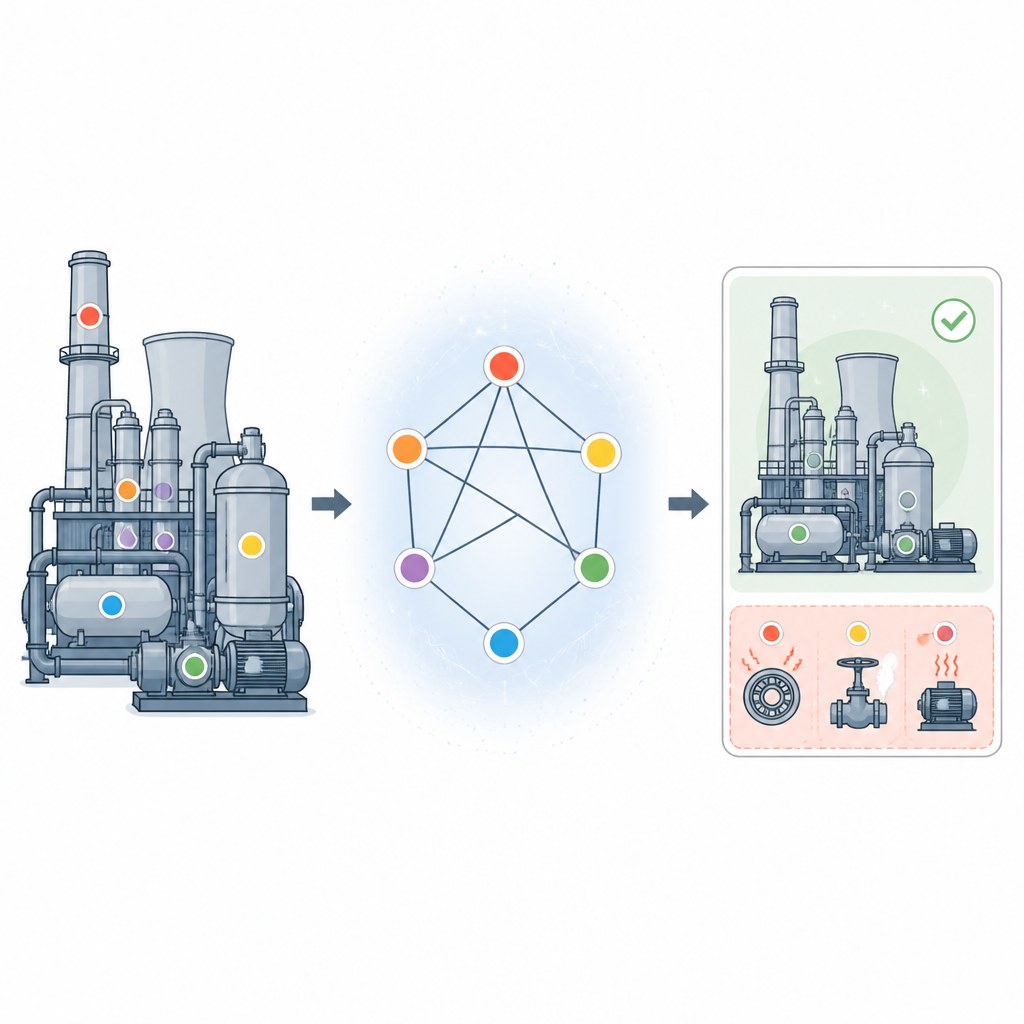
From scattered sensor readings to connected stories
In many industrial systems, sensors are treated as if they work alone: each reading is monitored or fed into a model without considering how it relates to others. The authors argue that this wastes valuable context. Instead, they represent sensors and their relationships as a network, or graph, where each sensor becomes a point and the links between points show how signals influence one another over time. This graph captures not only what each sensor measures, but also how changes ripple through the system, turning raw data into a connected story about how faults develop.
Adding expert knowledge to the map
To move beyond purely data-driven models, the researchers build a knowledge graph that encodes how engineers understand their equipment. In this graph, components, symptoms, and known fault types are linked by relationships such as which part affects which, or which symptom tends to appear with a given failure. These expert-verified links are combined with patterns found in historical sensor data. By weaving this expert map into the sensor graph, the method can focus on the connections that actually make physical sense, rather than chasing every statistical coincidence.
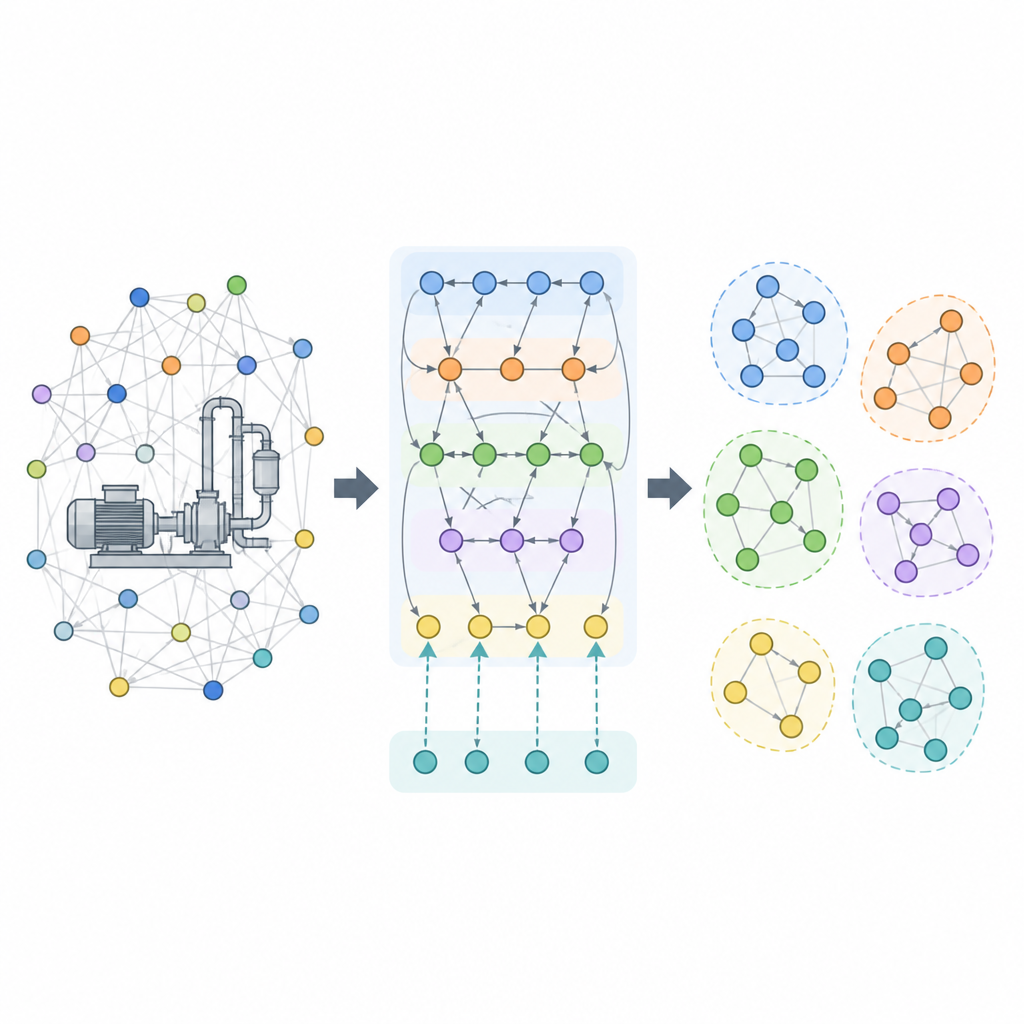
Teaching the model to tease out real causes
A key challenge in fault diagnosis is separating cause from coincidence. In complex plants, many signals move together not because one causes another, but because both respond to hidden influences such as operating conditions or noise. The proposed model, called KG-EIGNN, tackles this using a strategy borrowed from causal analysis. It creates controlled variations of the sensor graph and introduces special helper variables that disturb the inputs without directly touching the final decision. By learning how predictions should stay stable under these carefully designed changes, the system learns to downplay misleading links and strengthen the ones that truly reflect how faults arise.
Handling rare faults and messy data
In real facilities, serious faults are rare, which is good for safety but difficult for machine learning. Many methods need huge, well-balanced datasets to work well. KG-EIGNN addresses this in two ways. First, it uses contrastive learning, which trains the model to recognize how different fault situations relate to one another even when some are scarce. Second, it blends this with standard supervised training, where known examples of normal and faulty states guide the predictions. Together with the knowledge graph and causal interventions, this hybrid approach helps the model generalize from limited examples and remain robust in the face of noisy, uneven data.
Putting the method to the test
The team evaluated KG-EIGNN on two realistic case studies. One simulates mixtures of water, oil, and gas flowing through pressurized pipes, while the other models a gas turbine within a nuclear power system. Both datasets include many sensors and multiple distinct fault types, plus normal operation. Across these tests, the new method consistently surpassed traditional classifiers and earlier graph-based models, achieving higher accuracy and better separation between different fault categories. It also showed strong performance on a metric that reflects how well the model ranks faulty versus healthy states, a crucial factor for reliable early warning.
What this means for real plants
To a lay reader, the key outcome is that KG-EIGNN acts like a smarter, more informed watchman for industrial systems. By combining sensor networks, expert maps of how equipment fails, and tools that probe cause rather than mere correlation, it can spot and distinguish faults more accurately and earlier than many existing approaches. While the current tests focus on simulated energy systems, the same ideas could extend to factories, chemical plants, and other sensor-rich settings. With further validation in real-world environments, this type of model could help reduce unplanned shutdowns, cut maintenance costs, and make critical infrastructure safer.
Citation: Bo, W., Ju, C., Hu, J. et al. KG-EIGNN: a knowledge graph based graph neural network for fault detection in industrial systems. Sci Rep 16, 15471 (2026). https://doi.org/10.1038/s41598-026-42723-5
Keywords: fault diagnosis, industrial sensors, graph neural network, knowledge graph, predictive maintenance