Clear Sky Science · en
Stability analysis of discrete delta fractional models under summation multipoint constraints for robust engineering systems
Why keeping digital systems steady matters
From temperature sensors in medical devices to controllers that keep power grids and robots running smoothly, many modern technologies rely on digital models that update step by step in time. But real systems are never perfectly quiet—signals are noisy, environments fluctuate, and components age. This paper asks a crucial question: when such systems are described using advanced "fractional" mathematics that accounts for memory effects, can we still trust their behavior when they are nudged or disturbed? The authors develop new theory showing that, under realistic conditions, these models remain predictably close to their ideal behavior, giving engineers stronger guarantees of reliability.
Discrete models that remember the past
Traditional equations often treat change as smooth and continuous, but many engineered systems operate in discrete steps: sensors sample at fixed times, controllers update once per cycle, and digital hardware switches between clock ticks. Fractional calculus extends ordinary calculus by allowing derivatives of non-integer order, building in a kind of mathematical memory, where the current state depends on a weighted history of past states. Over the last three decades, researchers have adapted these ideas to such stepwise, or discrete, settings. The paper focuses on a particular family called discrete delta fractional problems, which model processes that move forward in time and can naturally capture complex phenomena like signal propagation, heat diffusion, and feedback control with memory.
Many constraints, all at once
Real devices rarely obey just a single simple boundary rule like “start here, end there.” Instead, engineers often impose several conditions at once: a sensor might need to match a known starting value, satisfy an average over several readings, and remain within a safe range. Mathematically, this leads to so-called summation multipoint boundary conditions, where the state at one time is linked to a sum over states at several other times. Until now, researchers had studied such multi-point constraints mainly in a related framework (the "nabla" setting), leaving a practical gap for the delta version that more directly describes forward-in-time dynamics. This article formulates, for the first time, discrete delta fractional models under these multipoint constraints and asks whether solutions not only exist and are unique, but also remain stable in the presence of disturbances.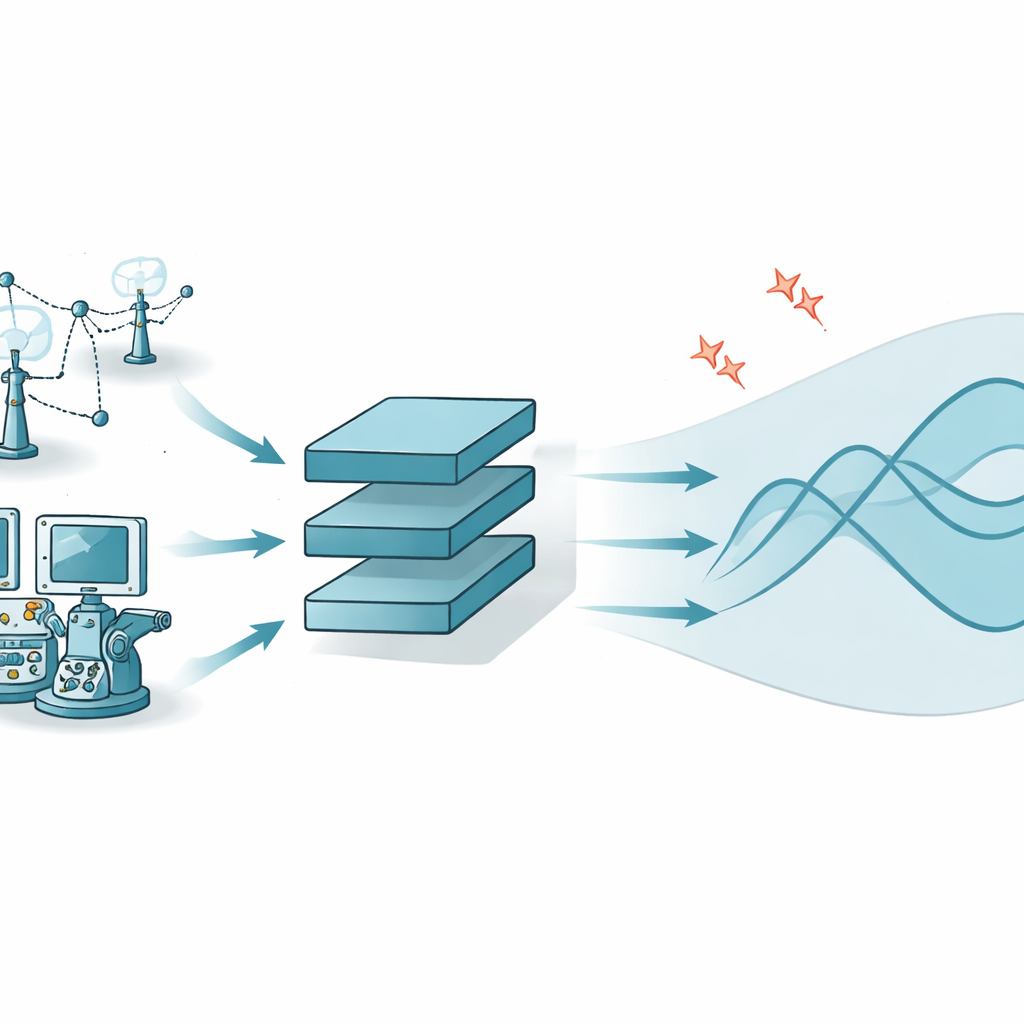
Building the mathematical backbone
To answer these questions, the authors construct a key tool known as a Green’s function, which acts like a fingerprint of how the system responds to influences at each time step. With this in hand, they can write the solution of their discrete model as a clear combination of boundary data and internal forcing terms. Using classic fixed-point theorems from functional analysis, they prove that under broad conditions there is at least one solution, and that this solution is unique when the system’s internal "nonlinear" response does not change too abruptly. In other words, if the physical law that links inputs and outputs behaves in a controlled way, the mathematical model does not wander off into multiple conflicting answers.
Quantifying robustness to disturbances
The heart of the paper is a rigorous stability analysis framed in the language of Ulam–Hyers and Ulam–Hyers–Rassias stability. These concepts go beyond the simple idea that solutions exist; they measure how close a true solution stays to an approximate one when the equations are slightly violated, for example by noise, modeling error, or environmental fluctuations. The authors show that if the system’s response satisfies a reasonable "Lipschitz" condition—roughly, if small changes in state produce proportionally small changes in output—then any approximate trajectory that nearly satisfies the equations is guaranteed to sit within an explicit bound of a genuine solution. They handle both uniform disturbances, which are similar at every time step, and non-uniform ones that vary over time. The result is a set of concrete constants that tell designers how much deviation they can expect and still be safe.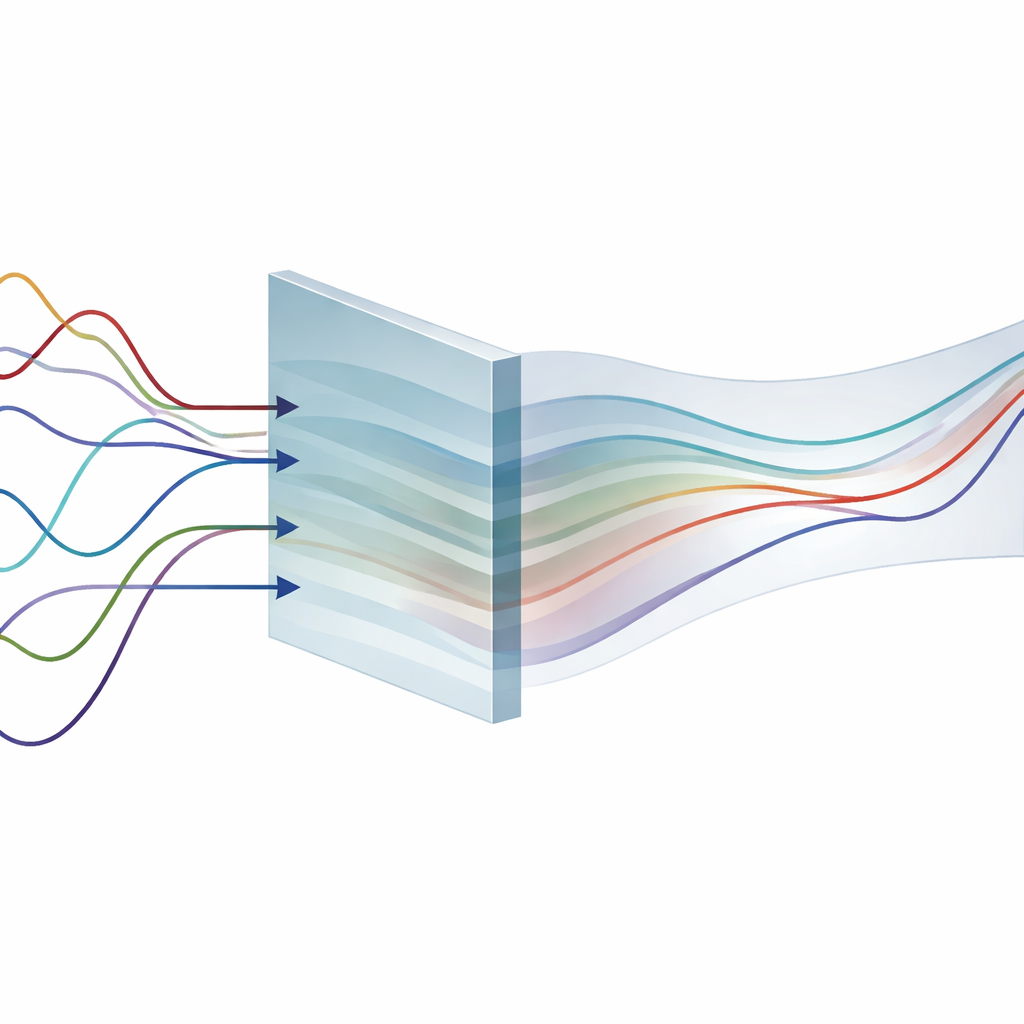
Putting theory to work in sensors
To demonstrate the practical side, the paper studies two test cases. The first is a nonlinear discrete system used as a benchmark, where the authors compute the relevant constants and verify that the theoretical bounds indeed hold: all solution curves remain trapped inside the predicted safe region, even under relatively strong perturbations. The second is a model of heat diffusion in a digital temperature sensor with memory, where the fractional order represents how past temperatures continue to influence current readings. Here too, the analysis shows that, despite changes in ambient conditions, the sensor’s computed temperature stays within a carefully quantified stability band. Graphical simulations display how different disturbance levels still produce trajectories that never escape this band, visually confirming the robustness guaranteed by the theory.
What this means for future technologies
In simple terms, the study shows that a sophisticated class of step-by-step, memory-rich models behaves in a reassuringly steady way under real-world imperfections. By providing explicit conditions that ensure existence, uniqueness, and strong forms of stability, the work gives engineers mathematical confidence that designs based on discrete delta fractional calculus with multipoint constraints will not suddenly become unreliable when faced with noise or environmental drift. This foundation opens the door to more widespread use of such models in next-generation sensor networks, control systems, and other technologies where both fine-grained memory and rock-solid robustness are essential.
Citation: Mohammed, P.O., Al-Sarairah, E., Baleanu, D. et al. Stability analysis of discrete delta fractional models under summation multipoint constraints for robust engineering systems. Sci Rep 16, 11928 (2026). https://doi.org/10.1038/s41598-026-42701-x
Keywords: fractional calculus, discrete-time systems, stability analysis, sensor networks, robust control