Clear Sky Science · en
Development of Zn1−xSnxO and Mg1−xSnxO transparent conducting oxide thin films for perovskite solar cell applications
Why clear electrodes matter for solar power
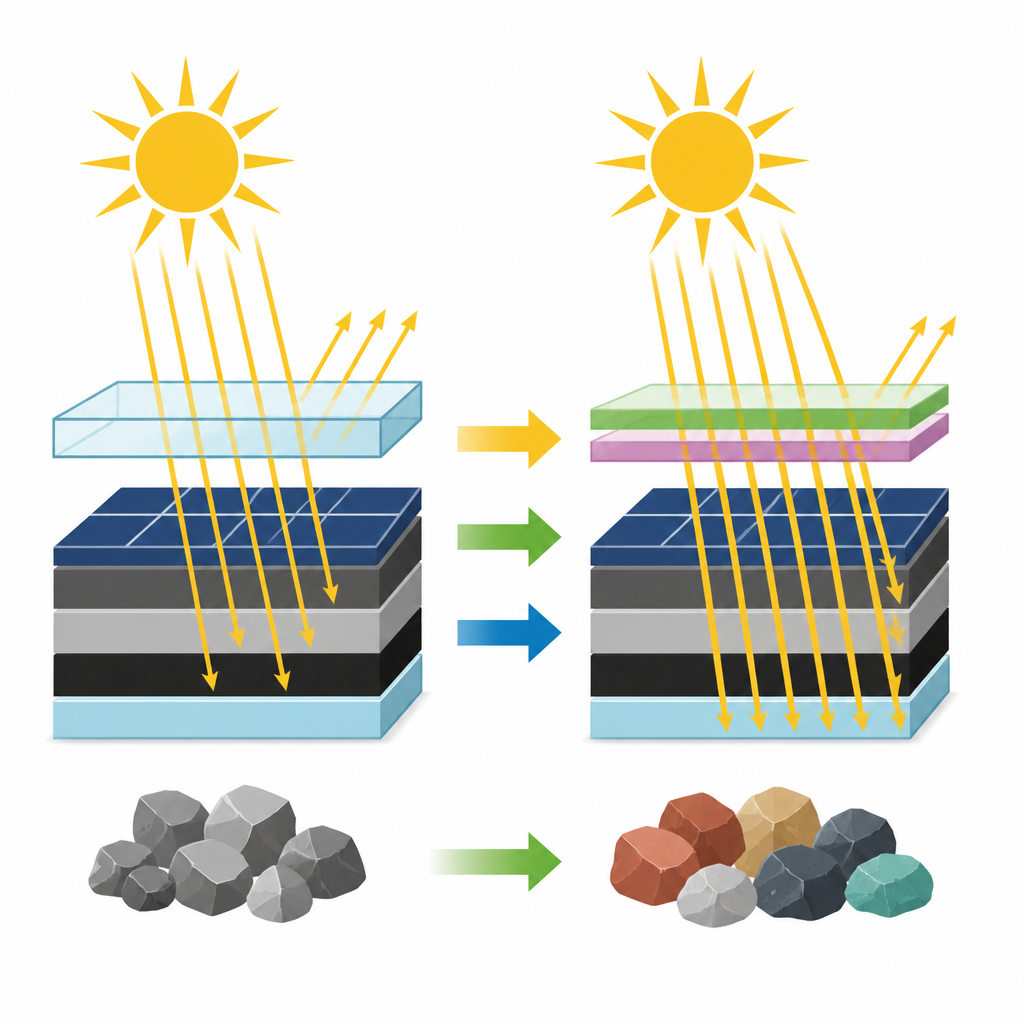
Modern solar panels do more than turn sunlight into electricity; they also showcase clever materials that let light pass through while still carrying electrical current. This study explores two such clear, electricity-carrying coatings made from abundant elements, aiming to replace today’s expensive industry standard and to support safer, lead-free perovskite solar cells.
New clear coatings built from common metals
The researchers focused on transparent conducting oxides, the glass-like front layer that both admits light and collects charge in many devices, from phone screens to solar cells. Instead of the usual indium-based materials, which are costly and scarce, they created two alternatives by combining tin oxide with either zinc or magnesium. These new coatings, called ZTO and MTO, were made using a simple spray technique that can cover large glass sheets without the need for complex vacuum equipment.
Spray, heat, and tune the films
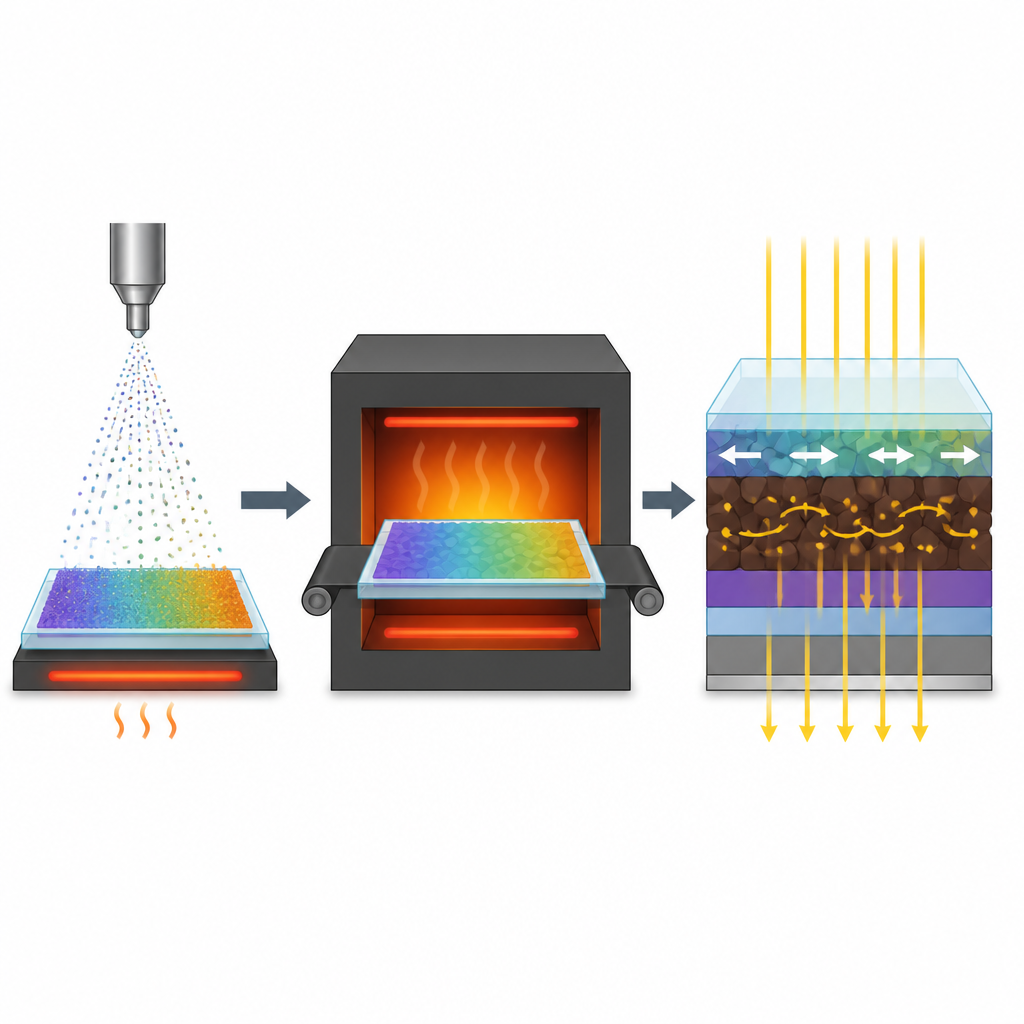
To build the coatings, the team dissolved metal salts in alcohol and sprayed the mist onto heated glass, then baked the films at high temperature. By carefully varying the mixing ratio of zinc or magnesium to tin, and then annealing the films, they could control thickness, crystal structure, and internal defects. X-ray measurements showed that heating improved the order of the atoms and reduced imperfections, while electron microscopy revealed more regular grains and smoother coverage after the heat treatment, both of which help charge move more easily.
Balancing clarity and conductivity
A good front layer for a solar cell must be both highly transparent and highly conductive, two qualities that often pull in opposite directions. Optical tests showed that both ZTO and MTO films let about 76–80 percent of visible light through, even after being thickened enough to conduct current well. At the same time, electrical measurements confirmed that the films carried negative charges efficiently, with the best magnesium-based films reaching very high carrier concentrations and low electrical resistance. The heating step slightly narrowed the films’ optical bandgaps and reduced unwanted chemical groups, changes linked to better charge transport without sacrificing too much transparency.
Putting the new layers into real solar cells
To see how these coatings perform in practice, the team built simple perovskite solar cells using a lead-free cesium tin chloride absorber and a low-cost graphite back contact. This design was chosen not to break efficiency records, but to clearly highlight how the front coatings affect performance. When the new ZTO and MTO layers replaced conventional transparent electrodes, the resulting devices produced measurable power under standard lighting. Cells with ZTO reached power conversion efficiencies of about 3.5 percent, while those with MTO achieved about 6.4 percent, thanks to stronger current and slightly higher voltage.
What this means for future solar technology
The study shows that clear, conductive coatings made from tin and magnesium can rival the optical clarity of today’s standard materials while offering strong electrical performance and using more abundant elements. Among the two options tested, the magnesium-based films performed better inside working perovskite solar cells, mainly because they conducted electricity more efficiently while still letting plenty of light through. Although these devices are not yet ready for rooftops or power plants, the results suggest a promising path toward cheaper, indium-free, and potentially safer solar modules that rely on scalable spray-coating methods.
Citation: Kiruthiga, G., Kumar, M.S., Raguram, T. et al. Development of Zn1−xSnxO and Mg1−xSnxO transparent conducting oxide thin films for perovskite solar cell applications. Sci Rep 16, 15968 (2026). https://doi.org/10.1038/s41598-026-42690-x
Keywords: transparent conducting oxide, perovskite solar cells, spray pyrolysis, tin oxide thin films, indium free electrodes