Clear Sky Science · en
A stable solid-like water at normal condition
Water That Acts Like a Solid
We usually think of water as something that flows, splashes and evaporates, unless it is frozen into ice. This study reveals a surprising new behavior: under the right kind of confinement, ordinary liquid water can behave like a solid while still sitting at everyday temperatures and pressures. Understanding this unusual state could change how we think about water in tiny pores inside rocks, in micro-machines and even in biological systems.
Trapping Water Inside Tiny Glass Tubes
The researchers worked with hair-thin tubes made of silica, a glass-like material similar to quartz. These tubes are hollow, so they can be filled with water, and their inner diameters range from fractions of a micrometer to several micrometers (a micrometer is a thousandth of a millimeter). When water was sealed inside tubes on the submicron to a few micrometers scale, it no longer behaved like a normal liquid. Using focused ion beams, the team could slice through the water inside the tubes, carve sharp-edged sections and even deform it under pressure without it flowing away—behavior we normally associate with soft solids rather than liquids. These solid-like “plugs” of water stayed intact from −20 to 90 degrees Celsius and from high vacuum to normal air pressure, remaining stable for at least 54 days. 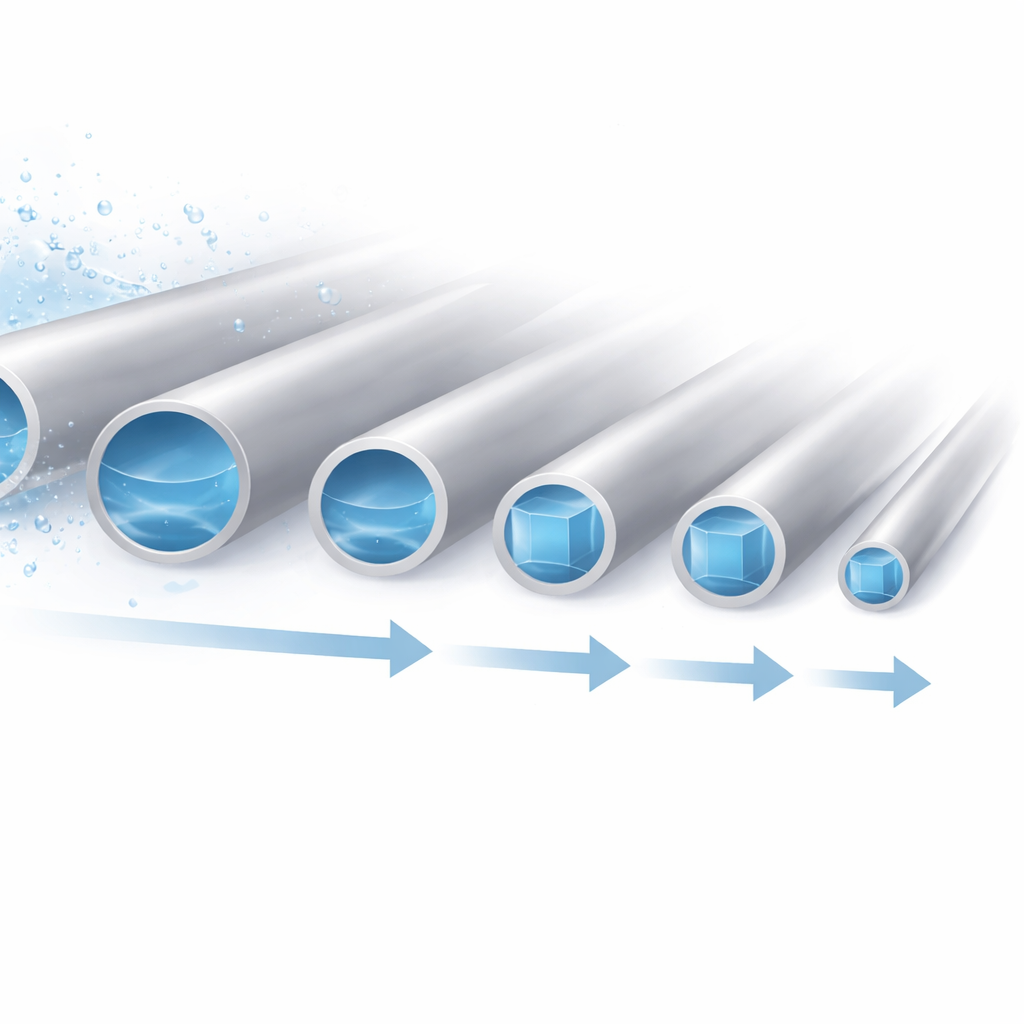
Probing the Hidden Inner Structure
To find out what made this confined water so different, the team turned to several types of “listening devices” for molecules: Raman and infrared spectroscopy, and proton nuclear magnetic resonance (¹H NMR). These tools measure how water molecules vibrate and move. In the smallest tubes, the spectral fingerprints shifted and broadened compared with ordinary liquid water, signaling slower motion and a reorganized network of bonds between water molecules. Electron diffraction—a way to see crystal patterns—showed no sharp spots or rings as seen in ice, but rather a diffuse halo. That means this solid-like water is not frozen in a regular crystal lattice, but is instead an amorphous, glass-like state: solid in behavior, yet lacking long-range order like snowflakes or ice cubes.
Ruling Out Contamination and Finding the Real Cause
One obvious question is whether the solid-like material might actually be some impurity or residue. To address this, the researchers analyzed the extruded material using techniques that reveal the elements present and their ion fragments. They found almost exclusively hydrogen and oxygen, consistent with water and the surrounding silica, and no clear signals of foreign elements. This supported the conclusion that the new phase is genuinely a form of confined water, not a contaminant. Attention then turned to the inner surface of the tubes. Detailed measurements showed that as the tube diameter shrinks below about 2–5 micrometers, the density of silanol groups—hydrogen-bearing sites on the silica surface—rises dramatically, especially within just a few nanometers of the inner wall. When the team chemically stripped away some of these groups, water that had been solid-like reverted to a normal liquid state. Conversely, when they increased the number of these groups on larger tubes, the confined water became solid-like. This reversible switch strongly pointed to surface chemistry, not just tight geometry, as the controlling factor. 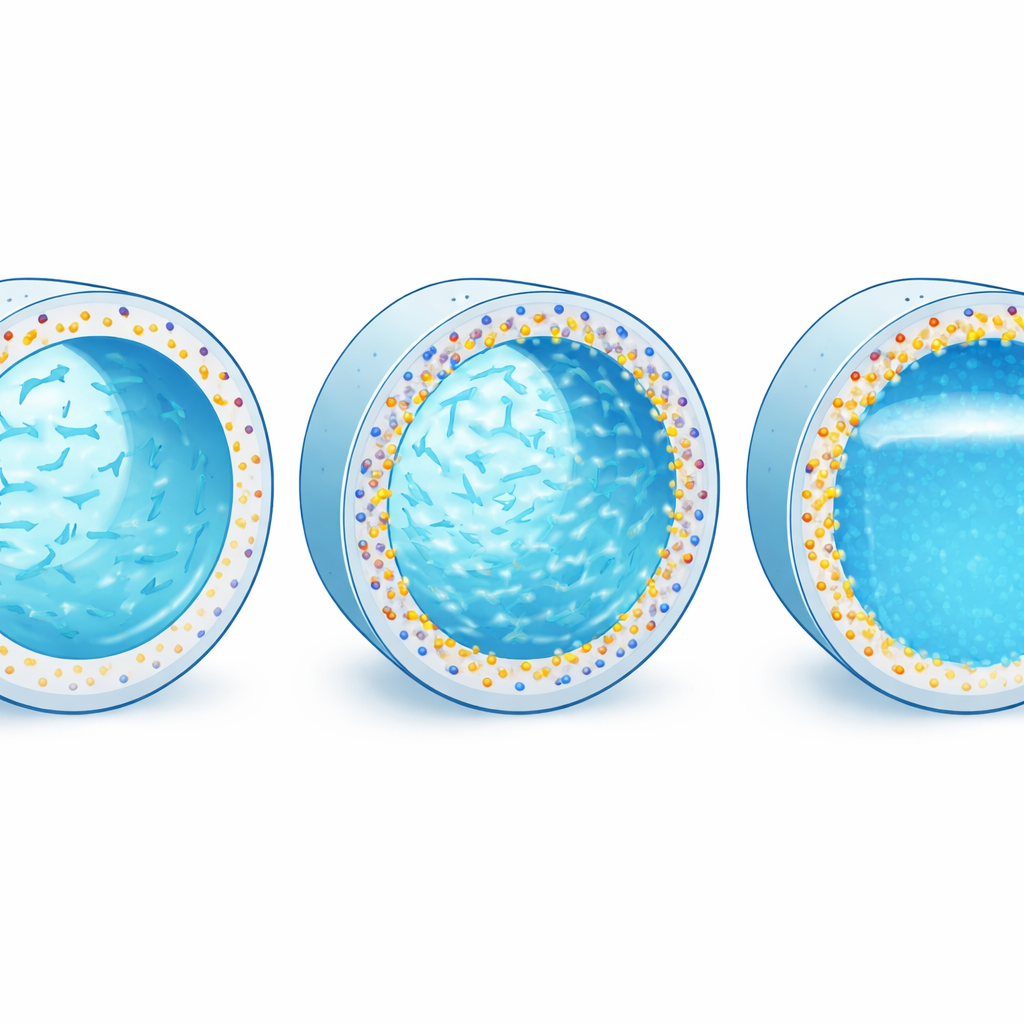
How Surface Chemistry Freezes Motion Without Making Ice
The emerging picture is that the crowded silanol groups on the inner walls act as powerful anchors for nearby water molecules. Through strong hydrogen bonding, they dampen both the jiggling and rotation of water molecules, effectively lowering their kinetic energy without forming a crystal. As the surface becomes more densely covered with these groups and the tube narrows, this influence extends farther from the wall, eventually locking a substantial volume of water into a low-mobility, solid-like state. The team showed that this state is favored under near-neutral to mildly basic conditions (moderate pH), but breaks down under very acidic conditions, which alter the proton balance at the surface and weaken the interfacial bonding network. Interestingly, adding salt up to high concentrations had little effect, indicating that short-range interactions at the wall dominate over bulk solution effects.
Why This Matters Beyond the Lab
For non-specialists, the key message is that water does not have to be frozen or squeezed into ultra-tiny nanometer pores to behave like a solid. In this work, the combination of submicron geometry and an extremely reactive inner surface makes water adopt a stable, glassy-like state at room temperature and ordinary pressure. This discovery may help explain puzzling flow behavior in tight rock formations rich in silica, where water can move more sluggishly than expected. It also suggests new ways to design microfluidic devices, tiny reactors and possibly non-freezing preservation methods that rely on immobilized water instead of ice. In short, by carefully engineering surfaces at small scales, we may be able to tune water between liquid-like and solid-like behavior on demand.
Citation: Wei-qing, A., Xiang-an, Y. & Ji-rui, Z. A stable solid-like water at normal condition. Sci Rep 16, 14588 (2026). https://doi.org/10.1038/s41598-026-42682-x
Keywords: confined water, silica microtubes, solid-like phase, interfacial chemistry, hydrogen bonding