Clear Sky Science · en
Potential evaluation and favorable zone optimization of CO2 geological sequestration in deep coal reservoirs
Why storing carbon in coal seams matters
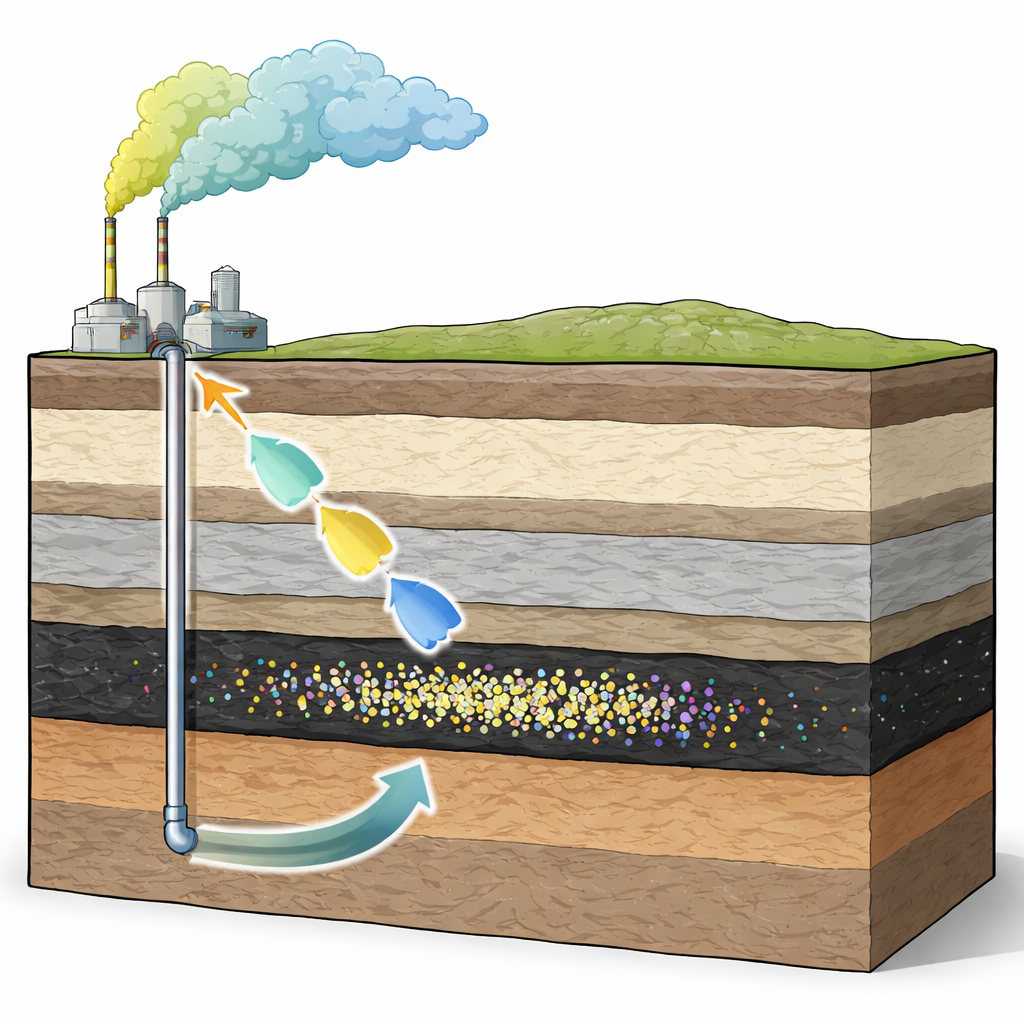
Cutting carbon dioxide (CO2) emissions fast enough to meet climate goals will require not only cleaner energy, but also places to safely lock away huge amounts of CO2 underground for centuries. Deep, unmineable coal seams are one promising option: they can soak up CO2 on their internal surfaces and keep it trapped, while also helping to push out valuable natural gas. This study looks at a major coal seam in China’s Qinshui Basin to ask a practical question: how much CO2 can these deep coal layers really hold, and where are the best spots to inject it?
The underground setting beneath a coal heartland
The work focuses on the No. 3 coal seam in the southern Qinshui Basin, one of China’s most important coal and coalbed methane regions. Here, thick layers of medium- to high-rank coal lie a few hundred to more than a thousand meters below ground, sandwiched between tight mudstones and sandstones that act as natural seals. Groundwater is divided into largely separate layers, so fluids do not easily move between them. The coal in this target seam is a hard, high-rank anthracite with very small pores and a large internal surface area, making it especially good at holding gas by adsorption—molecules sticking to pore walls—while the surrounding rocks help prevent leakage.
How CO2 behaves as conditions change with depth
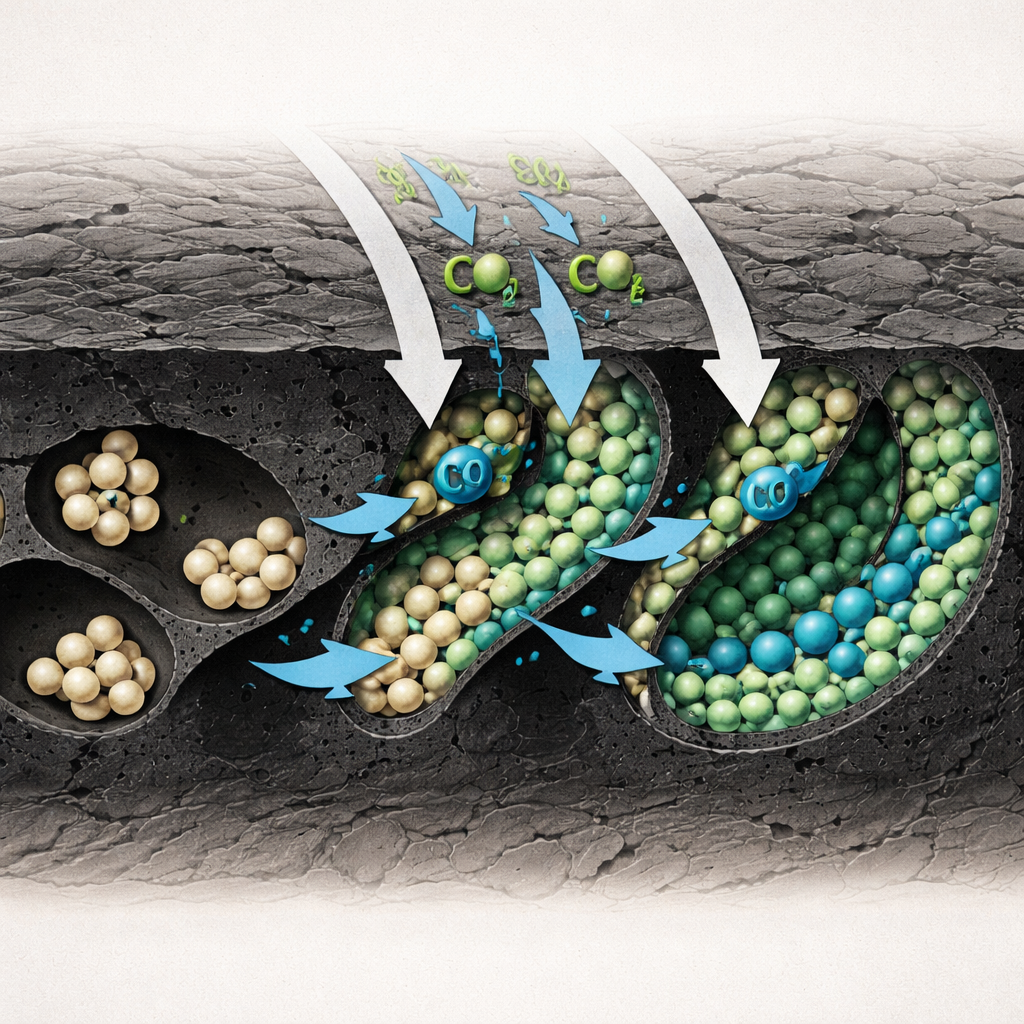
As CO2 is pumped underground, temperature and pressure rise with depth, eventually pushing the gas into a supercritical state that has the density of a liquid and the mobility of a gas. The researchers recreated these conditions in the lab using powdered coal from about 900 meters depth. They measured how much CO2 the coal could take up at three temperatures (20, 30, and 40 °C) and pressures up to 20 megapascals. At all temperatures, the coal at first grabbed CO2 quickly as pressure rose, then reached a peak, and finally showed a gentle decline in the “excess” amount measured. Warmer conditions reduced how much CO2 was held at any given pressure, meaning deeper, hotter seams behave differently from shallower, cooler ones.
Building a simple but powerful storage calculator
To turn these measurements into a tool for planning, the team tested three standard mathematical descriptions of adsorption and found that a multilayer approach known as the BET model best captured CO2 behavior, especially near and above the critical point where the gas becomes supercritical. They then combined this adsorption model with separate formulas for CO2 occupying open pore space as a free fluid and for the small fraction that dissolves into formation water. Mineral reactions, which would lock CO2 into solid carbonates over millions of years, were judged negligible for engineering time scales in this coal seam. The result is a compact equation set that estimates total CO2 storage per unit mass of coal as a function of depth, using typical values for porosity, water content, coal density, and in-situ pressure and temperature.
How much can be stored, and where is best
Feeding regional geological data into this framework, the authors calculated how storage capacity changes from about 300 to 1300 meters depth. In shallower, “subcritical” layers, adsorption on coal surfaces dominates and increases modestly with depth before leveling off. Below roughly 800 meters, where CO2 becomes supercritical, the share of storage as dense free fluid in the pores rises quickly, and total capacity climbs steeply until around 1100 meters, then grows more slowly. Overall, the main coal seams in the study block could theoretically hold about 575 million tonnes of CO2, with around two-thirds of this capacity in the deeper supercritical zone. Detailed structural mapping shows that the most promising zones, labeled Units I and II, lie in the northern, structurally simple part of the block, where thick coal, good sealing rocks, and few leakage-prone faults coincide with strong coalbed methane potential.
What this means for climate action and energy use
For non-specialists, the key message is that certain deep coal seams can act like vast underground sponges for CO2, especially where pressure and temperature push the gas into a dense, supercritical state. In the Qinshui Basin example, adsorption onto the coal and dense free CO2 in pore space together account for over 99% of the storage potential, while dissolution in water and very slow mineral reactions matter little in the short to medium term. The study shows that the sweet spot for both safety and efficiency lies between about 800 and 1100 meters depth, and that the best injection sites often overlap with existing gas fields and wells. That opens the door to projects that simultaneously store CO2 and boost methane production, helping to pay for the storage while advancing China’s "dual carbon" goals of peaking and then reducing emissions.
Citation: Xue, Z., Xu, X., Tian, L. et al. Potential evaluation and favorable zone optimization of CO2 geological sequestration in deep coal reservoirs. Sci Rep 16, 12208 (2026). https://doi.org/10.1038/s41598-026-42680-z
Keywords: CO2 storage, deep coal seams, supercritical fluids, coalbed methane, carbon capture and storage